
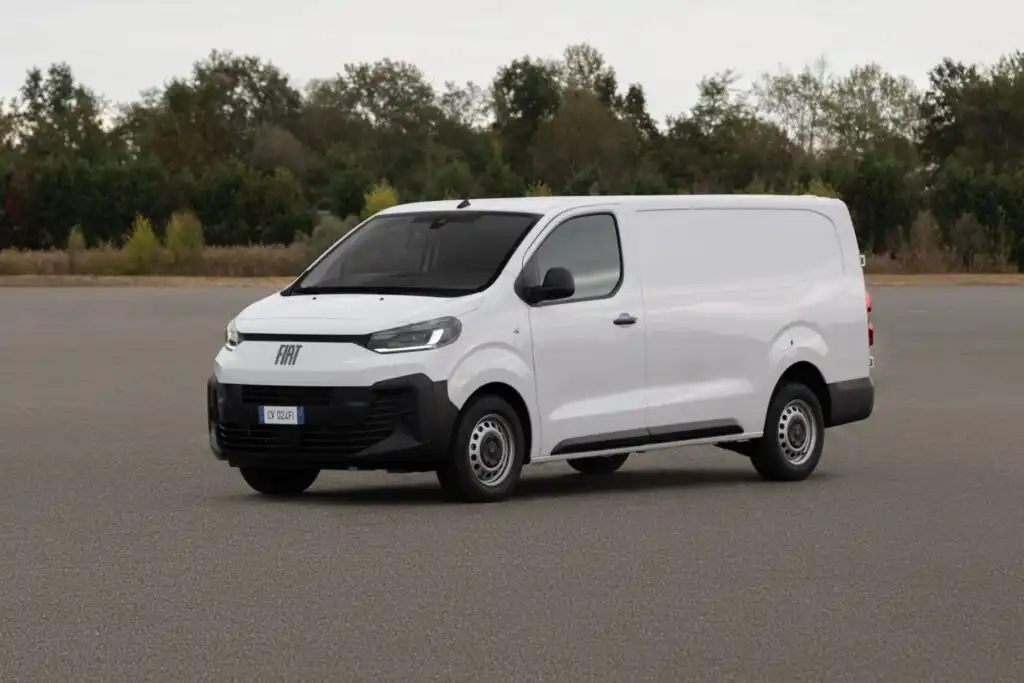
The Fiat Scudo III, specifically the e-Scudo 50 kWh (136 Hp) L2 panel van introduced with the 2023 facelift, represents Fiat Professional’s entry into the all-electric commercial vehicle segment. Production commenced in November 2023, building upon the established Scudo III platform (launched in 2016, and facelifted in 2023). This variant is positioned as a practical and environmentally conscious solution for urban delivery and commercial applications, offering a balance between range, payload capacity, and operational cost. The “L2” designation indicates a medium wheelbase length within the Scudo range, offering a compromise between cargo volume and maneuverability. It’s part of a collaborative effort with Stellantis, sharing its underpinnings with the Peugeot e-Partner and Citroën ë-Bergo, but distinguished by Fiat’s branding and specific trim levels.
Technical Specifications
| Brand | Fiat |
| Model | Scudo |
| Generation | Scudo III (facelift 2023) Panel Van |
| Type (Engine) | e-Scudo 50 kWh (136 Hp) L2 |
| Start of production | November, 2023 |
| Powertrain Architecture | BEV (Electric Vehicle) |
| Body type | Van |
| Seats | 2-3 |
| Doors | 4-5 |
| Fuel Type | Electricity |
| Maximum speed | 130 km/h (80.78 mph) |
| Gross battery capacity | 50 kWh |
| Battery technology | Lithium-ion (Li-Ion) |
| Battery location | Below the floor |
| All-electric range (WLTP) | 223 km (138.57 mi) |
| Average Energy consumption (WLTP) | 23.6 kWh/100 km (37.98 kWh/100 mi) |
| MPGe | 89 |
| km/kWh | 4.2 |
| mi/kWh | 2.6 |
| Electric motor power | 136 Hp |
| Electric motor Torque | 260 Nm (191.77 lb.-ft.) |
| Electric motor model/code | ZK01 |
| Electric motor location | Front axle, Transverse |
| Electric motor type | Synchronous |
| System power | 136 Hp |
| System torque | 260 Nm (191.77 lb.-ft.) |
| Trunk (boot) space – minimum | 5300 l (187.17 cu. ft.) |
| Trunk (boot) space – maximum | 5800 l (204.83 cu. ft.) |
| Length | 4983 mm (196.18 in.) |
| Width | 1920 mm (75.59 in.) |
| Width including mirrors | 2204 mm (86.77 in.) |
| Height | 1895 mm (74.61 in.) |
| Wheelbase | 3275 mm (128.94 in.) |
| Front track | 1627 mm (64.06 in.) |
| Rear (Back) track | 1600 mm (62.99 in.) |
| Front overhang | 904 mm (35.59 in.) |
| Rear overhang | 803 mm (31.61 in.) |
| Ride height (ground clearance) | 150 mm (5.91 in.) |
| Drivetrain Architecture | One electric motor drives the front wheels. |
| Drive wheel | Front wheel drive |
| Number of gears and type of gearbox | 1 gears, automatic transmission |
| Front suspension | Independent, type McPherson with coil spring and anti-roll bar |
| Rear suspension | Trailing arm |
| Front brakes | Ventilated discs |
| Rear brakes | Disc |
| Assisting systems | ABS (Anti-lock braking system) |
| Steering type | Steering rack and pinion |
| Power steering | Electric Steering |
| Tires size | 215/65 R16 |
| Wheel rims size | 16 |
Powertrain & Engine Architecture
The e-Scudo 50 kWh utilizes a fully electric powertrain. At its heart is a synchronous electric motor, designated ZK01, producing 136 horsepower and 260 Nm (191.77 lb.-ft.) of torque. This motor is transversely mounted on the front axle, driving the front wheels. The power is supplied by a 50 kWh lithium-ion battery pack located under the vehicle floor, contributing to a lower center of gravity and maximizing interior space. The vehicle employs a single-speed automatic transmission, typical of electric vehicles, providing seamless acceleration. The charging port location is not publicly available. The e-Scudo does not have a traditional internal combustion engine, eliminating emissions and reducing reliance on fossil fuels.
Driving Characteristics
The 136 hp electric motor provides adequate performance for urban and suburban driving. Acceleration is brisk from a standstill due to the instant torque delivery characteristic of electric motors. However, compared to Scudo variants equipped with diesel engines, particularly the higher-output versions, the e-Scudo exhibits a more moderate pace, especially when fully loaded. The single-speed transmission simplifies operation, but lacks the gear ratios available in traditional automatic or manual transmissions, potentially impacting efficiency at higher speeds. The lower center of gravity, thanks to the battery pack’s placement, contributes to improved handling and stability. The regenerative braking system allows for energy recovery during deceleration, extending the vehicle’s range.
Equipment & Trim Levels
The e-Scudo 50 kWh L2 typically comes standard with features geared towards commercial use, including a driver’s airbag, ABS, and basic infotainment system. Trim levels vary by market, but generally include options for upgraded infotainment with touchscreen displays, navigation, and smartphone integration (Apple CarPlay/Android Auto). Additional features may include rear parking sensors, a reversing camera, and climate control. Interior upholstery is typically durable and practical, focusing on wear resistance rather than luxury. Optional extras often include upgraded seating, additional storage compartments, and specialized cargo area configurations.
Chassis & Braking
The e-Scudo utilizes a McPherson strut independent suspension setup at the front, providing a comfortable ride and responsive handling. The rear suspension employs a trailing arm configuration, optimized for load-carrying capacity. The braking system features ventilated discs at the front and solid discs at the rear, providing adequate stopping power. ABS (Anti-lock Braking System) is standard. The steering is rack and pinion with electric power assistance, offering precise control and ease of maneuvering. The vehicle is equipped with 215/65 R16 tires mounted on 16-inch steel wheels.
Market Reception & Comparison
The e-Scudo has been generally well-received as a viable electric alternative in the commercial vehicle segment. Critics have praised its practicality, decent range for urban applications, and reduced running costs. Compared to diesel-powered Scudo variants, the e-Scudo offers lower emissions and reduced noise pollution, making it suitable for environmentally sensitive areas. However, its higher initial purchase price and limited range compared to some competitors are noted drawbacks. Against rivals like the Mercedes-Benz eSprinter and Ford E-Transit, the e-Scudo offers a competitive price point and a good balance of features. Fuel economy, expressed as kWh/100km, is a key metric for electric vehicles, and the e-Scudo’s 23.6 kWh/100km is competitive within its class.
Legacy
The Fiat e-Scudo 50 kWh L2 represents a significant step for Fiat Professional in embracing electric mobility. While long-term reliability data is still emerging, the electric powertrain is expected to require less maintenance than a traditional internal combustion engine. The battery pack is covered by an eight-year/100,000-mile warranty, providing peace of mind for owners. As demand for electric commercial vehicles continues to grow, the e-Scudo is poised to become an increasingly important part of Fiat’s lineup. Its success will depend on continued improvements in battery technology, charging infrastructure, and overall cost competitiveness. On the used car market, early e-Scudo models are beginning to appear, and their value will be influenced by battery health and mileage.
