Technical Specifications
| Brand | Fiat |
| Model | Scudo |
| Generation | Scudo III Panel Van |
| Type (Engine) | 1.5 Multijet (102 Hp) L2 |
| Start of production | December, 2021 |
| End of production | October, 2023 |
| Powertrain Architecture | Internal Combustion engine |
| Body type | Van |
| Seats | 2-3 |
| Doors | 4-5 |
| Combined fuel consumption (WLTP) | 6.1-7.2 l/100 km (38.6 – 32.7 US mpg, 46.3 – 39.2 UK mpg, 16.4 – 13.9 km/l) |
| CO2 emissions (WLTP) | 161-188 g/km |
| Fuel Type | Diesel |
| Acceleration 0 – 100 km/h | 19.6 sec |
| Acceleration 0 – 62 mph | 19.6 sec |
| Acceleration 0 – 60 mph | 18.6 sec |
| Maximum speed | 145 km/h (90.1 mph) |
| Emission standard | Euro 6d-ISC-FCM |
| Weight-to-power ratio | 15.5 kg/Hp, 64.3 Hp/tonne |
| Weight-to-torque ratio | 5.9 kg/Nm, 170.2 Nm/tonne |
| Power | 102 Hp @ 3500 rpm |
| Power per litre | 68 Hp/l |
| Torque | 270 Nm @ 1600 rpm (199.14 lb.-ft. @ 1600 rpm) |
| Engine layout | Front, Transverse |
| Engine Model/Code | DV5RUCD |
| Engine displacement | 1499 cm3 (91.47 cu. in.) |
| Number of cylinders | 4 |
| Engine configuration | Inline |
| Cylinder Bore | 75 mm (2.95 in.) |
| Piston Stroke | 84.8 mm (3.34 in.) |
| Number of valves per cylinder | 4 |
| Fuel injection system | Diesel Commonrail |
| Engine aspiration | Turbocharger, Intercooler |
| Valvetrain | DOHC |
| Engine oil capacity | 5.75 l (6.08 US qt | 5.06 UK qt) |
| Kerb Weight | 1586 kg (3496.53 lbs.) |
| Max. weight | 2695-2830 kg (5941.46 – 6239.08 lbs.) |
| Max load | 1109-1244 kg (2444.93 – 2742.55 lbs.) |
| Trunk (boot) space – minimum | 5300 l (187.17 cu. ft.) |
| Trunk (boot) space – maximum | 5800 l (204.83 cu. ft.) |
| Fuel tank capacity | 69 l (18.23 US gal | 15.18 UK gal) |
| AdBlue tank | 22.5 l (5.94 US gal | 4.95 UK gal) |
| Max. roof load | 170 kg (374.79 lbs.) |
| Permitted trailer load with brakes (12%) | 2000 kg (4409.25 lbs.) |
| Length | 4959 mm (195.24 in.) |
| Width | 1920 mm (75.59 in.) |
| Width with mirrors folded | 2010 mm (79.13 in.) |
| Width including mirrors | 2204 mm (86.77 in.) |
| Height | 1881 mm (74.06 in.) |
| Wheelbase | 3275 mm (128.94 in.) |
| Front track | 1630 mm (64.17 in.) |
| Rear (Back) track | 1618 mm (63.7 in.) |
| Front overhang | 881 mm (34.69 in.) |
| Rear overhang | 803 mm (31.61 in.) |
| Ride height (ground clearance) | 150 mm (5.91 in.) |
| Minimum turning circle (turning diameter) | 12.4 m (40.68 ft.) |
| Drivetrain Architecture | Front wheel drive |
| Drive wheel | Front wheel drive |
| Number of gears and type of gearbox | 6 gears, manual transmission |
| Front suspension | Independent, type McPherson with coil spring and anti-roll bar |
| Rear suspension | Trailing arm |
| Front brakes | Ventilated discs, 304×28 mm |
| Rear brakes | Disc, 290×12 mm |
| Assisting systems | ABS (Anti-lock braking system) |
| Steering type | Steering rack and pinion |
| Power steering | Electric Steering |
| Tires size | 215/65 R16; 225/55 R17 |
| Wheel rims size | 16; 17 |
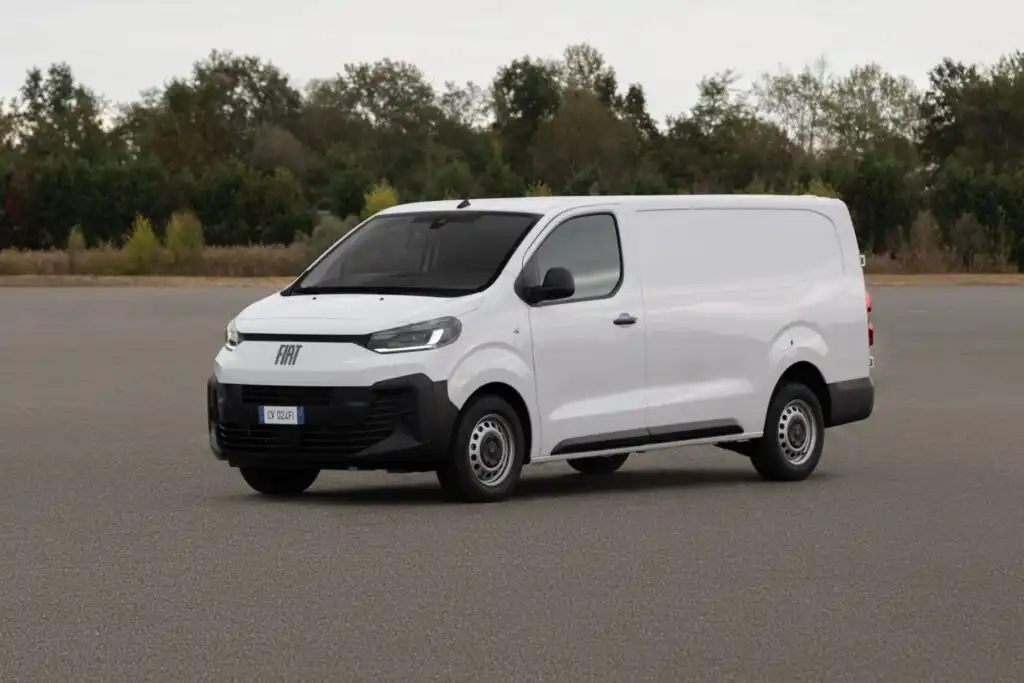
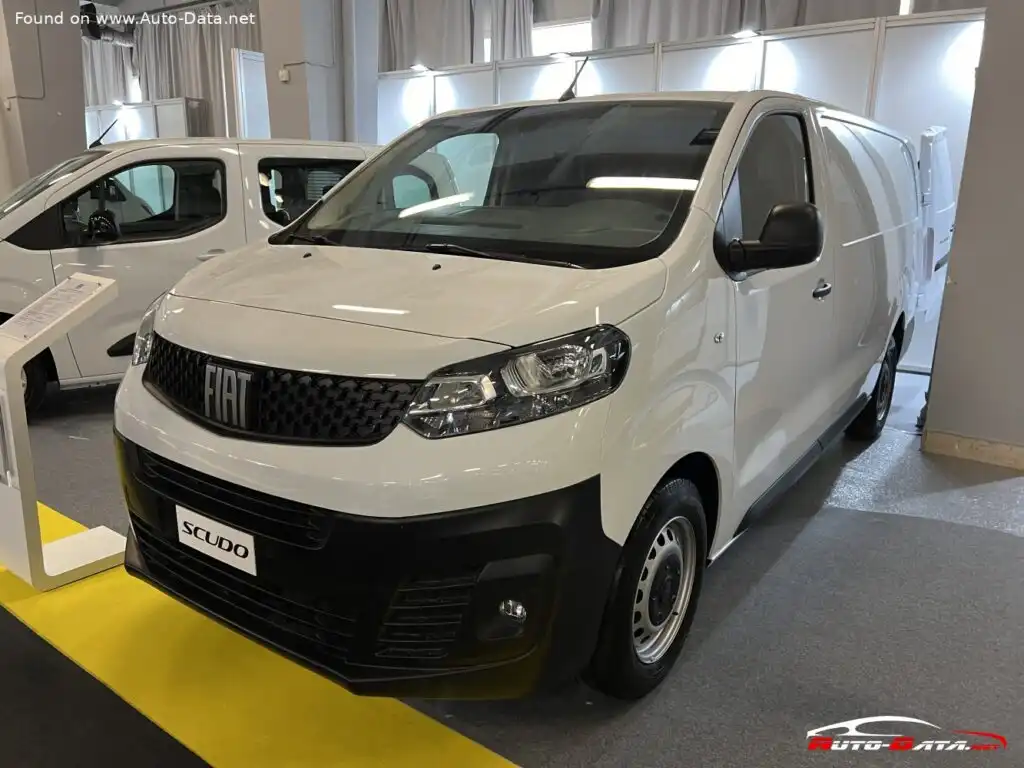
The Fiat Scudo III Panel Van 1.5 Multijet (102 Hp) L2, launched in late 2021, is a key component of the Scudo’s third generation, built upon the 1HX0 platform jointly developed with Peugeot and Citroën. This variant was engineered to deliver a balance of practicality, fuel efficiency, and affordability for commercial users. The “L2” designation indicates a medium-length wheelbase, offering a useful cargo capacity while maintaining maneuverability in urban settings. This model aimed to secure a substantial portion of the European light commercial vehicle market, competing with established rivals such as the Ford Transit Custom and Volkswagen Transporter.
Powertrain & Engine Architecture
The Scudo III 1.5 Multijet L2 is powered by the DV5RUCD engine, a 1.5-liter inline four-cylinder diesel. This engine employs a common-rail direct injection system, delivering fuel at high pressure for optimized combustion efficiency. A turbocharger with an intercooler further enhances power output. The engine produces a peak of 102 horsepower at 3500 rpm, and 270 Nm (199.14 lb.-ft.) of torque is available from as low as 1600 rpm, providing strong low-end pulling power. The engine features a Double Overhead Camshaft (DOHC) valvetrain with four valves per cylinder. This specific version is paired with a six-speed manual transmission, selected for its durability and fuel economy. The engine also incorporates a Start & Stop system and a diesel particulate filter to comply with the stringent Euro 6d-ISC-FCM emission standards.
Driving Characteristics
The combination of 102 hp and the six-speed manual transmission results in a van that prioritizes fuel economy and usability over outright performance. Acceleration is modest, taking approximately 19.6 seconds to reach 100 km/h (0-62 mph). However, the readily available torque at low engine speeds makes it well-suited for everyday driving and carrying moderate loads. The gear ratios are optimized for efficiency, with taller gearing in higher gears to reduce engine revs during cruising. Compared to the more powerful Scudo variants (with 120 or 170 hp engines), this version feels less responsive, especially when fully loaded or ascending hills. The manual transmission provides drivers with greater control over gear selection, allowing for optimization of fuel consumption and engine braking.
Equipment & Trim Levels
The Scudo III 1.5 Multijet L2 typically features a functional, work-focused interior. Standard equipment includes a driver’s airbag, ABS brakes, a basic audio system with USB connectivity, and manual air conditioning. The cabin can accommodate up to three occupants, depending on the configuration. Interior trim is generally durable and practical, utilizing hard-wearing plastics and cloth upholstery. Optional extras included a touchscreen infotainment system with navigation, rear parking sensors, cruise control, and upgraded seating. The van’s design emphasizes providing a reliable and functional workspace rather than luxurious amenities.
Chassis & Braking
The Scudo III utilizes a front-wheel-drive layout, contributing to its relatively low weight and improved fuel efficiency. The front suspension employs an independent McPherson strut setup with coil springs and an anti-roll bar, providing a comfortable ride and stable handling. The rear suspension features a trailing arm configuration, optimized for load-carrying capacity. Braking is handled by ventilated discs at the front and solid discs at the rear, equipped with ABS (Anti-lock Braking System) as standard. The steering is rack and pinion with electric power assistance, offering precise control and ease of maneuvering.
Market Reception & Comparison
The Fiat Scudo III 1.5 Multijet (102 Hp) L2 was generally well-received by critics as a practical and economical work van. Its fuel consumption figures of 6.1-7.2 l/100 km (38.6 – 32.7 US mpg) were competitive within its segment. Compared to the higher-powered Scudo variants, this version offered a lower purchase price and reduced running costs, making it appealing to budget-conscious buyers. However, some reviewers noted its lack of outright performance, particularly when heavily loaded. Compared to rivals like the Ford Transit Custom and Volkswagen Transporter, the Scudo offered a compelling value proposition, benefiting from the shared platform and components with Peugeot and Citroën, which allowed for economies of scale.
Legacy
The 1.5 Multijet engine, in its various iterations, has proven to be a reliable and durable powerplant within the Stellantis group. While the Scudo III was discontinued in 2023, examples of the 1.5 Multijet (102 Hp) L2 continue to be available on the used car market. Its relatively simple mechanical design and readily available parts contribute to its long-term reliability and affordability. The Scudo III, and this variant in particular, represents a solid choice for businesses and tradespeople seeking a dependable and economical light commercial vehicle.