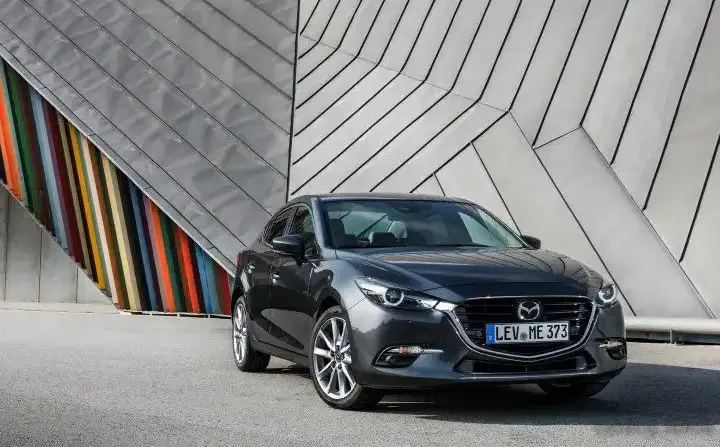
The Mazda 3 III Sedan (BM), particularly the facelifted version introduced in 2017, represented a significant evolution of Mazda’s compact offering. The 1.5 SkyActiv-D variant, producing 105 horsepower, was a key model in several European markets, offering a balance of fuel efficiency and reasonable performance. Production of this specific configuration ran from 2017 to 2018, fitting within the broader BM generation that spanned from 2013 to 2019. This model aimed to appeal to drivers seeking lower running costs without sacrificing the Mazda’s reputation for driving dynamics.
Technical Specifications
| Brand | Mazda |
| Model | 3 |
| Generation | 3 III Sedan (BM, facelift 2017) |
| Type (Engine) | 1.5 SkyActiv-D (105 Hp) |
| Start of production | 2017 |
| End of production | 2018 |
| Powertrain Architecture | Internal Combustion engine |
| Body type | Sedan |
| Seats | 5 |
| Doors | 4 |
| Fuel consumption (urban) | 4.3 l/100 km (54.7 US mpg, 65.7 UK mpg, 23.3 km/l) |
| Fuel consumption (extra urban) | 3.5 l/100 km (67.2 US mpg, 80.7 UK mpg, 28.6 km/l) |
| Fuel consumption (combined) | 3.8 l/100 km (61.9 US mpg, 74.3 UK mpg, 26.3 km/l) |
| CO2 emissions | 99 g/km |
| Fuel Type | Diesel |
| Acceleration 0 – 100 km/h | 11 sec |
| Acceleration 0 – 62 mph | 11 sec |
| Acceleration 0 – 60 mph | 10.5 sec |
| Maximum speed | 186 km/h (115.58 mph) |
| Emission standard | Euro 6 |
| Weight-to-power ratio | 12 kg/Hp, 83 Hp/tonne |
| Weight-to-torque ratio | 4.7 kg/Nm, 213.4 Nm/tonne |
| Power | 105 Hp |
| Power per litre | 70 Hp/l |
| Torque | 270 Nm @ 1600-2500 rpm (199.14 lb.-ft. @ 1600-2500 rpm) |
| Engine layout | Front, Transverse |
| Engine displacement | 1499 cm3 (91.47 cu. in.) |
| Number of cylinders | 4 |
| Engine configuration | Inline |
| Cylinder Bore | 76 mm (2.99 in.) |
| Piston Stroke | 82.6 mm (3.25 in.) |
| Compression ratio | 14.8:1 |
| Number of valves per cylinder | 4 |
| Fuel injection system | Diesel Commonrail |
| Engine aspiration | Turbocharger, Intercooler |
| Engine oil capacity | 5.1 l (5.39 US qt | 4.49 UK qt) |
| Coolant | 7 l (7.4 US qt | 6.16 UK qt) |
| Kerb Weight | 1265-1347 kg (2788.85 – 2969.63 lbs.) |
| Max. weight | 1870 kg (4122.64 lbs.) |
| Max load | 523-605 kg (1153.02 – 1333.8 lbs.) |
| Trunk (boot) space – minimum | 419 l (14.8 cu. ft.) |
| Fuel tank capacity | 51 l (13.47 US gal | 11.22 UK gal) |
| Max. roof load | 75 kg (165.35 lbs.) |
| Permitted trailer load with brakes (8%) | 1300 kg (2866.01 lbs.) |
| Permitted trailer load with brakes (12%) | 1300 kg (2866.01 lbs.) |
| Permitted trailer load without brakes | 600 kg (1322.77 lbs.) |
| Permitted towbar download | 75 kg (165.35 lbs.) |
| Length | 4580 mm (180.31 in.) |
| Width | 1795 mm (70.67 in.) |
| Width including mirrors | 2053 mm (80.83 in.) |
| Height | 1450 mm (57.09 in.) |
| Wheelbase | 2700 mm (106.3 in.) |
| Ride height (ground clearance) | 155 mm (6.1 in.) |
| Minimum turning circle (turning diameter) | 10.6 m (34.78 ft.) |
| Drivetrain Architecture | Front wheel drive |
| Drive wheel | Front wheel drive |
| Number of gears and type of gearbox | 6 gears, manual transmission |
| Front suspension | Independent, type McPherson with coil spring and anti-roll bar |
| Rear suspension | Independent multi-link suspension |
| Front brakes | Ventilated discs |
| Rear brakes | Disc |
| Assisting systems | ABS (Anti-lock braking system) |
| Steering type | Steering rack and pinion |
| Power steering | Electric Steering |
| Tires size | 205/60 R16; 215/45 R18 |
| Wheel rims size | 16; 18 |
INTRODUCTION
The Mazda 3 III Sedan, launched in 2013 and facelifted in 2017, was a crucial model for Mazda, embodying the company’s “KODO – Soul of Motion” design language and “SKYACTIV” technology. The 1.5 SkyActiv-D 105 hp variant was primarily aimed at the European market, where diesel engines held significant popularity due to their fuel efficiency and lower tax implications. Positioned as an entry-level diesel option, it sat below the more powerful 2.2-liter SkyActiv-D models in the lineup. This trim level prioritized economy and affordability, making it a popular choice for fleet buyers and private individuals seeking a practical and efficient sedan.
Powertrain & Engine Architecture
The heart of this Mazda 3 is the 1.5-liter SkyActiv-D inline-four diesel engine. Designated with engine codes such as VM44, this engine is a key example of Mazda’s SkyActiv technology, focusing on high compression ratios (14.8:1) for improved thermal efficiency. It utilizes a common-rail direct injection system, delivering fuel at extremely high pressures for optimized combustion. A turbocharger with an intercooler is employed to boost power output and improve responsiveness. The engine produces 105 horsepower and 270 Nm (199 lb-ft) of torque between 1600 and 2500 rpm. The engine is transversely mounted in the front of the vehicle. The 1.5 SkyActiv-D was typically paired with a six-speed manual transmission, although a six-speed automatic transmission was also available, albeit less common. The automatic transmission offered smooth shifts but slightly impacted fuel economy compared to the manual.
Driving Characteristics
The 1.5 SkyActiv-D with 105 hp delivers adequate, but not exhilarating, performance. Acceleration from 0 to 60 mph takes around 10.5 seconds, and top speed is around 115.58 mph. The engine’s torque peak, available from 1600 rpm, provides sufficient pulling power for everyday driving situations, including highway overtaking. Compared to the more powerful 2.2-liter diesel variants, the 1.5 feels noticeably less responsive, particularly at higher speeds. The six-speed manual transmission offers precise shifts and allows the driver to maximize the engine’s efficiency. The automatic transmission, while convenient, can feel somewhat hesitant during quick acceleration. The Mazda 3’s well-tuned chassis and suspension contribute to a comfortable and engaging driving experience, even with the lower-powered engine.
Equipment & Trim Levels
The 1.5 SkyActiv-D typically came equipped with a reasonable level of standard features. Base models included air conditioning, power windows, power mirrors, a basic audio system with USB connectivity, and stability control. Higher trim levels, such as Sport or Touring, added features like alloy wheels, a touchscreen infotainment system, rear parking sensors, and cruise control. Interior upholstery was typically cloth, with options for partial leather trim on higher-spec models. Optional extras included a sunroof, navigation system, and advanced safety features like lane departure warning and blind-spot monitoring.
Chassis & Braking
The Mazda 3 III Sedan utilizes a front-wheel-drive layout with an independent McPherson strut suspension at the front and an independent multi-link suspension at the rear. This suspension setup provides a good balance of ride comfort and handling precision. Braking duties are handled by ventilated discs at the front and solid discs at the rear. Anti-lock Braking System (ABS) is standard. The chassis is relatively lightweight, contributing to the car’s agility. Stabilizer bars are fitted to both the front and rear axles to reduce body roll during cornering.
Market Reception & Comparison
The 1.5 SkyActiv-D variant was generally well-received by automotive critics for its fuel efficiency and refined driving experience. However, some reviewers noted that the engine lacked the punch of its larger counterparts. Compared to the 2.2-liter SkyActiv-D, the 1.5 offered significantly better fuel economy (around 3.8 l/100km combined) but slower acceleration. Against competitors like the Volkswagen Golf and Ford Focus, the Mazda 3 offered a more engaging driving experience and a more premium interior feel. The 1.5 SkyActiv-D’s reliability was generally considered good, although diesel particulate filter (DPF) issues could occur with infrequent long-distance driving.
Legacy
The 1.5 SkyActiv-D engine, while not the most powerful option in the Mazda 3 lineup, proved to be a reliable and fuel-efficient choice for many owners. On the used car market, these models are often sought after by buyers prioritizing economy and practicality. The SkyActiv technology employed in this engine helped establish Mazda as a leader in fuel efficiency and low emissions. While DPF maintenance should be considered, the 1.5 SkyActiv-D remains a viable option for those seeking a well-rounded and economical compact sedan.