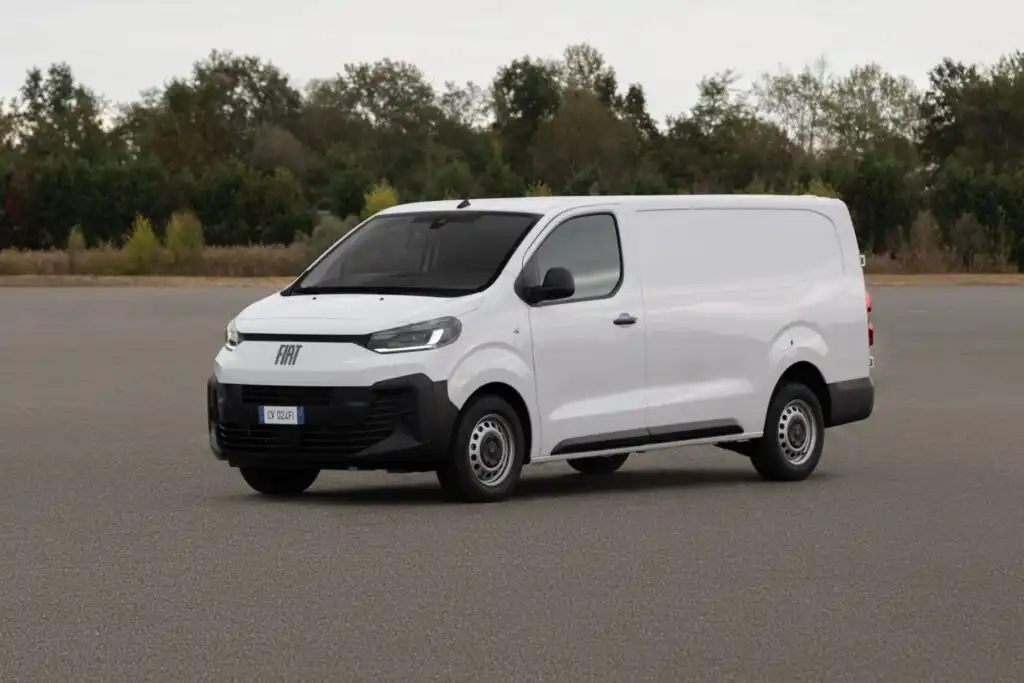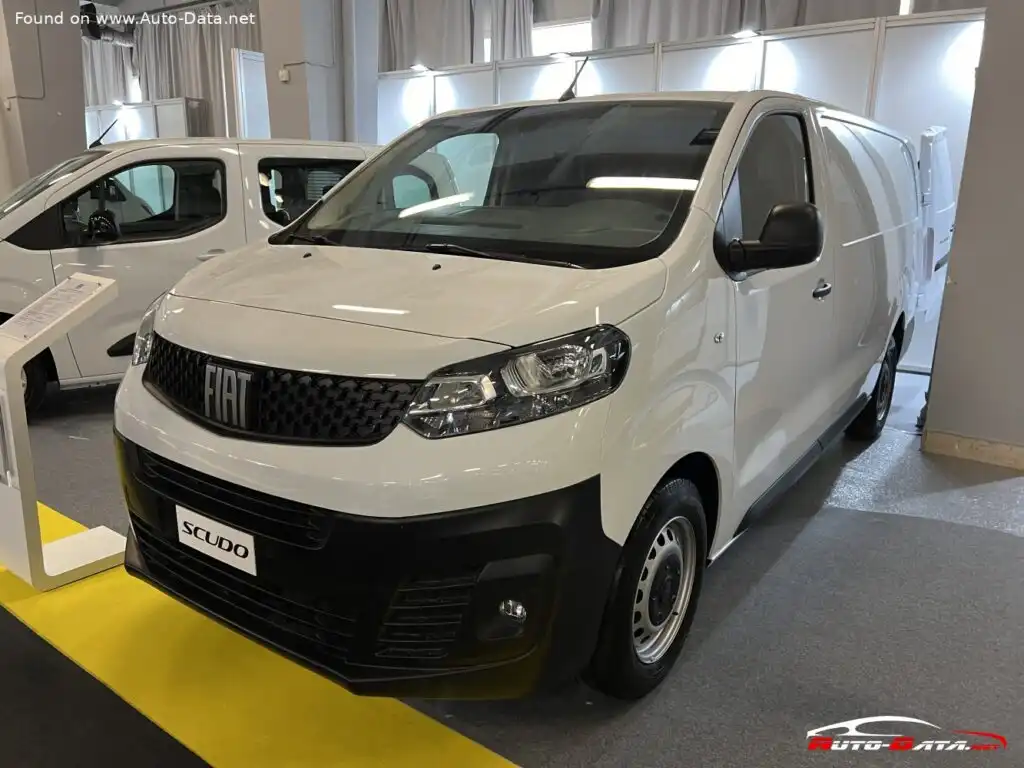
The Fiat Scudo III Panel Van 2.0 Multijet (145 Hp) L2 represents a mid-cycle offering within the third generation of the Fiat Scudo, produced from December 2021 to October 2023. This variant, characterized by its 2.0-liter turbocharged diesel engine and a longer wheelbase (“L2” designation), was primarily aimed at commercial users requiring a balance of cargo capacity, fuel efficiency, and moderate performance. It slots into the Scudo lineup as a workhorse option, positioned between the base engine variants and the higher-output models geared towards more demanding applications. The Scudo III, jointly developed with PSA (Peugeot-Citroën), shares its platform with the Peugeot Expert and Citroën Jumpy, reflecting a collaborative effort to streamline production and offer a competitive range of light commercial vehicles in the European market.
Technical Specifications
| Brand | Fiat |
| Model | Scudo |
| Generation | Scudo III Panel Van |
| Type (Engine) | 2.0 Multijet (145 Hp) L2 |
| Start of production | December, 2021 |
| End of production | October, 2023 |
| Powertrain Architecture | Internal Combustion engine |
| Body type | Van |
| Seats | 2-3 |
| Doors | 4-5 |
| Combined fuel consumption (WLTP) | 6.9-7.7 l/100 km (34.1 – 30.5 US mpg, 40.9 – 36.7 UK mpg, 14.5 – 13 km/l) |
| CO2 emissions (WLTP) | 179-204 g/km |
| Fuel Type | Diesel |
| Acceleration 0 – 100 km/h | 12.4 sec |
| Acceleration 0 – 62 mph | 12.4 sec |
| Acceleration 0 – 60 mph | 11.8 sec |
| Maximum speed | 185 km/h (114.95 mph) |
| Emission standard | Euro 6d-ISC-FCM |
| Weight-to-power ratio | 11.4 kg/Hp, 87.7 Hp/tonne |
| Weight-to-torque ratio | 4.9 kg/Nm, 205.7 Nm/tonne |
| Power | 145 Hp @ 3750 rpm |
| Power per litre | 72.6 Hp/l |
| Torque | 340 Nm @ 2000 rpm (250.77 lb.-ft. @ 2000 rpm) |
| Engine layout | Front, Transverse |
| Engine Model/Code | DW10FDDU |
| Engine displacement | 1997 cm3 (121.86 cu. in.) |
| Number of cylinders | 4 |
| Engine configuration | Inline |
| Cylinder Bore | 85 mm (3.35 in.) |
| Piston Stroke | 88 mm (3.46 in.) |
| Number of valves per cylinder | 4 |
| Fuel injection system | Diesel Commonrail |
| Engine aspiration | Turbocharger, Intercooler |
| Valvetrain | DOHC |
| Engine oil capacity | 6 l (6.34 US qt | 5.28 UK qt) |
| Kerb Weight | 1653 kg (3644.24 lbs.) |
| Max. weight | 2830-3100 kg (6239.08 – 6834.33 lbs.) |
| Max load | 1177-1447 kg (2594.84 – 3190.09 lbs.) |
| Trunk (boot) space – minimum | 5300 l (187.17 cu. ft.) |
| Trunk (boot) space – maximum | 5800 l (204.83 cu. ft.) |
| Fuel tank capacity | 69 l (18.23 US gal | 15.18 UK gal) |
| AdBlue tank | 22.5 l (5.94 US gal | 4.95 UK gal) |
| Max. roof load | 170 kg (374.79 lbs.) |
| Permitted trailer load with brakes (12%) | 2500 kg (5511.56 lbs.) |
| Length | 4959 mm (195.24 in.) |
| Width | 1920 mm (75.59 in.) |
| Width with mirrors folded | 2010 mm (79.13 in.) |
| Width including mirrors | 2204 mm (86.77 in.) |
| Height | 1881 mm (74.06 in.) |
| Wheelbase | 3275 mm (128.94 in.) |
| Front track | 1630 mm (64.17 in.) |
| Rear (Back) track | 1618 mm (63.7 in.) |
| Front overhang | 881 mm (34.69 in.) |
| Rear overhang | 803 mm (31.61 in.) |
| Ride height (ground clearance) | 150 mm (5.91 in.) |
| Minimum turning circle (turning diameter) | 12.4 m (40.68 ft.) |
| Drivetrain Architecture | Front wheel drive |
| Drive wheel | Front wheel drive |
| Number of gears and type of gearbox | 6 gears, manual transmission |
| Front suspension | Independent, type McPherson with coil spring and anti-roll bar |
| Rear suspension | Trailing arm |
| Front brakes | Ventilated discs, 304×28 mm |
| Rear brakes | Disc, 294×22 mm |
| Assisting systems | ABS (Anti-lock braking system) |
| Steering type | Steering rack and pinion |
| Power steering | Electric Steering |
| Tires size | 215/65 R16; 225/55 R17 |
| Wheel rims size | 16; 17 |
Powertrain & Engine Architecture
The heart of the Scudo III 2.0 Multijet (145 Hp) L2 is the DW10FDDU engine, a 1.997-liter inline-four cylinder diesel. This engine is a product of PSA’s engine development and utilizes a common-rail direct injection system, delivering fuel at extremely high pressure for optimized combustion. The engine features a turbocharger with an intercooler, enhancing power output and efficiency. The DOHC (Double Overhead Camshaft) valvetrain manages the four valves per cylinder, contributing to improved breathing and overall engine performance. The engine is transversely mounted in the front of the vehicle, driving the front wheels. The 6-speed manual transmission provides gear ratios tailored for both load-carrying and highway cruising. The engine also incorporates a Start & Stop system and a particulate filter to meet stringent Euro 6d-ISC-FCM emission standards.
Driving Characteristics
The 145 horsepower and 340 Nm (250.77 lb.-ft.) of torque offered by this engine configuration provide adequate, though not exceptional, performance for a commercial van. Acceleration from 0-100 km/h (0-62 mph) takes approximately 12.4 seconds. The engine’s torque curve is relatively flat, providing usable power across a broad RPM range, making it well-suited for hauling loads. Compared to higher-output versions of the 2.0 Multijet, this variant feels less strained under heavy loads, but also lacks the same level of responsiveness. The manual transmission allows for driver control, but the gear ratios are optimized for fuel economy and load-carrying rather than sporty driving. The longer wheelbase (“L2”) contributes to a more stable ride, particularly when fully loaded, but also increases the turning circle.
Equipment & Trim Levels
The Scudo III Panel Van 2.0 Multijet (145 Hp) L2 typically came equipped with a functional, work-oriented interior. Standard features generally included a driver’s airbag, ABS brakes, a basic audio system, and manual air conditioning. The cabin typically featured durable, easy-to-clean plastic trim and cloth upholstery. Optional extras included a passenger airbag, rear parking sensors, a touchscreen infotainment system with navigation, and cruise control. Trim levels varied depending on the market, but generally offered upgrades to the interior finish and additional convenience features.
Chassis & Braking
The Scudo III utilizes a McPherson strut independent suspension setup at the front, providing a reasonable level of ride comfort and handling. The rear suspension employs a trailing arm configuration, chosen for its simplicity and load-carrying capacity. The braking system consists of ventilated discs at the front (304x28mm) and solid discs at the rear (294x22mm). ABS (Anti-lock Braking System) is standard. The steering is rack and pinion with electric power assistance, offering a reasonable level of precision and ease of use.
Market Reception & Comparison
The Fiat Scudo III 2.0 Multijet (145 Hp) L2 was generally well-received as a practical and economical work van. Critics praised its fuel efficiency (6.9-7.7 l/100 km) and its ability to carry substantial loads. Compared to the higher-output 177 hp version, this variant offered a lower purchase price and potentially lower running costs, but at the expense of performance. The 1.5 BlueHDi engine offered by Peugeot and Citroen in similar vans provided comparable fuel economy and performance. The Scudo’s main competitors included the Ford Transit Custom, Volkswagen Transporter, and Mercedes-Benz Vito.
Legacy
The DW10FDDU engine, while not known for being particularly groundbreaking, has proven to be a relatively reliable unit when properly maintained. Common issues include diesel particulate filter (DPF) clogging and occasional injector problems. The Scudo III, as a whole, has established a reputation as a durable and practical commercial vehicle. On the used market, these vans represent a relatively affordable option for businesses and tradespeople seeking a dependable workhorse. The availability of spare parts is generally good, and the relatively simple mechanical design makes them relatively easy to repair.