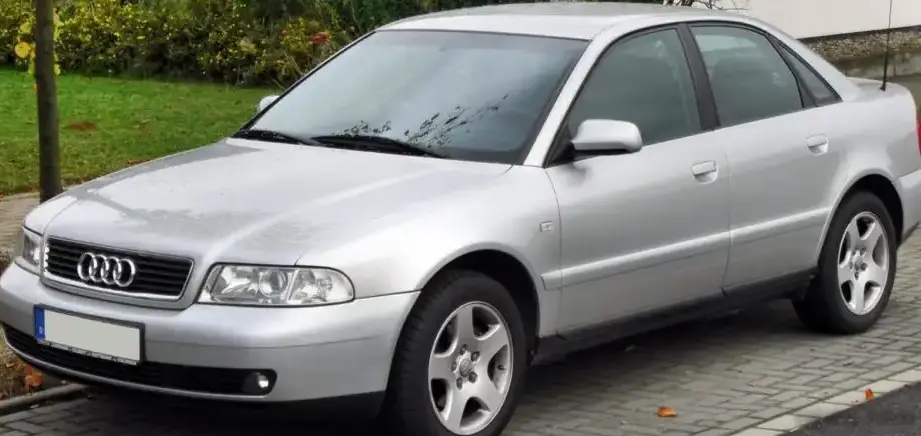
The Audi A4 (B5) facelift, produced from 1999 to 2000, represented a significant mid-cycle refresh of Audi’s popular compact executive car. This iteration, designated Typ 8D, brought revised styling, improved interior appointments, and updated engine options. Among these, the 1.8 20V Turbo quattro variant, producing 150 horsepower, occupied an important position in the lineup, offering a blend of performance and all-weather capability. It was positioned as a step up from the base 1.8L non-turbo models, appealing to buyers seeking more spirited driving without the higher price tag of the more potent V6 options.
Technical Specifications
| Brand | Audi |
| Model | A4 |
| Generation | A4 (B5, Typ 8D, facelift 1999) |
| Type (Engine) | 1.8 20V Turbo (150 Hp) quattro |
| Start of production | 1999 |
| End of production | 2000 |
| Powertrain Architecture | Internal Combustion engine |
| Body type | Sedan |
| Seats | 5 |
| Doors | 4 |
| Fuel consumption (urban) | 12.2 l/100 km (19.3 US mpg, 23.2 UK mpg, 8.2 km/l) |
| Fuel consumption (extra urban) | 7.3 l/100 km (32.2 US mpg, 38.7 UK mpg, 13.7 km/l) |
| Fuel consumption (combined) | 9.1 l/100 km (25.8 US mpg, 31 UK mpg, 11 km/l) |
| Fuel Type | Petrol (Gasoline) |
| Acceleration 0 – 100 km/h | 8.6 sec |
| Acceleration 0 – 62 mph | 8.6 sec |
| Acceleration 0 – 60 mph | 8.2 sec |
| Maximum speed | 219 km/h (136.08 mph) |
| Weight-to-power ratio | 9.2 kg/Hp, 109.1 Hp/tonne |
| Weight-to-torque ratio | 6.5 kg/Nm, 152.7 Nm/tonne |
| Power | 150 Hp @ 5700 rpm |
| Power per litre | 84.2 Hp/l |
| Torque | 210 Nm @ 1750-4600 rpm (154.89 lb.-ft. @ 1750-4600 rpm) |
| Engine layout | Front, Longitudinal |
| Engine Model/Code | AEB, ANB, APU, AWT |
| Engine displacement | 1781 cm3 (108.68 cu. in.) |
| Number of cylinders | 4 |
| Engine configuration | Inline |
| Cylinder Bore | 81 mm (3.19 in.) |
| Piston Stroke | 86.4 mm (3.4 in.) |
| Compression ratio | 9.5:1 |
| Number of valves per cylinder | 5 |
| Fuel injection system | Multi-port manifold injection |
| Engine aspiration | Turbocharger |
| Valvetrain | DOHC |
| Engine oil capacity | 3.5 l (3.7 US qt | 3.08 UK qt) |
| Coolant | 6.5 l (6.87 US qt | 5.72 UK qt) |
| Kerb Weight | 1375 kg (3031.36 lbs.) |
| Max. weight | 1925 kg (4243.9 lbs.) |
| Max load | 550 kg (1212.54 lbs.) |
| Trunk (boot) space – minimum | 440 l (15.54 cu. ft.) |
| Fuel tank capacity | 60 l (15.85 US gal | 13.2 UK gal) |
| Length | 4479 mm (176.34 in.) |
| Width | 1733 mm (68.23 in.) |
| Height | 1415 mm (55.71 in.) |
| Wheelbase | 2607 mm (102.64 in.) |
| Front track | 1498 mm (58.98 in.) |
| Rear (Back) track | 1477 mm (58.15 in.) |
| Drag coefficient (Cd) | 0.31 |
| Minimum turning circle | 11.1 m (36.42 ft.) |
| Drive wheel | All wheel drive (4×4) |
| Number of gears | 5 |
| Gearbox type | Manual transmission |
| Front suspension | Wishbone |
| Rear suspension | Double wishbone |
| Front brakes | Ventilated discs |
| Rear brakes | Disc |
| Assisting systems | ABS (Anti-lock braking system) |
| Steering type | Steering rack and pinion |
| Power steering | Hydraulic Steering |
| Tires size | 195/65 R15 |
| Wheel rims size | 15 |
Powertrain & Engine Architecture
The heart of this A4 variant was the 1.8-liter, 20-valve turbocharged inline-four engine. Commonly identified by engine codes AEB, ANB, APU, and AWT, this powerplant was a sophisticated design for its time. It featured a cast iron block with an aluminum cylinder head, incorporating five valves per cylinder (three intake, two exhaust) for improved breathing. Fuel delivery was handled by a Bosch Motronic multi-port fuel injection system, precisely metering fuel into the intake ports. The turbocharger, a K03 unit, provided a significant boost in power and torque compared to naturally aspirated engines. The engine’s robust bottom end and well-designed cooling system allowed it to reliably handle the increased pressures. The five-speed manual transmission was well-matched to the engine’s characteristics, providing crisp shifts and a good balance between acceleration and fuel economy.
Driving Characteristics
The 1.8T quattro offered a noticeably more engaging driving experience than the base A4 models. While not as overtly powerful as the 2.8L V6, the turbocharger provided a strong mid-range punch, making it well-suited for everyday driving and overtaking maneuvers. The quattro all-wheel-drive system provided excellent traction in all weather conditions, enhancing stability and confidence. The five-speed manual transmission allowed for precise control over the engine’s powerband. The gear ratios were well-spaced, providing adequate acceleration in each gear. Compared to the automatic transmission options, the manual offered a more direct connection to the engine and a more sporty feel. While the 0-60 mph time of around 8.2 seconds wasn’t groundbreaking, it was respectable for a compact executive car of that era.
Equipment & Trim Levels
The 1.8T quattro typically came equipped with a reasonable level of standard features. This included power windows, power locks, air conditioning, and an AM/FM stereo. Higher trim levels offered options such as leather upholstery, sunroof, heated front seats, and a premium sound system. The interior design was typically understated and functional, reflecting Audi’s commitment to quality and ergonomics. The dashboard layout was clean and well-organized, with easy-to-read gauges. The seats were comfortable and supportive, providing good long-distance driving comfort.
Chassis & Braking
The B5 A4 featured a fully independent suspension system, with wishbone setups at both the front and rear. This provided a comfortable ride while maintaining good handling characteristics. The quattro all-wheel-drive system added to the car’s stability and cornering ability. The braking system consisted of ventilated discs at the front and solid discs at the rear. Anti-lock brakes (ABS) were standard, providing enhanced stopping power and control. The steering was precise and responsive, thanks to a rack-and-pinion system with hydraulic power assistance.
Market Reception & Comparison
The 1.8T quattro was generally well-received by automotive critics. It was praised for its blend of performance, handling, and all-weather capability. It offered a compelling alternative to the more expensive V6 models, providing a good balance of features and value. Compared to the 1.8L non-turbo A4, the 1.8T quattro offered a significant performance upgrade. It also provided better traction and stability thanks to the quattro system. Fuel economy was reasonable for a turbocharged engine, averaging around 25.8 US mpg in combined driving. Reliability was generally good, although some owners reported issues with the turbocharger and the cooling system.
Legacy
The 1.8T engine, in its various iterations, became a mainstay of the Volkswagen Group’s lineup for many years. The B5 A4 1.8T quattro remains a popular choice among enthusiasts today, prized for its performance, reliability, and relatively affordable price. While some maintenance may be required due to the car’s age, parts are readily available. The quattro all-wheel-drive system continues to be a valuable asset, particularly in regions with inclement weather. The B5 A4 1.8T quattro represents a sweet spot in the Audi lineup, offering a compelling combination of performance, practicality, and German engineering.