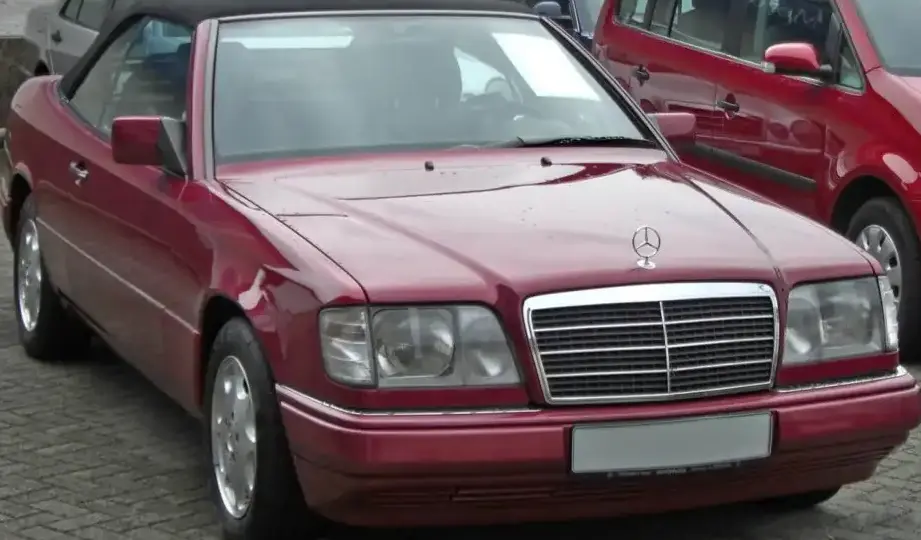
The Mercedes-Benz E 200 Cabriolet (A124) represents a compelling blend of open-air luxury and reliable engineering from the German automaker. Produced between March 1993 and July 1997, this variant occupied a significant position within the A124 Cabriolet range, offering a more accessible entry point into the world of Mercedes-Benz convertibles compared to the higher-performance E 320 or more specialized AMG models. It was part of the W124 series, renowned for its robust build quality and sophisticated design, and aimed at buyers seeking a comfortable and stylish grand tourer.
Technical Specifications
| Brand | Mercedes-Benz |
| Model | E-class |
| Generation | E-class Cabrio (A124) |
| Type (Engine) | E 200 (136 Hp) Automatic |
| Start of production | March, 1993 |
| End of production | July, 1997 |
| Powertrain Architecture | Internal Combustion engine |
| Body type | Cabriolet |
| Seats | 4 |
| Doors | 2 |
| Fuel consumption (urban) | 11.7 l/100 km (20.1 US mpg) |
| Fuel consumption (extra urban) | 7 l/100 km (33.6 US mpg) |
| Fuel Type | Petrol (Gasoline) |
| Acceleration 0 – 100 km/h | 13.9 sec |
| Acceleration 0 – 62 mph | 13.9 sec |
| Acceleration 0 – 60 mph | 13.2 sec |
| Maximum speed | 195 km/h (121.17 mph) |
| Weight-to-power ratio | 11.9 kg/Hp |
| Weight-to-torque ratio | 8.5 kg/Nm |
| Power | 136 Hp @ 5500 rpm |
| Torque | 190 Nm @ 4000 rpm (140.14 lb.-ft. @ 4000 rpm) |
| Engine layout | Front, Longitudinal |
| Engine Model/Code | M 111 E 20 / 111.940 |
| Engine displacement | 1998 cm3 (121.93 cu. in.) |
| Number of cylinders | 4 |
| Engine configuration | Inline |
| Cylinder Bore | 89.9 mm (3.54 in.) |
| Piston Stroke | 78.7 mm (3.1 in.) |
| Compression ratio | 9.6:1 |
| Number of valves per cylinder | 4 |
| Fuel injection system | Multi-port manifold injection |
| Engine aspiration | Naturally aspirated engine |
| Valvetrain | DOHC |
| Engine oil capacity | 5.5 l (5.81 US qt | 4.84 UK qt) |
| Coolant | 8.5 l (8.98 US qt | 7.48 UK qt) |
| Kerb Weight | 1620 kg (3571.49 lbs.) |
| Max. weight | 2120 kg (4673.8 lbs.) |
| Max load | 500 kg (1102.31 lbs.) |
| Trunk (boot) space – minimum | 300 l (10.59 cu. ft.) |
| Fuel tank capacity | 70 l (18.49 US gal | 15.4 UK gal) |
| Length | 4655 mm (183.27 in.) |
| Width | 1740 mm (68.5 in.) |
| Height | 1391 mm (54.76 in.) |
| Wheelbase | 2715 mm (106.89 in.) |
| Front track | 1501 mm (59.09 in.) |
| Rear (Back) track | 1491 mm (58.7 in.) |
| Drivetrain Architecture | Rear wheel drive |
| Number of gears and type of gearbox | 4 gears, automatic transmission |
| Front suspension | Wishbone |
| Rear suspension | Independent multi-link suspension |
| Front brakes | Ventilated discs |
| Rear brakes | Disc |
| Assisting systems | ABS (Anti-lock braking system) |
| Steering type | Cone worm with recirculation balls |
| Power steering | Hydraulic Steering |
| Tires size | Front wheel tires: 195/65 R15Rear wheel tires: 195/65 R15 |
| Wheel rims size | Front wheel rims: 6.5J x 15Rear wheel rims: 6.5J x 15 |
Powertrain & Engine Architecture
The E 200 Cabriolet was powered by the M111 E 20 engine, a 1.998-liter inline-four cylinder powerplant. This engine, designated with the code 111.940, featured multi-port fuel injection and a double overhead camshaft (DOHC) valvetrain. The M111 engine family was known for its relatively lightweight construction and good refinement. The 9.6:1 compression ratio contributed to a respectable 136 horsepower at 5500 rpm and 190 Nm (140 lb-ft) of torque at 4000 rpm. The engine’s longitudinal mounting allowed for a more balanced weight distribution. Paired with the engine was a four-speed automatic transmission, offering smooth shifts but lacking the responsiveness of a manual gearbox. This automatic transmission was a common unit in Mercedes-Benz vehicles of the era, prioritizing comfort over outright performance.
Driving Characteristics
The E 200 Automatic offered a comfortable and relaxed driving experience. Acceleration was adequate for everyday driving, with a 0-60 mph time of around 13.2 seconds and a top speed of 195 km/h (121 mph). However, it wasn’t a particularly sporty car. The automatic transmission, while smooth, resulted in some power loss and a less engaging driving experience compared to the five-speed manual transmission available with other E-Class variants. The gear ratios were optimized for fuel efficiency and cruising comfort rather than rapid acceleration. Compared to the E 320, which featured a larger six-cylinder engine, the E 200 felt noticeably less powerful, especially when fully loaded or tackling steep inclines. However, the E 200’s lighter weight did contribute to slightly better handling and fuel economy.
Equipment & Trim Levels
The E 200 Cabriolet typically came standard with features expected of a luxury vehicle in the early 1990s. This included power windows, central locking, a high-quality sound system, and leather upholstery. The interior trim was generally conservative and elegant, reflecting Mercedes-Benz’s design philosophy of the time. Optional extras included automatic climate control, heated seats, a sunroof (in addition to the convertible top), and upgraded audio systems. The wood trim was a popular option, adding a touch of warmth to the cabin. The standard upholstery was typically a durable cloth, with leather being a significant upgrade.
Chassis & Braking
The A124 Cabriolet chassis featured independent suspension all around, with a wishbone setup at the front and a multi-link suspension at the rear. This provided a comfortable ride and good handling characteristics. The E 200 typically came equipped with ventilated disc brakes at the front and solid disc brakes at the rear. Anti-lock braking system (ABS) was standard, enhancing safety and stability during braking. The steering was a recirculating ball system with hydraulic power assistance, offering a good balance of feel and ease of use. Stabilizer bars were fitted front and rear to reduce body roll during cornering.
Market Reception & Comparison
The E 200 Cabriolet was generally well-received by critics as an accessible entry point into the Mercedes-Benz convertible range. It was praised for its comfortable ride, build quality, and elegant styling. However, some reviewers noted its relatively modest performance compared to the more powerful E 320 models. Fuel economy was considered reasonable for a vehicle of its size and class. Compared to the E 320, the E 200 offered a lower purchase price and potentially lower running costs due to its smaller engine. The E 200 also proved to be a more economical choice than the diesel-powered E 290 Turbodiesel, which, while offering excellent fuel economy, lacked the refinement of the gasoline engine.
Legacy
The M111 engine, in general, is known for its durability and reliability. The E 200 Cabriolet, when properly maintained, has proven to be a long-lasting vehicle. However, like all cars of this era, it is susceptible to age-related issues such as corrosion, rubber component degradation, and electrical problems. The automatic transmission, while reliable, can require servicing over time. Today, the E 200 Cabriolet (A124) is a sought-after classic car, appreciated for its timeless design and comfortable driving experience. Well-maintained examples command reasonable prices in the used car market, making it an attainable entry point into classic Mercedes-Benz ownership.