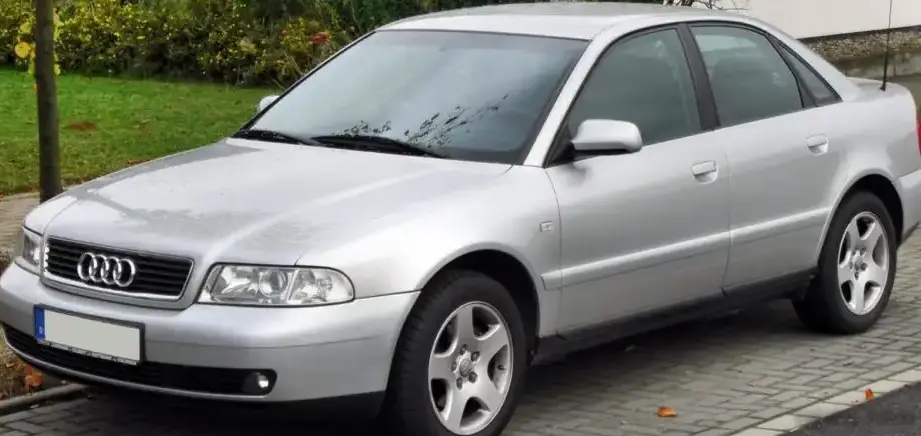
The Audi A4 (B5) facelift, produced from 1999 to 2000, represented a significant mid-cycle refresh of Audi’s popular compact executive car. Among the various engine and drivetrain configurations offered, the 1.8 Turbo quattro model, producing 180 horsepower, occupied a sweet spot in the lineup, blending performance with all-weather capability. This variant was positioned as a premium offering, appealing to buyers seeking a more engaging driving experience than the base models, but without the higher price tag of the more potent S4 or V6 options. It was a key player in Audi’s strategy to establish itself as a leading luxury brand in the late 1990s, particularly in European markets where the combination of turbocharging, all-wheel drive, and a refined interior was highly valued.
Technical Specifications
| Brand | Audi |
| Model | A4 |
| Generation | A4 (B5, Typ 8D, facelift 1999) |
| Type (Engine) | 1.8 Turbo (180 Hp) quattro |
| Start of production | 1999 |
| End of production | 2000 |
| Powertrain Architecture | Internal Combustion engine |
| Body type | Sedan |
| Seats | 5 |
| Doors | 4 |
| Fuel consumption (urban) | 12.1 l/100 km (19.4 US mpg, 23.3 UK mpg, 8.3 km/l) |
| Fuel consumption (extra urban) | 7.2 l/100 km (32.7 US mpg, 39.2 UK mpg, 13.9 km/l) |
| Fuel consumption (combined) | 9 l/100 km (26.1 US mpg, 31.4 UK mpg, 11.1 km/l) |
| Fuel Type | Petrol (Gasoline) |
| Acceleration 0 – 100 km/h | 8 sec |
| Acceleration 0 – 62 mph | 8 sec |
| Acceleration 0 – 60 mph | 7.6 sec |
| Maximum speed | 230 km/h (142.92 mph) |
| Weight-to-power ratio | 7.7 kg/Hp, 130.4 Hp/tonne |
| Weight-to-torque ratio | 5.9 kg/Nm, 170.3 Nm/tonne |
| Power | 180 Hp @ 5500 rpm |
| Power per litre | 101.1 Hp/l |
| Torque | 235 Nm @ 1950-5000 rpm (173.33 lb.-ft. @ 1950-5000 rpm) |
| Engine layout | Front, Longitudinal |
| Engine Model/Code | AJL |
| Engine displacement | 1781 cm3 (108.68 cu. in.) |
| Number of cylinders | 4 |
| Engine configuration | Inline |
| Cylinder Bore | 81 mm (3.19 in.) |
| Piston Stroke | 86.4 mm (3.4 in.) |
| Compression ratio | 9.5:1 |
| Number of valves per cylinder | 5 |
| Fuel injection system | Multi-port manifold injection |
| Engine aspiration | Turbocharger |
| Engine oil capacity | 3.5 l (3.7 US qt | 3.08 UK qt) |
| Coolant | 6.5 l (6.87 US qt | 5.72 UK qt) |
| Kerb Weight | 1380 kg (3042.38 lbs.) |
| Max. weight | 1930 kg (4254.92 lbs.) |
| Max load | 550 kg (1212.54 lbs.) |
| Trunk (boot) space – minimum | 440 l (15.54 cu. ft.) |
| Fuel tank capacity | 60 l (15.85 US gal | 13.2 UK gal) |
| Length | 4479 mm (176.34 in.) |
| Width | 1733 mm (68.23 in.) |
| Height | 1415 mm (55.71 in.) |
| Wheelbase | 2607 mm (102.64 in.) |
| Front track | 1498 mm (58.98 in.) |
| Rear (Back) track | 1475 mm (58.07 in.) |
| Drag coefficient (Cd) | 0.31 |
| Minimum turning circle | 11.1 m (36.42 ft.) |
| Drive wheel | All wheel drive (4×4) |
| Number of gears and type of gearbox | 5 gears, manual transmission |
| Tires size | 195/65 R15 |
| Wheel rims size | 15 |
Powertrain & Engine Architecture
The heart of the A4 1.8T quattro is the AJL engine code, a 1.8-liter, inline-four cylinder gasoline engine. This engine utilizes a single overhead camshaft (SOHC) design with five valves per cylinder (three intake, two exhaust). The key feature, of course, is the K03 turbocharger, which significantly boosts power output compared to the naturally aspirated 1.8L engine available in other A4 variants. Fuel delivery is managed by a Bosch Motronic multi-port fuel injection system, carefully calibrated to optimize performance and efficiency. The engine’s relatively high 9.5:1 compression ratio contributes to its responsiveness. The five-speed manual transmission was the standard offering, providing precise gear changes and a direct connection to the engine. The quattro all-wheel drive system employs a Torsen differential, distributing torque between the front and rear axles based on traction conditions, enhancing stability and grip.
Driving Characteristics
The 180 hp 1.8T quattro offered a noticeable step up in performance compared to the base A4 models. Acceleration from 0-60 mph in around 7.6 seconds was respectable for the era, and the turbocharger provided a strong mid-range punch. While not as brutally fast as the S4, the 1.8T quattro delivered a more than adequate driving experience for most drivers. The all-wheel drive system instilled confidence in various weather conditions, making it a practical choice for those living in regions with inclement weather. The five-speed manual transmission allowed for precise control, while the gear ratios were well-matched to the engine’s powerband. Compared to the 1.9 TDI diesel, the 1.8T offered quicker acceleration but at the expense of fuel economy. The higher-output 2.8L V6 models provided even more power, but came with a significant price premium.
Equipment & Trim Levels
The A4 1.8T quattro typically came standard with features such as power windows, power locks, air conditioning, and an upgraded audio system. Interior upholstery was usually cloth, although leather options were available. The dashboard layout was functional and well-designed, with clear instrumentation. Optional extras included a sunroof, heated front seats, automatic climate control, and a premium sound system. The quattro badge was prominently displayed on the exterior, signifying the vehicle’s all-wheel drive capability. Sport packages were also offered, adding features like sport suspension and alloy wheels.
Chassis & Braking
The B5 A4 featured a fully independent suspension system, with MacPherson struts at the front and a multi-link setup at the rear. This configuration provided a comfortable ride while maintaining good handling characteristics. The 1.8T quattro models typically came equipped with disc brakes on all four wheels, providing ample stopping power. Anti-lock braking system (ABS) was standard. Stabilizer bars were fitted to both the front and rear axles to reduce body roll during cornering. The chassis was designed to be rigid, contributing to the car’s overall stability and handling precision.
Market Reception & Comparison
The Audi A4 1.8T quattro was generally well-received by automotive critics. It was praised for its blend of performance, handling, and refinement. The all-wheel drive system was a major selling point, particularly in markets with challenging weather conditions. Fuel economy was considered reasonable for a turbocharged engine of this size. Compared to its rivals, such as the BMW 3 Series and Mercedes-Benz C-Class, the A4 offered a compelling combination of features and value. The 1.8T quattro was often seen as a more practical and affordable alternative to the more expensive V6 models.
Legacy
The AJL 1.8T engine proved to be remarkably durable and reliable, provided it was properly maintained. The turbocharger could be a potential point of failure, but with regular oil changes and careful driving, it typically lasted for many years. The quattro all-wheel drive system also proved to be robust and dependable. Today, the B5 A4 1.8T quattro remains a popular choice among enthusiasts, offering a classic Audi driving experience at an affordable price. Parts availability is generally good, and the car’s relatively simple mechanical design makes it relatively easy to maintain and repair. It’s a testament to Audi’s engineering prowess that these cars continue to be enjoyed on the roads today.