
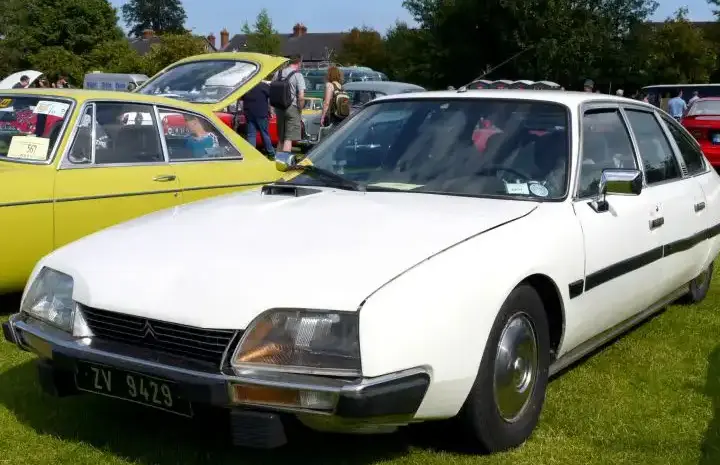
Technical Specifications
| Brand | Citroen |
| Model | CX |
| Generation | CX I |
| Type (Engine) | Prestige 2400 (130 Hp) Automatic |
| Start of production | 1980 year |
| End of production | 1982 year |
| Powertrain Architecture | Internal Combustion engine |
| Body type | Hatchback |
| Seats | 5 |
| Doors | 5 |
| Fuel Type | Petrol (Gasoline) |
| Acceleration 0 – 100 km/h | 12.8 sec |
| Acceleration 0 – 62 mph | 12.8 sec |
| Acceleration 0 – 60 mph | 12.2 sec |
| Maximum speed | 180 km/h (111.85 mph) |
| Weight-to-power ratio | 11.3 kg/Hp, 88.4 Hp/tonne |
| Weight-to-torque ratio | 7.3 kg/Nm, 136.7 Nm/tonne |
| Power | 130 Hp @ 5000 rpm |
| Power per litre | 55.4 Hp/l |
| Torque | 201 Nm @ 3750 rpm (148.25 lb.-ft. @ 3750 rpm) |
| Engine layout | Front, Transverse |
| Engine Model/Code | M23.622 |
| Engine displacement | 2347 cm3 (143.22 cu. in.) |
| Number of cylinders | 4 |
| Engine configuration | Inline |
| Cylinder Bore | 93.5 mm (3.68 in.) |
| Piston Stroke | 85.5 mm (3.37 in.) |
| Compression ratio | 9:1 |
| Number of valves per cylinder | 2 |
| Fuel injection system | Multi-port manifold injection |
| Engine aspiration | Naturally aspirated engine |
| Engine oil capacity | 5.3 l (5.6 US qt | 4.66 UK qt) |
| Coolant | 11 l (11.62 US qt | 9.68 UK qt) |
| Kerb Weight | 1470 kg (3240.8 lbs.) |
| Max. weight | 1925 kg (4243.9 lbs.) |
| Max load | 455 kg (1003.1 lbs.) |
| Trunk (boot) space – minimum | 325 l (11.48 cu. ft.) |
| Fuel tank capacity | 68 l (17.96 US gal | 14.96 UK gal) |
| Permitted trailer load with brakes (12%) | 1300 kg (2866.01 lbs.) |
| Length | 4916 mm (193.54 in.) |
| Width | 1734 mm (68.27 in.) |
| Height | 1357 mm (53.43 in.) |
| Wheelbase | 3095 mm (121.85 in.) |
| Front track | 1474 mm (58.03 in.) |
| Rear (Back) track | 1360 mm (53.54 in.) |
| Front overhang | 1057 mm (41.61 in.) |
| Rear overhang | 764 mm (30.08 in.) |
| Ride height (ground clearance) | 155 mm (6.1 in.) |
| Drag coefficient (Cd) | 0.37 |
| Minimum turning circle (turning diameter) | 11.80 m (38.71 ft.) |
| Drivetrain Architecture | The Internal combustion engine (ICE) drives the front wheels of the vehicle. |
| Drive wheel | Front wheel drive |
| Number of gears and type of gearbox | 3 gears, automatic transmission |
| Front brakes | Ventilated discs |
| Rear brakes | Disc |
| Steering type | Steering rack and pinion |
| Wheel rims size | 5.5J x 14 |
The Citroën CX I Prestige 2400 Automatic, produced between 1980 and 1982, was a significant iteration of the CX model line. The CX, launched in 1974, was designed as a replacement for the iconic DS, inheriting and refining its predecessor’s advanced hydropneumatic suspension. The “I” designation denoted the first series of the CX, and the Prestige 2400 Automatic represented a higher trim level, emphasizing luxury and ease of use. It was positioned within the 1HX0/A3 platform family, sharing its core structure with other CX variants but distinguished by its engine and transmission combination.
Powertrain & Engine Architecture
The heart of the CX I Prestige 2400 Automatic was the M23.622 engine, a 2.4-liter (2347 cc) inline-four cylinder petrol engine. This engine featured a cast iron block and an aluminum cylinder head, employing a belt-driven single overhead camshaft (SOHC) valvetrain with two valves per cylinder. Fuel delivery was managed by a Bosch multi-port fuel injection system, providing improved efficiency and responsiveness compared to earlier carbureted Citroën engines. The engine produced 130 horsepower at 5000 rpm and 201 Nm (148.25 lb-ft) of torque at 3750 rpm. Paired with this engine was a three-speed automatic transmission, designed to provide smooth and effortless gear changes. This transmission, while offering convenience, was not known for its sportiness and contributed to a slightly slower acceleration time compared to the manual transmission options.
Driving Characteristics
The CX I Prestige 2400 Automatic offered a distinctly comfortable and refined driving experience. The hydropneumatic suspension, a Citroën hallmark, provided an exceptionally smooth ride, absorbing bumps and imperfections in the road with remarkable ease. However, the combination of the 2.4-liter engine and the three-speed automatic transmission resulted in performance that was more geared towards cruising than spirited driving. Acceleration from 0-60 mph took around 12.2 seconds, and the top speed was approximately 111.85 mph. The automatic transmission’s gear ratios were optimized for fuel economy and smooth operation, rather than maximizing acceleration. Compared to the manual transmission versions of the 2400, or the more powerful CX 2500 GTI, the automatic felt noticeably less responsive. The steering, while precise, lacked the directness found in some contemporary vehicles.
Equipment & Trim Levels
The Prestige trim level of the CX I 2400 Automatic included a number of features designed to enhance comfort and luxury. Standard equipment typically included velour upholstery, power-assisted steering, central locking, and electric windows. The dashboard layout was characteristically Citroën, featuring a unique combination of analog gauges and switches. Optional extras available for this trim included a sunroof, air conditioning, and upgraded audio systems. The interior was spacious and well-appointed, reflecting Citroën’s commitment to providing a premium driving experience.
Chassis & Braking
The CX I Prestige 2400 Automatic utilized a front-wheel-drive layout with independent suspension on all four wheels, utilizing Citroën’s innovative hydropneumatic system. This system allowed for self-leveling and adjustable ride height, contributing to the car’s exceptional ride quality. The front suspension featured independent double wishbones, while the rear suspension employed trailing arms. Braking duties were handled by ventilated discs at the front and solid discs at the rear. The braking system was generally effective, although it lacked the anti-lock braking system (ABS) that would become more common in later models. Stabilizer bars were fitted to both the front and rear axles to reduce body roll during cornering.
Market Reception & Comparison
The CX I Prestige 2400 Automatic was generally well-received by automotive critics, who praised its ride comfort, innovative technology, and spacious interior. However, some reviewers noted that the automatic transmission detracted from the car’s overall performance. Compared to the manual transmission versions of the 2400, the automatic offered less engaging driving experience. Fuel economy was reasonable for the time, but not exceptional. The CX, in general, was seen as a sophisticated and technologically advanced vehicle, but its complexity also raised concerns about long-term reliability and maintenance costs. Compared to its German rivals, such as the Mercedes-Benz W123 and BMW E28, the CX offered a different driving experience, prioritizing comfort and innovation over outright performance and traditional luxury.
Legacy
The Citroën CX I Prestige 2400 Automatic, while not the most sought-after variant of the CX range, remains a fascinating example of 1980s automotive engineering. The M23.622 engine, while not known for its exceptional durability, is generally reliable if properly maintained. The three-speed automatic transmission, however, can be prone to wear and tear. Today, the CX is a popular choice among classic car enthusiasts who appreciate its unique design, innovative technology, and comfortable ride. Parts availability can be a challenge, but a dedicated community of owners and specialists exists to support the preservation of these iconic vehicles. The hydropneumatic suspension requires regular maintenance to ensure optimal performance, but when properly cared for, it continues to provide a remarkably smooth and comfortable driving experience.
