
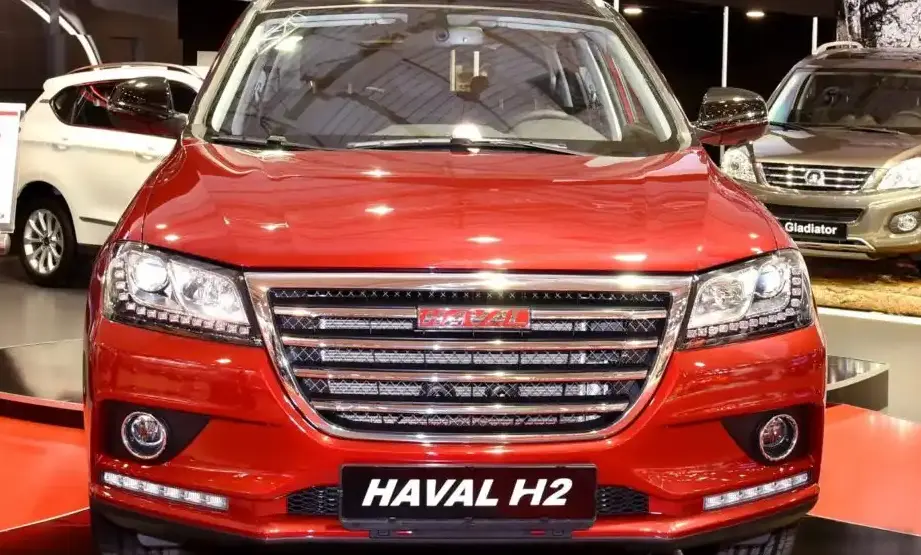
The Haval H2 1.5, a compact SUV produced by the Chinese manufacturer Haval, entered production in 2015. Positioned as an entry-level offering within Haval’s expanding lineup, the H2 aimed to provide a relatively affordable and feature-rich option in the burgeoning compact SUV segment. This particular variant, equipped with the 1.5-liter turbocharged engine producing 150 horsepower, was a key model for Haval as it sought to establish a foothold in both the domestic Chinese market and, eventually, international markets. The H2 is based on a dedicated SUV platform, representing Haval’s move towards independent vehicle development rather than relying on licensed designs. It’s a five-door, five-seater vehicle designed to appeal to young families and urban drivers.
Technical Specifications
| Brand | Haval |
| Model | H2 |
| Generation | H2 |
| Type (Engine) | 1.5 (150 Hp) |
| Start of production | 2015 |
| Powertrain Architecture | Internal Combustion engine |
| Body type | SUV |
| Seats | 5 |
| Doors | 5 |
| Fuel Type | Petrol (Gasoline) |
| Emission standard | Euro 5/Euro 5+ |
| Weight-to-power ratio | 10.5 kg/Hp, 95.5 Hp/tonne |
| Weight-to-torque ratio | 7.5 kg/Nm, 133.8 Nm/tonne |
| Power | 150 Hp @ 5600 rpm |
| Power per litre | 100.2 Hp/l |
| Torque | 210 Nm @ 2200-4500 rpm (154.89 lb.-ft. @ 2200-4500 rpm) |
| Engine layout | Front, Transverse |
| Engine Model/Code | GW4G15B |
| Engine displacement | 1497 cm3 (91.35 cu. in.) |
| Number of cylinders | 4 |
| Engine configuration | Inline |
| Number of valves per cylinder | 4 |
| Fuel injection system | Multi-port manifold injection |
| Engine aspiration | Turbocharger, Intercooler |
| Kerb Weight | 1570 kg (3461.26 lbs.) |
| Max. weight | 1985 kg (4376.18 lbs.) |
| Max load | 415 kg (914.92 lbs.) |
| Length | 4335 mm (170.67 in.) |
| Width | 1814 mm (71.42 in.) |
| Height | 1695 mm (66.73 in.) |
| Wheelbase | 2560 mm (100.79 in.) |
| Front track | 1525 mm (60.04 in.) |
| Rear (Back) track | 1520 mm (59.84 in.) |
| Ride height (ground clearance) | 184 mm (7.24 in.) |
| Drivetrain Architecture | The Internal combustion engine (ICE) drives the front wheels of the vehicle. |
| Drive wheel | Front wheel drive |
| Number of gears and type of gearbox | 6 gears, manual transmission |
| Front suspension | Independent type McPherson |
| Rear suspension | Independent multi-link suspension |
| Front brakes | Ventilated discs |
| Rear brakes | Disc |
| Assisting systems | ABS (Anti-lock braking system) |
| Tires size | 235/55 R18 |
| Wheel rims size | 18 |
Powertrain & Engine Architecture
The Haval H2 1.5 is powered by the GW4G15B, a 1.5-liter inline-four cylinder gasoline engine. This engine utilizes a single-scroll turbocharger with an intercooler to boost power output. The engine employs multi-point fuel injection, a relatively conventional system for its time, and features four valves per cylinder. The engine’s design prioritizes a balance between fuel efficiency and adequate performance for its intended market segment. The 6-speed manual transmission is the only transmission option available with this engine, offering drivers full control over gear selection. The engine’s turbocharger is designed to minimize turbo lag, providing a reasonably responsive driving experience. The engine is front-mounted and transversely positioned, a common layout for front-wheel-drive vehicles.
Driving Characteristics
The 150 horsepower and 210 Nm (154.89 lb-ft) of torque provided by the 1.5-liter engine offer adequate, though not exceptional, performance. Acceleration is best described as moderate, with a 0-60 mph time estimated to be around 9-10 seconds. The six-speed manual transmission allows for precise gear changes, but the gear ratios are tuned more for fuel economy than outright performance. Compared to potential higher-output engine options (which weren’t widely available on the H2), this variant feels less eager to accelerate, particularly when fully loaded. The front-wheel-drive configuration contributes to predictable handling, but it lacks the all-weather capability of an all-wheel-drive system. The turbocharger does provide a noticeable boost in power during mid-range acceleration, making overtaking maneuvers manageable.
Equipment & Trim Levels
The Haval H2 1.5 typically came equipped with a reasonable level of standard features, aiming to provide good value for money. These included air conditioning, power windows and mirrors, a basic audio system with USB connectivity, and ABS brakes. Higher trim levels added features such as alloy wheels, a touchscreen infotainment system, rear parking sensors, and a sunroof. Interior upholstery was typically cloth, with options for leatherette in higher trims. The dashboard layout is functional and straightforward, prioritizing ease of use over stylistic flair. Optional extras often included a navigation system, a reversing camera, and upgraded sound systems.
Chassis & Braking
The Haval H2 utilizes an independent McPherson strut suspension setup at the front and an independent multi-link suspension at the rear. This suspension configuration aims to provide a comfortable ride quality while maintaining reasonable handling characteristics. The front brakes are ventilated discs, providing good stopping power, while the rear brakes are solid discs. The ABS (Anti-lock Braking System) is standard, enhancing safety during emergency braking situations. The vehicle’s ride height of 184mm (7.24 inches) provides adequate ground clearance for navigating typical urban and rural roads. Stabilizer bars are fitted to both the front and rear axles to reduce body roll during cornering.
Market Reception & Comparison
The Haval H2 1.5 was generally well-received in the Chinese market as an affordable and practical compact SUV. Critics praised its spacious interior and relatively generous equipment list for its price point. However, some reviewers noted that the engine’s performance was adequate but not particularly exciting. Fuel economy was considered to be competitive within its class. Compared to other compact SUVs available in China at the time, the H2 offered a compelling value proposition, particularly for budget-conscious buyers. Reliability reports were mixed, with some owners reporting minor issues with the infotainment system and some engine components.
Legacy
The Haval H2 played a significant role in establishing Haval as a major player in the Chinese SUV market. While the 1.5-liter turbocharged engine isn’t known for exceptional longevity, it has proven to be reasonably durable with proper maintenance. On the used car market, the H2 1.5 remains an affordable option for those seeking a compact SUV with a decent level of features. Its relatively simple mechanical design makes it easier and less expensive to repair compared to more complex modern SUVs. The H2 paved the way for Haval’s subsequent models, demonstrating the brand’s ability to design and manufacture competitive SUVs. The model has since been superseded by newer Haval offerings, but it remains a notable vehicle in the company’s history.
