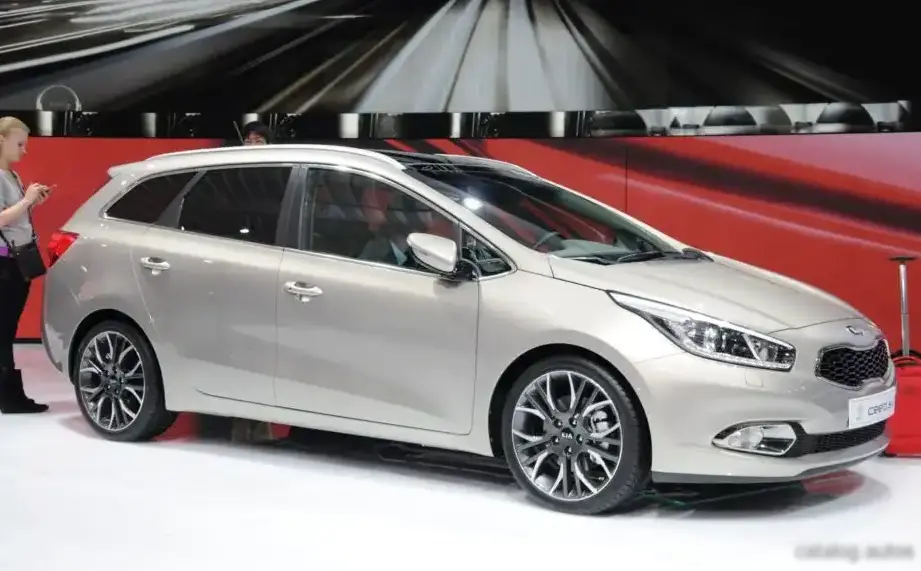
The Kia Cee’d SW II 1.6 CRDi 16V Automatic, produced between 2012 and 2015, represents a significant offering in the European compact estate (station wagon) market. Part of the second generation of the Cee’d (BD) family, the SW – signifying “Station Wagon” – aimed to provide practicality and fuel efficiency to buyers seeking a versatile family vehicle. This particular variant, equipped with the 1.6-liter diesel engine producing 128 horsepower and paired with a six-speed automatic transmission, occupied a mid-range position within the Cee’d SW II lineup, offering a balance between affordability and convenience. It was designed to appeal to drivers prioritizing ease of use and lower running costs over outright performance.
Technical Specifications
| Brand | Kia |
| Model | Cee’d |
| Generation | Cee’d SW II |
| Type (Engine) | 1.6 CRDi 16V (128 Hp) Automatic |
| Start of production | 2012 |
| End of production | 2015 |
| Powertrain Architecture | Internal Combustion engine |
| Body type | Station wagon (estate) |
| Seats | 5 |
| Doors | 5 |
| Fuel consumption (urban) | 7.5 l/100 km (31.4 US mpg, 37.7 UK mpg, 13.3 km/l) |
| Fuel consumption (extra urban) | 4.6 l/100 km (51.1 US mpg, 61.4 UK mpg, 21.7 km/l) |
| Fuel consumption (combined) | 5.6 l/100 km (42 US mpg, 50.4 UK mpg, 17.9 km/l) |
| CO2 emissions | 149 g/km |
| Fuel Type | Diesel |
| Acceleration 0 – 100 km/h | 12.1 sec |
| Acceleration 0 – 62 mph | 12.1 sec |
| Acceleration 0 – 60 mph | 11.5 sec |
| Maximum speed | 185 km/h (114.95 mph) |
| Emission standard | Euro 5 |
| Weight-to-power ratio | 10.7 kg/Hp |
| Weight-to-torque ratio | 5.3 kg/Nm |
| Power | 128 Hp @ 4000 rpm |
| Torque | 260 Nm @ 1900-2750 rpm (191.77 lb.-ft. @ 1900-2750 rpm) |
| Engine layout | Front, Transverse |
| Engine Model/Code | D4FB |
| Engine displacement | 1582 cm3 (96.54 cu. in.) |
| Number of cylinders | 4 |
| Engine configuration | Inline |
| Cylinder Bore | 77.2 mm (3.04 in.) |
| Piston Stroke | 84.5 mm (3.33 in.) |
| Compression ratio | 17.3:1 |
| Number of valves per cylinder | 4 |
| Fuel injection system | Diesel Commonrail |
| Engine aspiration | Turbocharger, Intercooler |
| Valvetrain | DOHC |
| Engine oil capacity | 5.3 l (5.6 US qt | 4.66 UK qt) |
| Coolant capacity | 6.7 l (7.08 US qt | 5.9 UK qt) |
| Kerb Weight | 1366-1488 kg (3011.51 – 3280.48 lbs.) |
| Max. weight | 1940 kg (4276.97 lbs.) |
| Max load | 452-574 kg (996.49 – 1265.45 lbs.) |
| Trunk (boot) space – minimum | 528 l (18.65 cu. ft.) |
| Trunk (boot) space – maximum | 1642 l (57.99 cu. ft.) |
| Fuel tank capacity | 53 l (14 US gal | 11.66 UK gal) |
| Permitted trailer load with brakes (12%) | 1300 kg (2866.01 lbs.) |
| Length | 4505 mm (177.36 in.) |
| Width | 1780 mm (70.08 in.) |
| Width including mirrors | 2045 mm (80.51 in.) |
| Height | 1485 mm (58.46 in.) |
| Wheelbase | 2650 mm (104.33 in.) |
| Front track | 1549-1553 mm (60.98 – 61.14 in.) |
| Rear (Back) track | 1557-1561 mm (61.3 – 61.46 in.) |
| Front overhang | 900 mm (35.43 in.) |
| Rear overhang | 955 mm (37.6 in.) |
| Minimum turning circle | 10.3 m (33.79 ft.) |
| Drivetrain Architecture | Front wheel drive |
| Number of gears and type of gearbox | 6 gears, automatic transmission |
| Front suspension | Independent type McPherson |
| Rear suspension | Independent multi-link spring suspension with stabilizer |
| Front brakes | Ventilated discs, 280-300 mm |
| Rear brakes | Disc, 262-284 mm |
| Assisting systems | ABS (Anti-lock braking system) |
| Steering type | Steering rack and pinion |
| Tires size | 205/55 R16; 225/45 R17 |
| Wheel rims size | 6; 5J x 16; 7J x 17 |
INTRODUCTION
The Kia Cee’d SW II, launched in 2012, represented a significant step forward for the Korean automaker in the European market. Building upon the success of the first-generation Cee’d, the SW variant offered increased practicality with its estate body style. The 1.6 CRDi 16V Automatic model was positioned as a sensible choice for families and individuals needing a versatile vehicle with reasonable running costs. It slotted in between the lower-powered diesel options and the more expensive petrol variants, offering a compromise between fuel economy and driving experience. The Cee’d SW II was built on the 1HX0/A3 platform, shared with the Hyundai i30, and aimed to compete with established rivals like the Ford Focus Estate and Volkswagen Golf Estate.
Powertrain & Engine Architecture
The heart of the Cee’d SW II 1.6 CRDi Automatic is the D4FB engine, a 1.6-liter inline-four cylinder diesel. This engine utilizes a second-generation common rail direct injection system, delivering fuel at extremely high pressure for improved combustion efficiency and reduced emissions. The engine features a turbocharger with an intercooler, boosting power output and providing a broader torque curve. The valvetrain employs a double overhead camshaft (DOHC) design with four valves per cylinder, optimizing airflow for enhanced performance. The six-speed automatic transmission is a conventional torque converter type, offering smooth gear changes but sacrificing some efficiency compared to a dual-clutch transmission. The transmission was chosen for its ease of use and suitability for drivers prioritizing comfort over sporty driving dynamics.
Driving Characteristics
The 128 horsepower and 260 Nm (191.77 lb-ft) of torque produced by the 1.6 CRDi engine provide adequate, though not exhilarating, performance. Acceleration from 0 to 60 mph takes around 11.5 seconds, and the top speed is 185 km/h (114.95 mph). The automatic transmission is programmed for fuel efficiency, resulting in relatively relaxed gear changes. While it offers a manual shift mode, it’s not particularly responsive. Compared to the higher-output diesel variants (like the 1.7 CRDi), this engine feels less powerful, especially when fully loaded. However, it offers a smoother and more refined driving experience than the lower-powered 1.4 diesel. The gear ratios are optimized for cruising, making it a comfortable long-distance vehicle.
Equipment & Trim Levels
The Cee’d SW II 1.6 CRDi Automatic typically came equipped with a reasonable level of standard features. These included air conditioning, electric front and rear windows, a radio/CD player with USB connectivity, and ABS brakes with Electronic Stability Control (ESC). Higher trim levels, such as ‘3’ or ‘4’, added features like alloy wheels, a touchscreen infotainment system, rear parking sensors, and climate control. Interior upholstery was typically cloth, with options for leather upgrades on higher trims. Optional extras included a panoramic sunroof, navigation system, and heated front seats.
Chassis & Braking
The Cee’d SW II utilizes a McPherson strut front suspension and a multi-link rear suspension, providing a comfortable ride and decent handling. Stabilizer bars are fitted to both the front and rear axles to reduce body roll. Braking duties are handled by ventilated discs at the front and solid discs at the rear. ABS (Anti-lock Braking System) and ESC (Electronic Stability Control) are standard features, enhancing safety. The suspension setup is tuned for comfort rather than outright sportiness, prioritizing ride quality over sharp handling.
Market Reception & Comparison
The Kia Cee’d SW II 1.6 CRDi Automatic was generally well-received by automotive critics as a practical and affordable estate car. It was praised for its spacious interior, generous boot capacity, and competitive fuel economy. However, some reviewers noted that the engine lacked the punch of its rivals and that the automatic transmission could feel sluggish at times. Compared to the 1.7 CRDi variant, the 1.6 offered lower running costs but sacrificed performance. Against competitors like the Ford Focus Estate and Volkswagen Golf Estate, the Cee’d SW II offered a compelling value proposition, often undercutting them on price while providing a similar level of equipment.
Legacy
The Kia Cee’d SW II 1.6 CRDi Automatic has proven to be a relatively reliable vehicle in the used car market. The D4FB engine is generally robust, although regular servicing is crucial to prevent issues with the diesel particulate filter (DPF). The automatic transmission, while not the most advanced, has also proven to be durable. Today, these vehicles are available at affordable prices, making them a practical choice for budget-conscious buyers seeking a spacious and fuel-efficient estate car. Its reputation for reliability and practicality has contributed to Kia’s growing popularity in the European market.