Technical Specifications
| Brand | Citroen |
| Model | CX |
| Generation | CX II |
| Type (Engine) | 20 RE (106 Hp) Manual 4-speed |
| Start of production | 1985 year |
| End of production | 1987 year |
| Powertrain Architecture | Internal Combustion engine |
| Body type | Hatchback |
| Seats | 5 |
| Doors | 5 |
| Fuel consumption (economy) – urban | 11.9 l/100 km (19.8 US mpg, 23.7 UK mpg, 8.4 km/l) |
| Fuel consumption (economy) – combined | 9.6 l/100 km (24.5 US mpg, 29.4 UK mpg, 10.4 km/l) |
| Fuel Type | Petrol (Gasoline) |
| Acceleration 0 – 100 km/h | 12.1 sec |
| Acceleration 0 – 62 mph | 12.1 sec |
| Acceleration 0 – 60 mph | 11.5 sec |
| Maximum speed | 177 km/h (109.98 mph) |
| Weight-to-power ratio | 11.7 kg/Hp, 85.8 Hp/tonne |
| Weight-to-torque ratio | 7.4 kg/Nm, 134.4 Nm/tonne |
| Power | 106 Hp @ 5500 rpm |
| Power per litre | 53.1 Hp/l |
| Torque | 166 Nm @ 3250 rpm (122.44 lb.-ft. @ 3250 rpm) |
| Engine layout | Front, Transverse |
| Engine Model/Code | 829.A5 |
| Engine displacement | 1995 cm3 (121.74 cu. in.) |
| Number of cylinders | 4 |
| Engine configuration | Inline |
| Cylinder Bore | 88 mm (3.46 in.) |
| Piston Stroke | 82 mm (3.23 in.) |
| Compression ratio | 9.2:1 |
| Number of valves per cylinder | 2 |
| Fuel injection system | Carburettor |
| Engine aspiration | Naturally aspirated engine |
| Valvetrain | OHV |
| Engine oil capacity | 5.5 l (5.81 US qt | 4.84 UK qt) |
| Coolant | 9.5 l (10.04 US qt | 8.36 UK qt) |
| Kerb Weight | 1235 kg (2722.71 lbs.) |
| Max. weight | 1780 kg (3924.23 lbs.) |
| Max load | 545 kg (1201.52 lbs.) |
| Trunk (boot) space – minimum | 485 l (17.13 cu. ft.) |
| Trunk (boot) space – maximum | 507 l (17.9 cu. ft.) |
| Fuel tank capacity | 68 l (17.96 US gal | 14.96 UK gal) |
| Max. roof load | 80 kg (176.37 lbs.) |
| Permitted trailer load with brakes (12%) | 1300 kg (2866.01 lbs.) |
| Permitted trailer load without brakes | 675 kg (1488.12 lbs.) |
| Permitted towbar download | 100 kg (220.46 lbs.) |
| Length | 4650 mm (183.07 in.) |
| Width | 1770 mm (69.69 in.) |
| Height | 1360 mm (53.54 in.) |
| Wheelbase | 2845 mm (112.01 in.) |
| Front track | 1520 mm (59.84 in.) |
| Rear (Back) track | 1370 mm (53.94 in.) |
| Ride height (ground clearance) | 157 mm (6.18 in.) |
| Drag coefficient (Cd) | 0.37 |
| Minimum turning circle (turning diameter) | 12.50 m (41.01 ft.) |
| Drivetrain Architecture | The Internal combustion engine (ICE) drives the front wheels of the vehicle. |
| Drive wheel | Front wheel drive |
| Number of gears and type of gearbox | 4 gears, manual transmission |
| Front suspension | Hydro-pneumatic element |
| Rear suspension | Hydro-pneumatic element |
| Front brakes | Ventilated discs |
| Rear brakes | Disc |
| Assisting systems | ABS (Anti-lock braking system) |
| Steering type | Steering rack and pinion |
| Power steering | Hydraulic Steering |
| Tires size | 195/70 R14; 185/70 R14 |
| Wheel rims size | 5.5J x 14 |
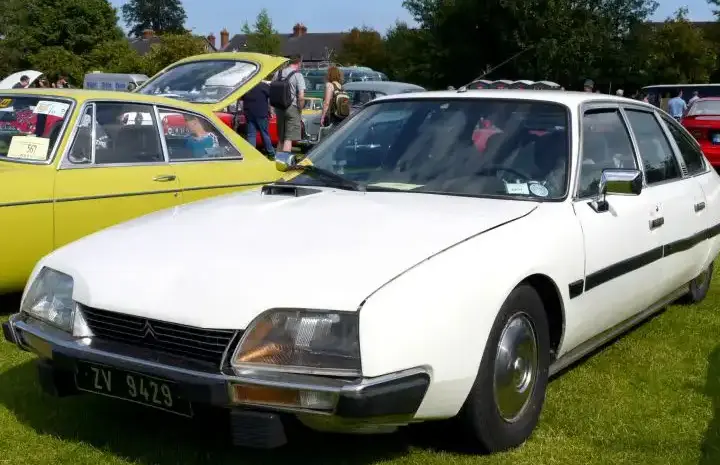
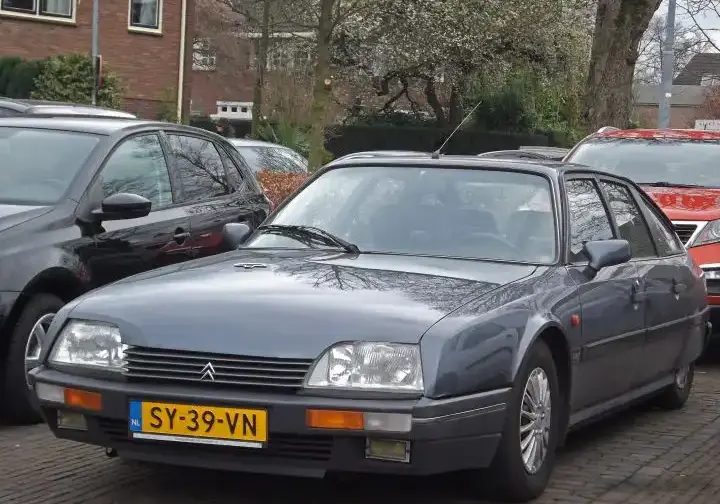
The Citroën CX II 20 RE, produced between 1985 and 1987, represented a mid-range offering within the second generation (CX II) of Citroën’s innovative CX line. Positioned as a comfortable and capable grand tourer, the 20 RE combined a 2.0-liter inline-four engine with a four-speed manual transmission. It served as a more accessible alternative to the higher-performance 25 GTI and the more economical diesel variants, appealing to buyers seeking a balance of power, refinement, and fuel efficiency. The CX II, building upon the groundbreaking CX platform introduced in 1974, continued Citroën’s tradition of advanced engineering, particularly in its hydropneumatic suspension system.
Powertrain & Engine Architecture
The Citroën CX 20 RE utilized the 829.A5 engine, a 1,995 cc inline-four cylinder petrol engine. This engine, while not a high-performance unit, was known for its smoothness and relative reliability. It featured a single overhead valve (OHV) valvetrain and a carburetor fuel injection system – a relatively conventional setup for the era, but less sophisticated than the fuel injection systems found in some contemporary vehicles. The engine produced 106 horsepower at 5,500 rpm and 166 Nm (122.44 lb-ft) of torque at 3,250 rpm. The four-speed manual transmission was a standard unit, providing a reasonably direct connection between the engine and the front wheels. The gear ratios were tuned for a balance of acceleration and fuel economy, prioritizing comfortable cruising over outright performance.
Driving Characteristics
The CX 20 RE with the manual transmission offered a more engaging driving experience than the automatic versions. While not a sports car, the 20 RE provided adequate acceleration for everyday driving and highway cruising. The 0-60 mph time of around 11.5 seconds and a top speed of 177 km/h (109.98 mph) were respectable for the mid-1980s. The hydropneumatic suspension, a hallmark of Citroën vehicles, provided an exceptionally smooth and comfortable ride, absorbing bumps and imperfections in the road surface with ease. The steering, while hydraulic, lacked the directness of some competitors, but was light and easy to use. The manual gearbox allowed for greater control over the engine’s power band, making it easier to navigate winding roads or overtake slower traffic.
Equipment & Trim Levels
The CX II 20 RE was generally well-equipped for its time. Standard features typically included power steering, front disc brakes, and the aforementioned hydropneumatic suspension. Interior appointments were comfortable, with cloth upholstery and a functional dashboard layout. Optional extras could include air conditioning, a sunroof, and upgraded audio systems. The trim level was generally considered mid-range within the CX lineup, offering a step up in comfort and features compared to the base models, but lacking the luxury appointments of the higher-specification versions.
Chassis & Braking
The CX II featured a monocoque chassis construction, providing a good balance of strength and rigidity. The hydropneumatic suspension system, utilizing spheres filled with nitrogen gas and hydraulic fluid, allowed for self-leveling and adjustable ride height. The front brakes were ventilated discs, providing good stopping power, while the rear brakes were solid discs. An anti-lock braking system (ABS) was available as an option, enhancing safety in slippery conditions. The suspension geometry was carefully tuned to minimize body roll and provide stable handling.
Market Reception & Comparison
The CX 20 RE was generally well-received by automotive critics as a comfortable and refined grand tourer. It was praised for its ride quality, spacious interior, and distinctive styling. However, some critics noted that the engine lacked the power of some competitors, and the carburetor fuel system was less efficient than modern fuel injection systems. Compared to the more powerful CX 25 GTI, the 20 RE offered a more affordable and fuel-efficient alternative, appealing to a wider range of buyers. Compared to the diesel versions, the 20 RE provided more spirited performance, but at the cost of fuel economy.
Legacy
The Citroën CX II 20 RE, while not the most powerful or technologically advanced version of the CX, remains a fondly remembered example of Citroën’s innovative engineering. The 829.A5 engine, while relatively simple, proved to be reasonably durable with proper maintenance. Today, the CX II 20 RE is a sought-after classic car, appreciated for its unique styling, comfortable ride, and distinctive character. Finding well-maintained examples can be challenging, as age and neglect have taken their toll on many vehicles. However, for enthusiasts willing to invest the time and effort, the CX 20 RE offers a rewarding and unique driving experience.