Technical Specifications
| Brand | Opel |
| Model | Astra |
| Generation | Astra F Classic (facelift 1994) |
| Type (Engine) | 1.7 TD (68 Hp) |
| Start of production | August, 1994 |
| End of production | December, 1997 |
| Powertrain Architecture | Internal Combustion engine |
| Body type | Sedan |
| Seats | 5 |
| Doors | 4 |
| Fuel consumption (urban) | 6.8 l/100 km (34.6 US mpg, 41.5 UK mpg, 14.7 km/l) |
| Fuel consumption (extra urban) | 5.1 l/100 km (46.1 US mpg, 55.4 UK mpg, 19.6 km/l) |
| Fuel consumption (combined) | 6.3 l/100 km (37.3 US mpg, 44.8 UK mpg, 15.9 km/l) |
| Fuel Type | Diesel |
| Acceleration 0 – 100 km/h | 16 sec |
| Acceleration 0 – 62 mph | 16 sec |
| Acceleration 0 – 60 mph | 15.2 sec |
| Maximum speed | 164 km/h (101.9 mph) |
| Weight-to-power ratio | 15.9 kg/Hp, 63 Hp/tonne |
| Weight-to-torque ratio | 8.2 kg/Nm, 122.2 Nm/tonne |
| Power | 68 Hp @ 4500 rpm |
| Power per litre | 40 Hp/l |
| Torque | 132 Nm @ 2400 rpm (97.36 lb.-ft. @ 2400 rpm) |
| Engine layout | Front, Transverse |
| Engine Model/Code | X17DTL |
| Engine displacement | 1700 cm3 (103.74 cu. in.) |
| Number of cylinders | 4 |
| Engine configuration | Inline |
| Cylinder Bore | 82.5 mm (3.25 in.) |
| Piston Stroke | 79.5 mm (3.13 in.) |
| Compression ratio | 22:1 |
| Number of valves per cylinder | 2 |
| Fuel injection system | Precombustion chamber injection |
| Engine aspiration | Turbocharger |
| Valvetrain | SOHC |
| Engine oil capacity | 4.5 l (4.76 US qt | 3.96 UK qt) |
| Coolant | 6.8 l (7.19 US qt | 5.98 UK qt) |
| Kerb Weight | 1080 kg (2380.99 lbs.) |
| Max. weight | 1555 kg (3428.19 lbs.) |
| Max load | 475 kg (1047.2 lbs.) |
| Trunk (boot) space – minimum | 500 l (17.66 cu. ft.) |
| Trunk (boot) space – maximum | 1200 l (42.38 cu. ft.) |
| Fuel tank capacity | 52 l (13.74 US gal | 11.44 UK gal) |
| Length | 4239 mm (166.89 in.) |
| Width | 1696 mm (66.77 in.) |
| Width including mirrors | 1852 mm (72.91 in.) |
| Height | 1410 mm (55.51 in.) |
| Wheelbase | 2517 mm (99.09 in.) |
| Front track | 1430 mm (56.3 in.) |
| Rear (Back) track | 1429 mm (56.26 in.) |
| Ride height (ground clearance) | 135 mm (5.31 in.) |
| Drag coefficient (Cd) | 0.31 |
| Minimum turning circle | 10.5 m (34.45 ft.) |
| Drivetrain Architecture | The Internal combustion engine (ICE) drives the front wheels of the vehicle. |
| Drive wheel | Front wheel drive |
| Number of gears and type of gearbox | 5 gears, manual transmission |
| Front brakes | Ventilated discs |
| Rear brakes | Drum |
| Steering type | Steering rack and pinion |
| Tires size | 175/70 R13 82T |
| Wheel rims size | 5.5J x 13 ET49 |
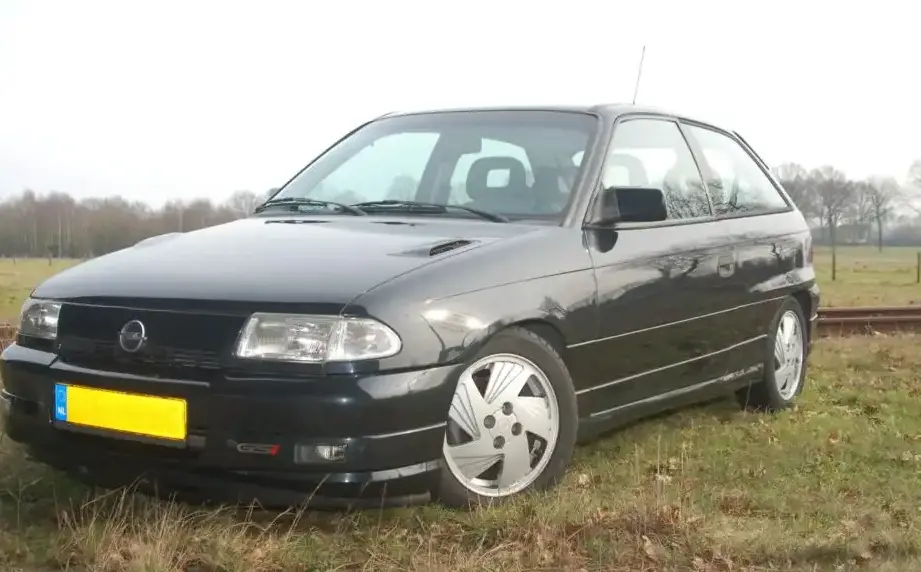
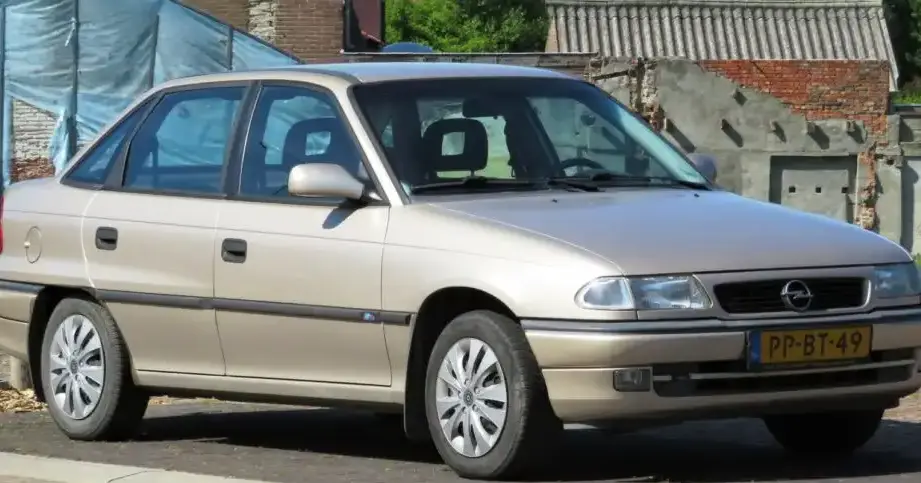
The Opel Astra F Classic 1.7 TD, produced from August 1994 to December 1997, served as an accessible entry point into the Astra range for European buyers prioritizing fuel efficiency and practicality. This variant, powered by a turbocharged diesel engine, was a key component of the refreshed Astra F lineup (commonly known as the Classic), which aimed to improve upon the original F-series design. It occupied the lower end of the performance spectrum, positioned below the gasoline-powered models and the more powerful diesel options, targeting budget-conscious consumers and those valuing economy over speed. The Astra F Classic, as a whole, was a significant model for Opel, building on the success of its predecessor and establishing a strong foothold in the competitive compact car segment.
Powertrain & Engine Architecture
The Astra F Classic 1.7 TD’s engine was the X17DTL, a 1.7-liter inline-four cylinder diesel. This engine employed precombustion chamber injection, a prevalent diesel technology of the time, where fuel is injected into a small pre-chamber before entering the main combustion chamber. This design promotes more complete combustion, especially during cold starts. A turbocharger provided a modest power and torque increase. The single overhead camshaft (SOHC) valvetrain operated two valves per cylinder. A 5-speed manual transmission was standard, selected for its efficiency and affordability. The transmission’s gear ratios were optimized for fuel economy rather than rapid acceleration.
Driving Characteristics
The 1.7 TD version of the Astra F Classic delivered a relaxed driving experience. With 68 horsepower and 132 Nm (97 lb-ft) of torque, acceleration was not particularly quick. 0-60 mph took approximately 15.2 seconds, and the top speed was around 102 mph. The emphasis was on usability and fuel efficiency. The manual transmission, while providing convenience, did highlight the engine’s limited power, resulting in noticeable hesitation during overtaking. Compared to the 1.8-liter gasoline versions, the 1.7 TD offered significantly better fuel economy but considerably slower acceleration. It also differed substantially from the more potent 2.0-liter diesel variants, which provided a more responsive driving experience.
Equipment & Trim Levels
The 1.7 TD Classic typically came with a fairly basic equipment level. Standard features generally included power steering, central locking, and a basic stereo system. Interior upholstery was usually cloth, and the dashboard featured a functional, though somewhat simple, design. Optional extras included air conditioning, electric windows, and upgraded audio systems. The trim level was generally considered entry-level, appealing to buyers prioritizing affordability and practicality. Higher trim levels, available with other engines, offered features like alloy wheels, enhanced interior trim, and more sophisticated audio systems.
Chassis & Braking
The Astra F Classic 1.7 TD utilized a MacPherson strut front suspension and a torsion beam rear suspension. This configuration provided a reasonable compromise between ride comfort and handling. The front brakes were ventilated discs, offering adequate stopping power, while the rear brakes were drums, a cost-saving measure common in this class. Stabilizer bars were typically fitted to both the front and rear axles, helping to minimize body roll during cornering. The suspension was tuned for comfort rather than sporty handling, aligning with the car’s overall focus on practicality and fuel efficiency.
Market Reception & Comparison
The Astra F Classic 1.7 TD was generally well-regarded as an economical and reliable family car. Critics praised its fuel efficiency and low running costs, but acknowledged its modest performance. Compared to the gasoline-powered Astra models, the 1.7 TD offered significantly better fuel economy but slower acceleration. Against competitors like the Volkswagen Golf and Ford Escort, the Astra F Classic 1.7 TD offered a competitive package in terms of price and fuel efficiency. However, some rivals offered more refined interiors or more powerful engine options.
Legacy
The X17DTL engine, while not known for its high performance, proved to be a durable and reliable unit. Many examples of the Astra F Classic 1.7 TD are still on the road today, a testament to its robust construction. In the used car market, these vehicles are often sought after by those looking for an affordable and economical vehicle. Maintenance is generally straightforward, and parts availability remains reasonable. However, potential buyers should be aware of the typical wear and tear associated with older diesel engines, such as turbocharger issues and injector problems. The Astra F Classic 1.7 TD represents a practical and economical choice for those seeking a dependable and affordable compact car from the 1990s.