Technical Specifications
| Brand | Kia |
| Model | Cee’d |
| Generation | Cee’d SW II |
| Type (Engine) | 1.6D 16V CRDi (110 Hp) |
| Start of production | 2012 |
| End of production | 2015 |
| Powertrain Architecture | Internal Combustion engine |
| Body type | Station wagon (estate) |
| Seats | 5 |
| Doors | 5 |
| Fuel consumption (urban) | 5.3 l/100 km (44.4 US mpg, 53.3 UK mpg, 18.9 km/l) |
| Fuel consumption (extra urban) | 4 l/100 km (58.8 US mpg, 70.6 UK mpg, 25 km/l) |
| Fuel consumption (combined) | 4.5 l/100 km (52.3 US mpg, 62.8 UK mpg, 22.2 km/l) |
| Fuel Type | Diesel |
| Acceleration 0 – 100 km/h | 11.8 sec |
| Acceleration 0 – 62 mph | 11.8 sec |
| Acceleration 0 – 60 mph | 11.2 sec |
| Maximum speed | 185 km/h (114.95 mph) |
| Emission standard | Euro 5 |
| Weight-to-power ratio | 12.9 kg/Hp, 77.5 Hp/tonne |
| Weight-to-torque ratio | 5.5 kg/Nm, 183.1 Nm/tonne |
| Power | 110 Hp |
| Power per litre | 69.5 Hp/l |
| Torque | 260 Nm @ 1900 rpm (191.77 lb.-ft. @ 1900 rpm) |
| Engine layout | Front, Transverse |
| Engine Model/Code | D4FB |
| Engine displacement | 1582 cm3 (96.54 cu. in.) |
| Number of cylinders | 4 |
| Engine configuration | Inline |
| Number of valves per cylinder | 4 |
| Fuel injection system | Diesel Commonrail |
| Engine aspiration | Turbocharger, Intercooler |
| Valvetrain | DOHC |
| Engine oil capacity | 5.3 l (5.6 US qt | 4.66 UK qt) |
| Coolant capacity | 6.9 l (7.29 US qt | 6.07 UK qt) |
| Kerb Weight | 1420 kg (3130.56 lbs.) |
| Max. weight | 1920 kg (4232.88 lbs.) |
| Max load | 500 kg (1102.31 lbs.) |
| Trunk (boot) space – minimum | 528 l (18.65 cu. ft.) |
| Trunk (boot) space – maximum | 1642 l (57.99 cu. ft.) |
| Fuel tank capacity | 53 l (14 US gal | 11.66 UK gal) |
| Length | 4505 mm (177.36 in.) |
| Width | 1780 mm (70.08 in.) |
| Height | 1485 mm (58.46 in.) |
| Wheelbase | 2650 mm (104.33 in.) |
| Minimum turning circle | 10.6 m (34.78 ft.) |
| Drivetrain Architecture | Front wheel drive |
| Number of gears | 6 gears, manual transmission |
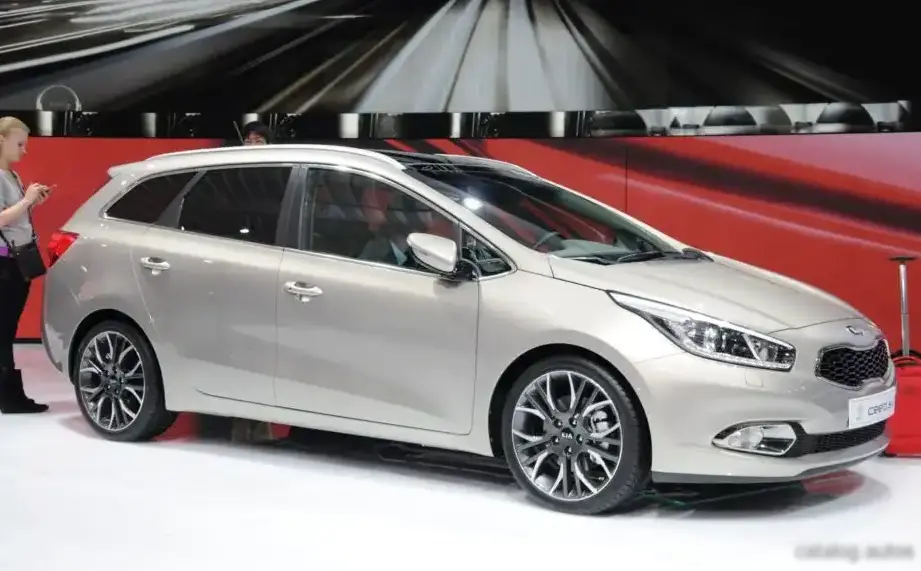
The Kia Cee’d SW II 1.6D 16V CRDi, produced between 2012 and 2015, was a key offering in the European compact estate (station wagon) segment. As part of the second generation Cee’d (JD) model range, the ‘SW’ designation signified Station Wagon, and the vehicle was designed to deliver a blend of practicality and fuel efficiency for families. This particular variant, powered by a 1.6-liter diesel engine producing 110 horsepower, occupied a mid-range position within the Cee’d SW II lineup, aiming to strike a balance between affordability and reasonable performance. It was targeted towards buyers who prioritized economy and cargo space over outright speed and driving excitement.
Powertrain & Engine Architecture
The Cee’d SW II 1.6D’s engine is the D4FB, a 1.6-liter inline-four cylinder diesel. This engine utilizes a second-generation common rail direct injection system, injecting fuel at very high pressures to optimize combustion efficiency. A variable geometry turbocharger (VGT) is employed to enhance low-end torque and improve engine responsiveness across the rev range. An intercooler further cools the intake air, increasing its density and contributing to increased power output. The engine features a double overhead camshaft (DOHC) valvetrain with four valves per cylinder, promoting efficient gas exchange. The 110 horsepower and 260 Nm (191.77 lb-ft) of torque are achieved at a relatively low 1900 rpm, prioritizing drivability and fuel economy. Critically, this variant was exclusively offered with a six-speed manual transmission; an automatic transmission was available on other Cee’d SW II models, but not paired with this specific 1.6D 110 hp engine.
Driving Characteristics
The 1.6D 110 hp Cee’d SW II provides a comfortable and practical driving experience, geared towards everyday usability. Acceleration is adequate, achieving a 0-60 mph time of approximately 11.2 seconds. However, it doesn’t offer the brisk performance of the more powerful 1.6 GDI gasoline engine or the higher-output diesel variants. The engine’s torque delivery is a key strength, providing sufficient pulling power for overtaking maneuvers and navigating inclines. The six-speed manual transmission is well-matched to the engine, allowing drivers to maintain the engine within its optimal power band. Compared to its siblings, the 1.6D 110 hp feels less refined and exhibits more noticeable engine noise, but it delivers significantly superior fuel economy. The gear ratios are tuned for efficiency, resulting in a relaxed and comfortable cruising experience.
Equipment & Trim Levels
The 1.6D 16V CRDi trim typically included standard features such as air conditioning, electric front windows, a radio/CD player with USB connectivity, and ABS brakes. Safety equipment included multiple airbags and stability control. Higher trim levels, designated as ‘3’ or ‘4’, added features like alloy wheels, rear parking sensors, cruise control, and a more advanced infotainment system. Interior upholstery was generally cloth, with options for upgraded materials available on the higher trim levels. Optional extras included a panoramic sunroof, leather seats, and a navigation system.
Chassis & Braking
The Cee’d SW II utilizes a MacPherson strut front suspension and a coupled torsion beam rear suspension. This configuration provides a good compromise between ride comfort and handling characteristics. The front suspension incorporates stabilizer bars to minimize body roll during cornering. Braking systems varied depending on the trim level. Base models typically featured disc brakes on the front wheels and drum brakes on the rear, while higher trims were upgraded to disc brakes on all four wheels. The steering system is a rack and pinion design, offering precise and responsive steering feel.
Market Reception & Comparison
The Kia Cee’d SW II 1.6D 16V CRDi was generally well-received by automotive reviewers for its practicality, fuel efficiency, and competitive pricing. It was frequently praised as a sensible and affordable family vehicle. When compared to competitors like the Ford Focus Estate and Volkswagen Golf Estate, the Cee’d SW II offered a longer warranty and a more generous standard equipment list. Some critics noted that the interior materials weren’t quite as premium as those found in some of its rivals. Fuel economy was a significant selling point, consistently achieving combined figures around 52.3 US mpg. Reliability proved to be good, with few reported issues concerning the 1.6D engine and transmission.
Legacy
The Kia Cee’d SW II 1.6D 16V CRDi continues to be a popular choice in the used car market, particularly for buyers seeking an economical and practical estate car. The D4FB engine is known for its durability and relatively low maintenance costs. While not a performance-focused vehicle, it provides a reliable and practical solution for everyday transportation needs. The Cee’d SW II played a crucial role in establishing Kia as a credible competitor in the European market, demonstrating the brand’s commitment to delivering quality and value to consumers.