
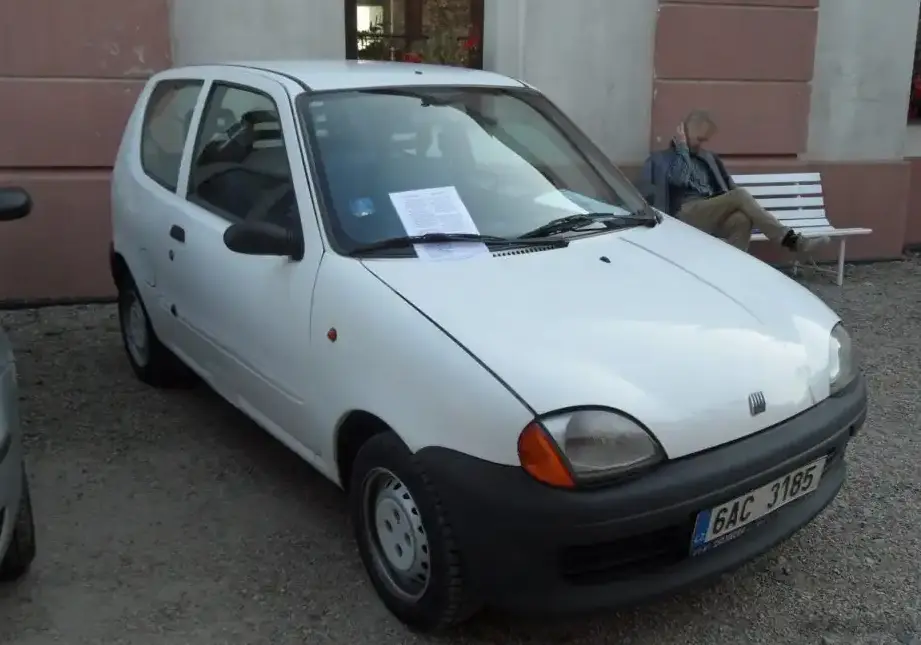
The Fiat Seicento 0.9, produced between 1998 and 2000, represents the entry point into the Seicento (Type 187) model range. Positioned as an affordable and economical city car, it was primarily sold in European markets, particularly Italy, where it aimed to provide basic transportation with minimal running costs. The Seicento itself was a replacement for the Fiat 900, and built upon the foundations of the earlier Fiat Cinquecento, offering a slightly more refined and spacious package. This 0.9-liter variant, with its modest 39 horsepower, was designed for urban environments and drivers prioritizing fuel efficiency over outright performance.
Technical Specifications
| Brand | Fiat |
| Model | Seicento |
| Generation | Seicento (187) |
| Type (Engine) | 0.9 (39 Hp) |
| Start of production | 1998 |
| End of production | 2000 |
| Powertrain Architecture | Internal Combustion engine |
| Body type | Hatchback |
| Seats | 5 |
| Doors | 3 |
| Fuel consumption (urban) | 7.9 l/100 km (29.8 US mpg) |
| Fuel consumption (extra urban) | 5.2 l/100 km (45.2 US mpg) |
| Fuel consumption (combined) | 6.1 l/100 km (38.6 US mpg) |
| Fuel Type | Petrol (Gasoline) |
| Acceleration 0 – 100 km/h | 18 sec |
| Acceleration 0 – 62 mph | 18 sec |
| Acceleration 0 – 60 mph | 17.1 sec |
| Maximum speed | 140 km/h (86.99 mph) |
| Weight-to-power ratio | 18.7 kg/Hp |
| Weight-to-torque ratio | 11.2 kg/Nm |
| Power | 39 Hp @ 5500 rpm |
| Power per litre | 43.4 Hp/l |
| Torque | 65 Nm @ 3000 rpm (47.94 lb.-ft. @ 3000 rpm) |
| Engine layout | Front, Transverse |
| Engine Model/Code | 1170 A1.046 |
| Engine displacement | 899 cm3 (54.86 cu. in.) |
| Number of cylinders | 4 |
| Engine configuration | Inline |
| Cylinder Bore | 65 mm (2.56 in.) |
| Piston Stroke | 67.7 mm (2.67 in.) |
| Compression ratio | 8.8:1 |
| Number of valves per cylinder | 2 |
| Fuel injection system | Multi-port manifold injection |
| Engine aspiration | Naturally aspirated engine |
| Valvetrain | OHC |
| Engine oil capacity | 3.8 l (4.02 US qt | 3.34 UK qt) |
| Coolant capacity | 4.8 l (5.07 US qt | 4.22 UK qt) |
| Kerb Weight | 730 kg (1609.37 lbs.) |
| Max. weight | 1150 kg (2535.32 lbs.) |
| Max load | 420 kg (925.94 lbs.) |
| Trunk (boot) space – minimum | 170 l (6 cu. ft.) |
| Trunk (boot) space – maximum | 810 l (28.6 cu. ft.) |
| Fuel tank capacity | 35 l (9.25 US gal | 7.7 UK gal) |
| Length | 3319 mm (130.67 in.) |
| Width | 1508 mm (59.37 in.) |
| Height | 1440 mm (56.69 in.) |
| Wheelbase | 2200 mm (86.61 in.) |
| Front track | 1277 mm (50.28 in.) |
| Rear track | 1275 mm (50.2 in.) |
| Minimum turning circle | 8.8 m (28.87 ft.) |
| Drivetrain | Front wheel drive |
| Number of gears | 5 gears, manual transmission |
| Front suspension | Spring Strut |
| Rear suspension | Coil spring |
| Front brakes | Disc |
| Rear brakes | Drum |
| Assisting systems | ABS (Anti-lock braking system) |
| Steering type | Steering rack and pinion |
| Tires size | 155/65 R13 |
Powertrain & Engine Architecture
The heart of the Seicento 0.9 is the Fiat 1170 A1.046 engine, a naturally aspirated, inline-four cylinder unit displacing 899cc. This engine is a descendant of the FIRE (Fully Integrated Robotized Engine) family, known for its simplicity and fuel efficiency. It utilizes a single overhead camshaft (OHC) operating two valves per cylinder. Fuel delivery is managed by a multi-port fuel injection system, a relatively modern feature for a car of this class at the time. The engine’s modest output of 39 horsepower at 5500 rpm and 65 Nm (47.94 lb-ft) of torque at 3000 rpm is a direct result of its small displacement and conservative tuning. The engine is transversely mounted, driving the front wheels. The transmission is a standard five-speed manual gearbox, optimized for maximizing fuel economy rather than providing sporty acceleration.
Driving Characteristics
The driving experience in the Seicento 0.9 is best described as utilitarian. Acceleration is slow, taking approximately 18 seconds to reach 62 mph (100 km/h). The engine feels strained at higher speeds, and the car is most comfortable cruising at lower speeds within city limits. The five-speed gearbox helps to keep the engine within its optimal operating range, but frequent downshifts are necessary for overtaking or climbing hills. Compared to higher-spec Seicento models equipped with the 1.1-liter engine, the 0.9 feels significantly underpowered. However, the light weight of the car (around 730 kg or 1609 lbs) mitigates some of the performance deficit. The steering is light and direct, making it easy to maneuver in tight spaces.
Equipment & Trim Levels
The Seicento 0.9 was typically offered with a very basic level of equipment. Standard features generally included front disc brakes, rear drum brakes, a steering wheel, cloth upholstery, and basic instrumentation. Power steering and central locking were often optional extras. Interior trim was functional and durable, prioritizing practicality over luxury. The dashboard layout was simple and straightforward. Optional extras could include a radio, upgraded seat fabrics, and occasionally, air conditioning, though this was rare on the base model.
Chassis & Braking
The Seicento utilizes a simple chassis design. Front suspension consists of MacPherson strut springs, while the rear employs a twist-beam axle with coil springs. This setup provides a comfortable, if somewhat basic, ride quality. The braking system features disc brakes on the front wheels and drum brakes on the rear. ABS (Anti-lock Braking System) was often an optional extra, depending on the market. The relatively light weight of the car helps to compensate for the limited braking power.
Market Reception & Comparison
The Seicento 0.9 was generally well-received as an affordable and economical city car. Critics praised its fuel efficiency and low running costs, but noted its lack of performance. Compared to the 1.1-liter Seicento, the 0.9 offered significantly less power but at a lower purchase price. The 1.1-liter version was considered a more versatile option for drivers who occasionally ventured outside of urban environments. The Seicento 0.9 competed with other small city cars such as the Renault Twingo and the Peugeot 106, offering a similar level of practicality and affordability.
Legacy
The Fiat Seicento 0.9, while not a performance icon, remains a popular choice among budget-conscious drivers and classic car enthusiasts. The FIRE engine is known for its reliability and relatively simple maintenance requirements. Parts availability is generally good, and the car’s straightforward design makes it relatively easy to repair. Today, well-maintained examples of the Seicento 0.9 can be found for very low prices, making them an attractive option for those seeking a cheap and cheerful runabout. However, potential buyers should be aware of the car’s limited performance and basic level of equipment.
