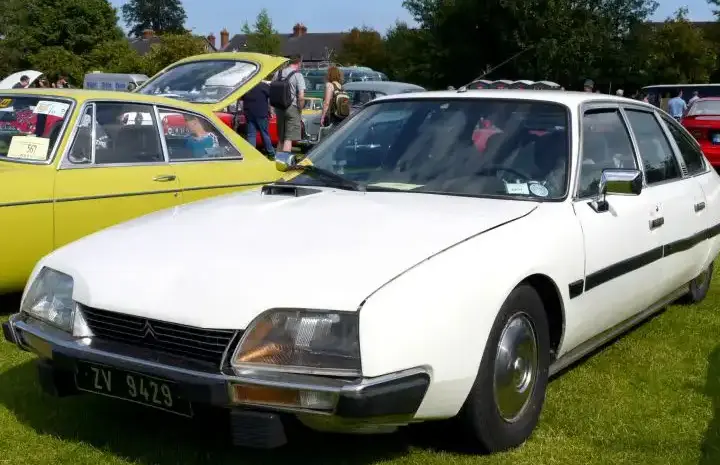
The Citroen CX II 25 GTi, produced between 1985 and 1989, represented a high-performance variant within the second generation (CX II) of Citroen’s innovative CX line. Building upon the already technologically advanced CX, the 25 GTi aimed to deliver a more engaging driving experience while retaining the comfort and unique hydropneumatic suspension system that defined the model. Positioned as the flagship performance trim, it offered a significant step up from the base models and served as a competitor to other European grand tourers of the era. The CX II itself was a continuation of the original CX, launched in 1974, and continued Citroen’s tradition of pushing boundaries in automotive engineering.
Technical Specifications
| Brand | Citroen |
| Model | CX |
| Generation | CX II |
| Type (Engine) | 25 GTi (138 Hp) |
| Start of production | 1985 |
| End of production | 1989 |
| Powertrain Architecture | Internal Combustion engine |
| Body type | Hatchback |
| Seats | 5 |
| Doors | 5 |
| Fuel consumption (urban) | 13.6 l/100 km (17.3 US mpg, 20.8 UK mpg, 7.4 km/l) |
| Fuel consumption (extra urban) | 7.3 l/100 km (32.2 US mpg, 38.7 UK mpg, 13.7 km/l) |
| Fuel consumption (combined) | 10 l/100 km (23.5 US mpg, 28.2 UK mpg, 10 km/l) |
| Fuel Type | Petrol (Gasoline) |
| Acceleration 0 – 100 km/h | 9.7 sec |
| Acceleration 0 – 62 mph | 9.7 sec |
| Acceleration 0 – 60 mph | 9.2 sec |
| Maximum speed | 201 km/h (124.9 mph) |
| Weight-to-power ratio | 9.9 kg/Hp, 100.7 Hp/tonne |
| Weight-to-torque ratio | 6.5 kg/Nm, 154 Nm/tonne |
| Power | 138 Hp @ 5000 rpm |
| Power per litre | 55.2 Hp/l |
| Torque | 211 Nm @ 4000 rpm (155.63 lb.-ft. @ 4000 rpm) |
| Maximum engine speed | 6000 rpm |
| Engine layout | Front, Transverse |
| Engine Model/Code | M25.659 |
| Engine displacement | 2500 cm3 (152.56 cu. in.) |
| Number of cylinders | 4 |
| Engine configuration | Inline |
| Cylinder Bore | 93 mm (3.66 in.) |
| Piston Stroke | 92 mm (3.62 in.) |
| Compression ratio | 8.75:1 |
| Number of valves per cylinder | 2 |
| Fuel injection system | Multi-port manifold injection |
| Engine aspiration | Naturally aspirated engine |
| Engine oil capacity | 5.5 l (5.81 US qt | 4.84 UK qt) |
| Coolant | 12.5 l (13.21 US qt | 11 UK qt) |
| Kerb Weight | 1370 kg (3020.33 lbs.) |
| Max. weight | 1885 kg (4155.71 lbs.) |
| Max load | 515 kg (1135.38 lbs.) |
| Trunk (boot) space – minimum | 485 l (17.13 cu. ft.) |
| Trunk (boot) space – maximum | 507 l (17.9 cu. ft.) |
| Fuel tank capacity | 68 l (17.96 US gal | 14.96 UK gal) |
| Max. roof load | 80 kg (176.37 lbs.) |
| Permitted trailer load with brakes (12%) | 1300 kg (2866.01 lbs.) |
| Permitted trailer load without brakes | 685 kg (1510.17 lbs.) |
| Permitted towbar download | 100 kg (220.46 lbs.) |
| Length | 4650 mm (183.07 in.) |
| Width | 1770 mm (69.69 in.) |
| Height | 1360 mm (53.54 in.) |
| Wheelbase | 2845 mm (112.01 in.) |
| Front track | 1520 mm (59.84 in.) |
| Rear (Back) track | 1370 mm (53.94 in.) |
| Ride height (ground clearance) | 160 mm (6.3 in.) |
| Drag coefficient (Cd) | 0.35 |
| Minimum turning circle (turning diameter) | 12.50 m (41.01 ft.) |
| Drivetrain Architecture | The Internal combustion engine (ICE) drives the front wheels of the vehicle. |
| Drive wheel | Front wheel drive |
| Number of gears and type of gearbox | 5 gears, manual transmission |
| Front suspension | Hydro-pneumatic element |
| Rear suspension | Hydro-pneumatic element |
| Front brakes | Ventilated discs |
| Rear brakes | Disc |
| Assisting systems | ABS (Anti-lock braking system) |
| Steering type | Steering rack and pinion |
| Power steering | Hydraulic Steering |
| Tires size | 195/70 R14 |
| Wheel rims size | 5.5J x 14 |
Powertrain & Engine Architecture
The heart of the CX II 25 GTi was the M25.659 2.5-liter inline-four cylinder engine. This engine, a mainstay of Peugeot-Citroen group vehicles of the era, featured a cast iron block and an aluminum cylinder head. It utilized a Bosch multi-port fuel injection system, providing precise fuel delivery for improved efficiency and performance. The engine’s 8.75:1 compression ratio was a compromise between performance and the fuel quality available in European markets. The valvetrain employed a single overhead camshaft (SOHC) operating two valves per cylinder. The engine was transversely mounted, contributing to the CX’s front-wheel-drive layout. The 25 GTi was exclusively offered with a five-speed manual transmission, designed to handle the engine’s output and provide a more engaging driving experience than the optional three-speed automatic available on lower trims.
Driving Characteristics
The CX II 25 GTi offered a unique driving experience, largely defined by Citroen’s hydropneumatic suspension. This system provided an exceptionally smooth ride, absorbing bumps and imperfections in the road with remarkable effectiveness. The 138 horsepower engine, while not overwhelming by modern standards, provided brisk acceleration, achieving 0-60 mph in approximately 9.2 seconds. Torque of 211 Nm (155.63 lb-ft) at 4000 rpm provided good mid-range punch, making the car feel responsive in everyday driving situations. The five-speed manual transmission allowed drivers to keep the engine in its optimal power band. Compared to the base 1.6-liter and 2.0-liter models, the 25 GTi offered a significantly more spirited driving experience. While the automatic transmission options in other CX II trims prioritized comfort, the 25 GTi’s manual gearbox catered to enthusiasts seeking greater control.
Equipment & Trim Levels
The 25 GTi trim level was well-equipped for its time. Standard features included power steering, ABS anti-lock brakes, and comfortable cloth upholstery. The interior featured a distinctive Citroen dashboard layout with a prominent instrument cluster. Optional extras included leather upholstery, air conditioning, and a sunroof. The 25 GTi also featured unique exterior styling cues, such as alloy wheels and a rear spoiler, differentiating it from other CX II models. The overall interior design prioritized ergonomics and driver comfort, reflecting Citroen’s commitment to providing a refined driving experience.
Chassis & Braking
The CX II utilized a robust chassis designed to accommodate the hydropneumatic suspension system. The front suspension employed a complex arrangement of hydraulic spheres and dampers, providing self-leveling and adjustable ride height. The rear suspension mirrored this design. Braking duties were handled by ventilated discs at the front and solid discs at the rear, providing adequate stopping power for the car’s weight and performance. The ABS system further enhanced braking safety. The steering system utilized a rack-and-pinion setup with hydraulic power assistance, offering precise and responsive steering feel.
Market Reception & Comparison
The Citroen CX II 25 GTi was generally well-received by automotive critics, who praised its comfortable ride, innovative suspension system, and engaging driving dynamics. However, some critics noted that the car’s styling was polarizing and that its complex hydropneumatic system could be expensive to maintain. Compared to other grand tourers of the era, such as the BMW 5 Series and the Mercedes-Benz E-Class, the CX II 25 GTi offered a unique blend of comfort and performance. Its fuel economy was comparable to its competitors, averaging around 23.5 US mpg in combined driving. Reliability was a mixed bag, with the hydropneumatic suspension requiring periodic maintenance and potential repairs.
Legacy
The Citroen CX II 25 GTi remains a sought-after classic car among enthusiasts. Its innovative technology, comfortable ride, and distinctive styling have earned it a dedicated following. The hydropneumatic suspension system, while complex, is widely regarded as a masterpiece of automotive engineering. Today, well-maintained examples of the 25 GTi command a premium in the used car market. While the hydropneumatic system requires specialized knowledge for maintenance and repair, the car’s unique driving experience and enduring appeal continue to attract collectors and enthusiasts alike. The M25 engine, while robust, can suffer from age-related issues, requiring careful inspection and maintenance to ensure long-term reliability.