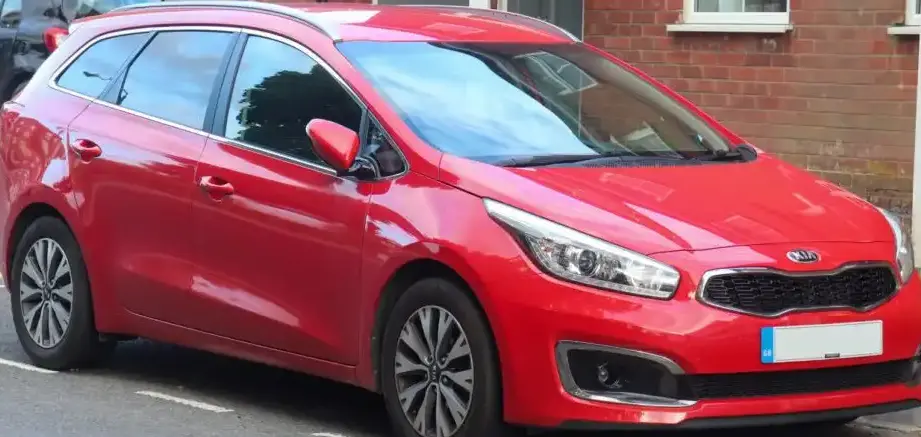
The Kia Cee’d SW II (facelift 2015) 1.6 CRDI 136 Hp ISG DCT represents a significant iteration within the second generation of Kia’s compact estate car. Produced from June 2015 through 2018, this variant aimed to balance fuel efficiency, practicality, and a more refined driving experience compared to lower-spec models. It occupied a mid-range position in the Cee’d SW lineup, offering a step up in performance and features from the base 1.4L petrol engine while remaining more accessible than the higher-output diesel options. The Cee’d SW, in general, was Kia’s offering in the competitive European C-segment, designed to appeal to families and individuals seeking a versatile and affordable vehicle.
Technical Specifications
| Brand | Kia |
| Model | Cee’d |
| Generation | Cee’d SW II (facelift 2015) |
| Type (Engine) | 1.6 CRDI (136 Hp) ISG DCT |
| Start of production | June, 2015 |
| End of production | 2018 |
| Powertrain Architecture | Internal Combustion engine |
| Body type | Station wagon (estate) |
| Seats | 5 |
| Doors | 5 |
| Fuel consumption (urban) | 4.6 l/100 km (51.1 US mpg, 61.4 UK mpg, 21.7 km/l) |
| Fuel consumption (extra urban) | 3.9 l/100 km (60.3 US mpg, 72.4 UK mpg, 25.6 km/l) |
| Fuel consumption (combined) | 4.2 l/100 km (56 US mpg, 67.3 UK mpg, 23.8 km/l) |
| CO2 emissions | 109 g/km |
| Fuel Type | Diesel |
| Acceleration 0 – 100 km/h | 10.9 sec |
| Acceleration 0 – 62 mph | 10.9 sec |
| Acceleration 0 – 60 mph | 10.4 sec |
| Maximum speed | 197 km/h (122.41 mph) |
| Emission standard | Euro 6 |
| Weight-to-power ratio | 9.9 kg/Hp, 101.4 Hp/tonne |
| Weight-to-torque ratio | 4.5 kg/Nm, 223.7 Nm/tonne |
| Power | 136 Hp @ 4000 rpm |
| Power per litre | 86 Hp/l |
| Torque | 300 Nm @ 1750-2500 rpm (221.27 lb.-ft. @ 1750-2500 rpm) |
| Engine layout | Front, Transverse |
| Engine Model/Code | D4FB |
| Engine displacement | 1582 cm3 (96.54 cu. in.) |
| Number of cylinders | 4 |
| Engine configuration | Inline |
| Cylinder Bore | 77.2 mm (3.04 in.) |
| Piston Stroke | 84.5 mm (3.33 in.) |
| Compression ratio | 16:1 |
| Number of valves per cylinder | 4 |
| Fuel injection system | Diesel Commonrail |
| Engine aspiration | Turbocharger, Intercooler |
| Engine oil capacity | 5.3 l (5.6 US qt | 4.66 UK qt) |
| Coolant | 6.7 l (7.08 US qt | 5.9 UK qt) |
| Kerb Weight | 1341-1475 kg (2956.4 – 3251.82 lbs.) |
| Max. weight | 1940 kg (4276.97 lbs.) |
| Max load | 465-599 kg (1025.15 – 1320.57 lbs.) |
| Trunk (boot) space – minimum | 528 l (18.65 cu. ft.) |
| Trunk (boot) space – maximum | 1642 l (57.99 cu. ft.) |
| Fuel tank capacity | 53 l (14 US gal | 11.66 UK gal) |
| Max. roof load | 80 kg (176.37 lbs.) |
| Permitted trailer load with brakes (12%) | 1500 kg (3306.93 lbs.) |
| Permitted trailer load without brakes | 650 kg (1433 lbs.) |
| Permitted towbar download | 75 kg (165.35 lbs.) |
| Length | 4505 mm (177.36 in.) |
| Width | 1780 mm (70.08 in.) |
| Width including mirrors | 2035 mm (80.12 in.) |
| Height | 1485 mm (58.46 in.) |
| Wheelbase | 2650 mm (104.33 in.) |
| Front track | 1549-1555 mm (60.98 – 61.22 in.) |
| Rear (Back) track | 1557-1563 mm (61.3 – 61.54 in.) |
| Front overhang | 900 mm (35.43 in.) |
| Rear overhang | 955 mm (37.6 in.) |
| Minimum turning circle | 10.6 m (34.78 ft.) |
| Drivetrain Architecture | Front wheel drive |
| Number of gears and type of gearbox | 7 gears, automatic transmission DCT |
| Front suspension | Independent type McPherson |
| Rear suspension | Independent multi-link suspension |
| Front brakes | Ventilated discs, 280-300 mm |
| Rear brakes | Disc, 262-284 mm |
| Tires size | 205/55 R16 91H; 225/45 R17 91V |
| Wheel rims size | 6; 5J x 16 ET50; 7; 0J x 17 ET53 |
INTRODUCTION
The Kia Cee’d SW II, particularly the facelifted version introduced in 2015, represented a maturing of Kia’s design and engineering capabilities. Built on the 1HX0/A3 platform shared with the Hyundai i30, the Cee’d SW aimed to provide a practical and stylish alternative to established European rivals. The 1.6 CRDI variant with 136 horsepower and a dual-clutch transmission (DCT) was positioned as a sweet spot in the range, offering a good balance of performance, fuel economy, and refinement. The “ISG” designation indicates the inclusion of Kia’s Idle Stop & Go system, further enhancing fuel efficiency in urban driving conditions.
Powertrain & Engine Architecture
At the heart of this Cee’d SW variant lies the D4FB 1.6-liter four-cylinder diesel engine. This engine is a common rail direct injection (CRDI) unit, utilizing a Bosch-supplied system for precise fuel delivery. The D4FB engine benefits from a turbocharger with an intercooler, which helps to boost power and torque while mitigating turbo lag. The engine produces 136 horsepower at 4,000 rpm and a substantial 300 Nm (221 lb-ft) of torque between 1750 and 2500 rpm. This broad torque curve contributes to strong mid-range acceleration and effortless cruising. The engine features four valves per cylinder and a compression ratio of 16:1. Paired with the engine is a seven-speed dual-clutch transmission (DCT). This DCT provides quicker and smoother gear changes compared to a traditional automatic transmission, contributing to a more engaging driving experience and improved fuel efficiency. The DCT also features a manual shift mode for greater driver control.
Driving Characteristics
The 1.6 CRDI 136 Hp DCT Cee’d SW delivers a composed and comfortable driving experience. Acceleration from 0 to 100 km/h (0-62 mph) takes approximately 10.9 seconds, which is respectable for a diesel estate. The DCT transmission contributes to brisk gear changes, and the engine’s strong torque output makes overtaking at highway speeds relatively effortless. Compared to the lower-powered 1.4L petrol version, the 1.6 CRDI offers significantly more pulling power, especially when fully loaded. While not as sporty as the higher-output diesel variants, the 136 hp version provides a good balance of performance and economy. The gear ratios are tuned for fuel efficiency, with taller gearing in higher gears to reduce engine speed at cruising speeds. The steering is light and precise, making it easy to maneuver in urban environments.
Equipment & Trim Levels
The 1.6 CRDI 136 Hp ISG DCT trim typically included a generous level of standard equipment. Features commonly found in this variant include air conditioning, electric front and rear windows, a touchscreen infotainment system with Bluetooth connectivity, and alloy wheels. Safety features such as ABS, ESC (Electronic Stability Control), and multiple airbags were also standard. Higher trim levels offered additional features such as a panoramic sunroof, leather upholstery, heated front seats, and a more advanced infotainment system with navigation. The interior typically featured a dark cloth upholstery and a functional, if not overly luxurious, dashboard design.
Chassis & Braking
The Cee’d SW II utilizes a McPherson strut front suspension and a multi-link rear suspension. This setup provides a good balance of ride comfort and handling. The suspension is tuned to prioritize comfort, but it still offers decent body control in corners. The front brakes are ventilated discs, ranging from 280-300mm in size, while the rear brakes are solid discs measuring 262-284mm. ABS (Anti-lock Braking System) is standard, providing enhanced braking performance and stability. The steering is a rack and pinion system, offering precise and responsive steering feel.
Market Reception & Comparison
The Kia Cee’d SW II 1.6 CRDI 136 Hp ISG DCT was generally well-received by automotive critics. It was praised for its fuel efficiency, spacious interior, and comfortable ride. Compared to rivals such as the Ford Focus Estate and Volkswagen Golf Estate, the Cee’d SW offered a competitive price point and a longer warranty. The 1.6 CRDI engine was considered a good compromise between performance and economy, although some reviewers noted that it wasn’t as refined as some of its competitors. The DCT transmission was generally praised for its smoothness and responsiveness. Fuel economy figures of around 4.2 l/100 km (56 US mpg) were consistently achieved in real-world testing.
Legacy
The Kia Cee’d SW II 1.6 CRDI 136 Hp ISG DCT has proven to be a reliable and durable vehicle. The D4FB engine, while not without its potential issues (such as diesel particulate filter clogging), is generally considered a robust unit when properly maintained. The DCT transmission has also proven to be relatively reliable, although regular servicing is essential. In the used car market, this variant represents a good value proposition, offering a practical and fuel-efficient estate car at an affordable price. Its spacious interior, comfortable ride, and generous equipment levels make it a popular choice for families and individuals seeking a versatile vehicle.