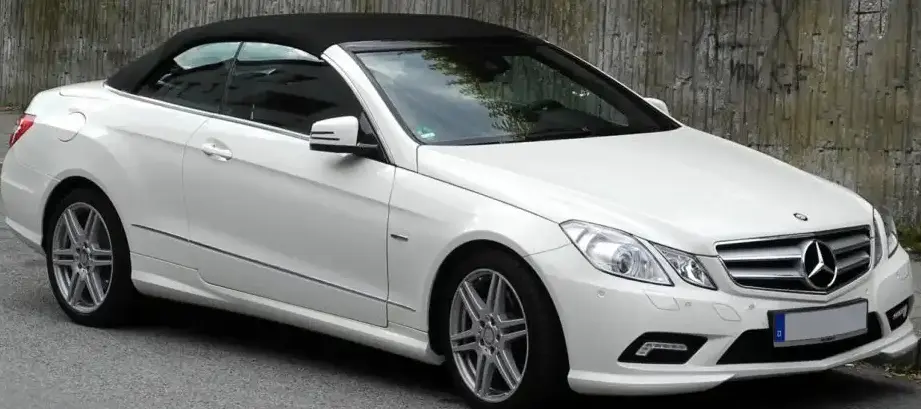
The Mercedes-Benz E-Class Cabriolet (A207) E 250 CGI BlueEFFICIENCY, produced from March 2010 to April 2011, represented a compelling entry point into the luxurious world of open-top E-Class motoring. Positioned as a mid-range offering within the A207 generation, this variant combined a turbocharged 1.8-liter four-cylinder engine with the smooth shifting 5G-TRONIC automatic transmission. It aimed to deliver a balance of performance, efficiency, and comfort, appealing to buyers seeking a stylish and refined convertible experience without the higher price tag of the more powerful E 350 or E 550 models.
Technical Specifications
| Brand | Mercedes-Benz |
| Model | E-Class |
| Generation | E-Class Cabrio (A207) |
| Type (Engine) | E 250 CGI BlueEFFICIENCY (204 Hp) 5G-TRONIC |
| Start of production | March, 2010 |
| End of production | April, 2011 |
| Powertrain Architecture | Internal Combustion engine |
| Body type | Cabriolet |
| Seats | 4 |
| Doors | 2 |
| Fuel consumption (urban) | 11-11.2 l/100 km (21.4 – 21 US mpg, 25.7 – 25.2 UK mpg, 9.1 – 8.9 km/l) |
| Fuel consumption (extra urban) | 6.1-6.4 l/100 km (38.6 – 36.8 US mpg, 46.3 – 44.1 UK mpg, 16.4 – 15.6 km/l) |
| Fuel consumption (combined) | 7.9-8.2 l/100 km (29.8 – 28.7 US mpg, 35.8 – 34.4 UK mpg, 12.7 – 12.2 km/l) |
| CO2 emissions | 185-190 g/km |
| Fuel Type | Petrol (Gasoline) |
| Acceleration 0 – 100 km/h | 7.8 sec |
| Acceleration 0 – 62 mph | 7.8 sec |
| Acceleration 0 – 60 mph | 7.4 sec |
| Maximum speed | 240 km/h (149.13 mph) |
| Emission standard | Euro 5 |
| Weight-to-power ratio | 7.9 kg/Hp, 125.9 Hp/tonne |
| Weight-to-torque ratio | 5.2 kg/Nm, 191.4 Nm/tonne |
| Power | 204 Hp @ 5500 rpm |
| Power per litre | 113.6 Hp/l |
| Torque | 310 Nm @ 2000-4300 rpm (228.64 lb.-ft. @ 2000-4300 rpm) |
| Engine layout | Front, Longitudinal |
| Engine Model/Code | M 271.860 |
| Engine displacement | 1796 cm3 (109.6 cu. in.) |
| Number of cylinders | 4 |
| Engine configuration | Inline |
| Cylinder Bore | 82 mm (3.23 in.) |
| Piston Stroke | 85 mm (3.35 in.) |
| Compression ratio | 9.3:1 |
| Number of valves per cylinder | 4 |
| Fuel injection system | Direct injection |
| Engine aspiration | Turbocharger, Intercooler |
| Valvetrain | DOHC |
| Engine oil capacity | 5.5 l (5.81 US qt | 4.84 UK qt) |
| Coolant | 7.2 l (7.61 US qt | 6.34 UK qt) |
| Kerb Weight | 1620 kg (3571.49 lbs.) |
| Max. weight | 2165 kg (4773.01 lbs.) |
| Max load | 545 kg (1201.52 lbs.) |
| Trunk (boot) space – minimum | 300 l (10.59 cu. ft.) |
| Trunk (boot) space – maximum | 390 l (13.77 cu. ft.) |
| Fuel tank capacity | 66 l (17.44 US gal | 14.52 UK gal) |
| Permitted trailer load with brakes (12%) | 1800 kg (3968.32 lbs.) |
| Permitted trailer load without brakes | 750 kg (1653.47 lbs.) |
| Permitted towbar download | 75 kg (165.35 lbs.) |
| Length | 4698 mm (184.96 in.) |
| Width | 1786 mm (70.31 in.) |
| Width including mirrors | 2015 mm (79.33 in.) |
| Height | 1398 mm (55.04 in.) |
| Wheelbase | 2760 mm (108.66 in.) |
| Front track | 1538 mm (60.55 in.) |
| Rear track | 1544 mm (60.79 in.) |
| Front overhang | 855 mm (33.66 in.) |
| Rear overhang | 1083 mm (42.64 in.) |
| Drag coefficient (Cd) | 0.28 |
| Minimum turning circle | 11 m (36.09 ft.) |
| Drivetrain Architecture | Rear wheel drive |
| Number of gears and type of gearbox | 5 gears, automatic transmission G-TRONIC |
| Front suspension | Coil spring, Independent multi-link suspension, Transverse stabilizer |
| Rear suspension | Independent multi-link spring suspension with stabilizer |
| Front brakes | Ventilated discs, 295 mm |
| Rear brakes | Disc, 300 mm |
| Assisting systems | ABS (Anti-lock braking system) |
| Steering type | Steering rack and pinion |
| Power steering | Hydraulic Steering |
| Tires size (Front) | 235/45 R17; 235/40 R18; 235/35 R19 |
| Tires size (Rear) | 235/45 R17; 255/40 R17; 255/35 R18; 255/30 R19 |
| Wheel rims size (Front) | 7.5J x 17; 8J x 18; 8J x 19; 8.5J x 19 |
| Wheel rims size (Rear) | 7.5J x 17; 8.5J x 17; 8.5J x 18; 8.5J x 19 |
INTRODUCTION
The A207 E-Class Cabriolet, launched in 2010, brought open-air luxury to the Mercedes-Benz lineup. The E 250 CGI BlueEFFICIENCY variant, powered by a 1.8-liter turbocharged engine and paired with a 5G-TRONIC automatic transmission, served as a more accessible entry point into the range. It was built on the W204 chassis, specifically adapted for convertible duty (A207). This model aimed to provide a balance between performance, fuel economy, and the prestige associated with the E-Class badge. It occupied a space below the more powerful E 350 and E 550 Cabriolets, targeting buyers who prioritized efficiency and a comfortable driving experience over outright speed.
Powertrain & Engine Architecture
At the heart of the E 250 CGI BlueEFFICIENCY lies the M271.860 engine, a 1.8-liter inline-four cylinder powerplant. This engine utilizes direct fuel injection and a turbocharger with an intercooler to deliver 204 horsepower at 5500 rpm and 310 Nm (228.64 lb.-ft.) of torque between 2000 and 4300 rpm. The “CGI” designation stands for “Charged Gasoline Injection,” highlighting the direct injection system. The engine features a double overhead camshaft (DOHC) valvetrain with four valves per cylinder. The 5G-TRONIC automatic transmission, a five-speed unit, was specifically tuned to complement the engine’s characteristics, providing smooth and responsive gear changes. This transmission was known for its comfort and efficiency, though it lacked the sportiness of some newer automatic transmissions with more gears.
Driving Characteristics
The E 250 CGI BlueEFFICIENCY Cabriolet offered a comfortable and refined driving experience. While not as quick as its larger-engined siblings, the 1.8-liter turbo provided adequate power for everyday driving and cruising. Acceleration from 0 to 60 mph took approximately 7.4 seconds, and the car could reach a top speed of 149.13 mph. The 5G-TRONIC transmission contributed to a relaxed driving style, with well-spaced gear ratios. Compared to a manual transmission equipped E-Class, the automatic prioritized ease of use over driver engagement. The turbocharger did provide a noticeable boost in power, but the engine lacked the immediate responsiveness of naturally aspirated engines. The rear-wheel drive configuration offered balanced handling, though it wasn’t particularly sporty.
Equipment & Trim Levels
The E 250 CGI BlueEFFICIENCY Cabriolet came standard with a generous array of features, befitting its luxury positioning. Standard equipment typically included leather upholstery, automatic climate control, a premium sound system, and power-adjustable seats. The A207 also featured Mercedes’ AIRCAP system, which reduced turbulence in the cabin at higher speeds with an extendable wind deflector. Optional extras included navigation, upgraded sound systems, parking assist, and various interior trim options. Interior color schemes were typically conservative, with a focus on elegance and sophistication. The dashboard layout was consistent with other A207 models, featuring a blend of analog gauges and a central infotainment screen.
Chassis & Braking
The A207 Cabriolet utilized a robust chassis designed to provide rigidity and handling stability. The front suspension featured coil springs and an independent multi-link setup with a transverse stabilizer bar. The rear suspension employed an independent multi-link spring suspension, also with a stabilizer bar. Braking duties were handled by ventilated discs at the front and solid discs at the rear. Anti-lock braking system (ABS) was standard. The suspension tuning prioritized comfort over outright sportiness, providing a smooth ride even on uneven surfaces. The steering was hydraulic power-assisted, offering a balanced feel.
Market Reception & Comparison
The E 250 CGI BlueEFFICIENCY Cabriolet was generally well-received by critics as a sensible and stylish option within the E-Class range. It was praised for its comfortable ride, refined interior, and relatively good fuel economy. However, some reviewers noted that the 1.8-liter engine lacked the punch of the larger engines available in the E-Class lineup. Compared to the E 350 Cabriolet, the E 250 offered lower running costs but sacrificed performance. Against competitors like the BMW 3 Series Convertible and Audi A5 Cabriolet, the E 250 offered a more luxurious and comfortable experience, but potentially at the expense of driving dynamics.
Legacy
The M271 engine, while generally reliable, can be prone to issues with the timing chain tensioner and oil leaks over time. The 5G-TRONIC transmission is also known to be durable, but regular fluid changes are crucial for maintaining its longevity. Today, the E 250 CGI BlueEFFICIENCY Cabriolet represents an affordable entry point into Mercedes-Benz open-top motoring. Well-maintained examples are still relatively common on the used car market, offering a blend of style, comfort, and reliability. Its relatively simple engine and transmission compared to newer models make it potentially easier and less expensive to maintain, appealing to enthusiasts seeking a classic Mercedes-Benz experience.