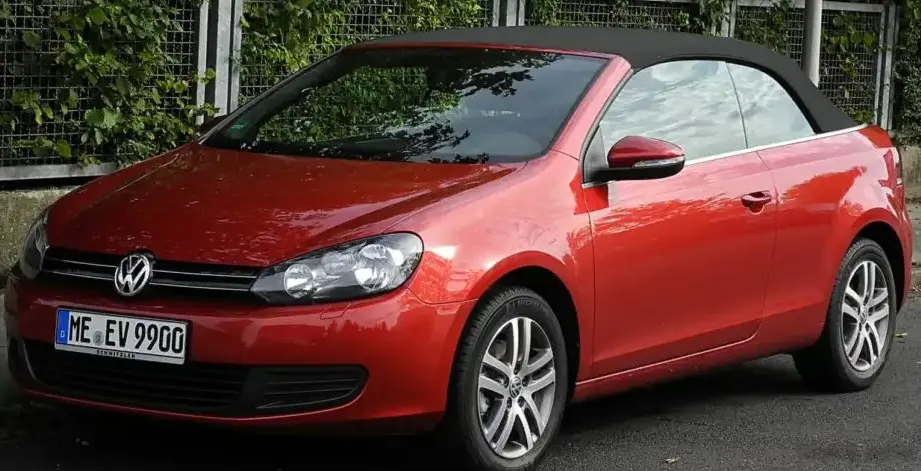
Technical Specifications
| Brand | Volkswagen |
| Model | Golf |
| Generation | Golf VI Cabriolet |
| Type (Engine) | 1.6 TDI (105 Hp) |
| Start of production | 2011 |
| End of production | 2015 |
| Powertrain Architecture | Internal Combustion engine |
| Body type | Cabriolet |
| Seats | 4 |
| Doors | 2 |
| Fuel consumption (urban) | 5.6 l/100 km (42 US mpg, 50.4 UK mpg, 17.9 km/l) |
| Fuel consumption (extra urban) | 4.3 l/100 km (54.7 US mpg, 65.7 UK mpg, 23.3 km/l) |
| Fuel consumption (combined) | 4.8 l/100 km (49 US mpg, 58.9 UK mpg, 20.8 km/l) |
| CO2 emissions | 125 g/km |
| Fuel Type | Diesel |
| Acceleration 0 – 100 km/h | 12.1 sec |
| Acceleration 0 – 62 mph | 12.1 sec |
| Acceleration 0 – 60 mph | 11.5 sec |
| Maximum speed | 188 km/h (116.82 mph) |
| Emission standard | Euro 5 |
| Weight-to-power ratio | 14.3 kg/Hp, 70.1 Hp/tonne |
| Weight-to-torque ratio | 6 kg/Nm, 166.9 Nm/tonne |
| Power | 105 Hp @ 4400 rpm |
| Power per litre | 65.7 Hp/l |
| Torque | 250 Nm @ 1500-2500 rpm (184.39 lb.-ft. @ 1500-2500 rpm) |
| Engine layout | Front, Transverse |
| Engine Model/Code | CAYC |
| Engine displacement | 1598 cm3 (97.52 cu. in.) |
| Number of cylinders | 4 |
| Engine configuration | Inline |
| Number of valves per cylinder | 4 |
| Fuel injection system | Diesel Commonrail |
| Engine aspiration | Turbocharger, Intercooler |
| Engine oil capacity | 4.3 l (4.54 US qt | 3.78 UK qt) |
| Kerb Weight | 1498 kg (3302.52 lbs) |
| Max. weight | 1920 kg (4232.88 lbs) |
| Max load | 422 kg (930.35 lbs) |
| Trunk (boot) space – minimum | 250 l (8.83 cu. ft.) |
| Fuel tank capacity | 55 l (14.53 US gal | 12.1 UK gal) |
| Length | 4246 mm (167.17 in) |
| Width | 1782 mm (70.16 in) |
| Height | 1423 mm (56.02 in) |
| Wheelbase | 2578 mm (101.5 in) |
| Front track | 1535 mm (60.43 in) |
| Rear (Back) track | 1508 mm (59.37 in) |
| Minimum turning circle | 10.9 m (35.76 ft) |
| Drivetrain Architecture | The Internal combustion engine (ICE) drives the front wheels of the vehicle. |
| Drive wheel | Front wheel drive |
| Number of gears and type of gearbox | 5 gears, manual transmission |
| Front brakes | Ventilated discs |
| Assisting systems | ABS (Anti-lock braking system) |
| Steering type | Steering rack and pinion |
| Tires size | 205/55 R16 |
| Wheel rims size | 6.5J x 16 |
The Golf VI Cabriolet, launched in 2011, represented the sixth generation of Volkswagen’s popular open-top Golf. Building upon the success of previous generations, the VI Cabriolet offered a blend of style, practicality, and driving enjoyment. The 1.6 TDI 105 hp variant served as the entry point to the range, appealing to buyers seeking a fuel-efficient and affordable convertible. It was built on the A5 platform, shared with the Golf Mk6 and other Volkswagen Group vehicles. This generation saw a significant improvement in structural rigidity compared to its predecessor, enhancing both safety and driving dynamics.
Powertrain & Engine Architecture
The heart of the Golf VI Cabriolet 1.6 TDI was the CAYC engine, a 1.6-liter inline-four cylinder diesel engine. This engine utilized a common rail direct injection system, delivering fuel directly into the combustion chamber at extremely high pressure for improved efficiency and reduced emissions. A turbocharger with an intercooler was employed to boost power output, providing 105 horsepower at 4400 rpm and a respectable 250 Nm (184 lb-ft) of torque between 1500 and 2500 rpm. The engine featured four valves per cylinder and adhered to Euro 5 emission standards. The engine was transversely mounted at the front of the vehicle. The 1.6 TDI was typically paired with a five-speed manual transmission, although a seven-speed DSG dual-clutch transmission was available as an option. The manual gearbox was chosen to maximize fuel economy and keep the entry price point competitive.
Driving Characteristics
The 1.6 TDI 105 hp Golf VI Cabriolet offered a relaxed and economical driving experience. Acceleration was not its strong suit, taking approximately 12.1 seconds to reach 62 mph (100 km/h). However, the readily available torque from the diesel engine provided sufficient power for everyday driving and comfortable cruising. The five-speed manual transmission was well-matched to the engine’s characteristics, allowing for smooth gear changes. Compared to the more powerful petrol variants, the 1.6 TDI felt noticeably slower, particularly when fully loaded or tackling steep inclines. However, the lower weight of the diesel engine compared to the larger petrol engines did contribute to slightly improved handling balance. The soft-top mechanism did add some weight, but the chassis was well-tuned to minimize body roll.
Equipment & Trim Levels
The 1.6 TDI variant of the Golf VI Cabriolet typically came with a reasonable level of standard equipment. This included power windows, central locking, air conditioning, and an audio system with CD player. Safety features such as ABS, traction control, and front airbags were also standard. Interior upholstery was typically cloth, with options for upgraded materials available. Trim levels varied depending on the market, but common options included alloy wheels, parking sensors, and a multi-function steering wheel. The dashboard layout was typical of the Golf VI, with a functional and ergonomic design. The convertible top was manually operated on the base models, with an electro-hydraulic folding mechanism available as an upgrade.
Chassis & Braking
The Golf VI Cabriolet utilized a MacPherson strut front suspension and a multi-link rear suspension, providing a comfortable ride and good handling characteristics. The front brakes were ventilated discs, while the rear brakes were typically solid discs on higher trim levels, but drums on the base 1.6 TDI model to reduce cost. ABS (Anti-lock Braking System) was standard, enhancing braking performance and stability. The steering was a rack and pinion system, providing precise and responsive control. Stabilizer bars were fitted to both the front and rear axles to minimize body roll during cornering. The suspension was tuned to provide a balance between comfort and handling, making it suitable for both city driving and longer journeys.
Market Reception & Comparison
The Golf VI Cabriolet 1.6 TDI was generally well-received by automotive critics as a practical and economical convertible option. Its fuel efficiency was a major selling point, particularly in Europe where diesel fuel was often cheaper than petrol. However, some reviewers criticized its relatively slow acceleration compared to the more powerful petrol variants. Compared to the 1.4 TSI petrol engine, the 1.6 TDI offered significantly better fuel economy but less outright performance. The 2.0 TDI variants provided more power but came at a higher price point. The 1.6 TDI appealed to buyers who prioritized fuel efficiency and affordability over sporty performance.
Legacy
The CAYC 1.6 TDI engine proved to be a relatively reliable unit, although, like all diesel engines, it was susceptible to issues related to the diesel particulate filter (DPF) if not properly maintained. Regular servicing and the use of high-quality diesel fuel were essential to ensure long-term reliability. Today, the Golf VI Cabriolet 1.6 TDI represents an affordable entry point into classic convertible ownership. While not the fastest or most luxurious option, it offers a practical and enjoyable open-top driving experience. Its fuel efficiency and relatively low running costs continue to make it an attractive option for budget-conscious buyers in the used car market.