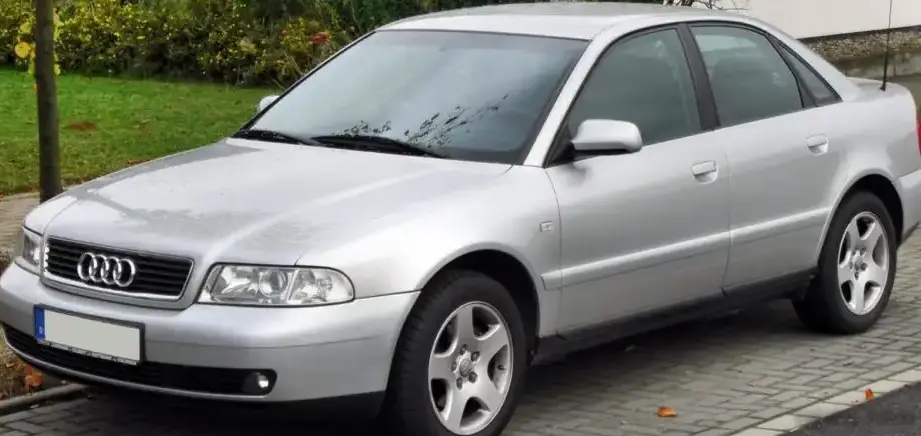
The Audi A4 (B5) 2.8 V6 30V, produced from 1999 to 2000, represents a significant refinement of the first-generation A4. This facelifted model, internally designated Typ 8D, built upon the success of the original B5 chassis, offering a more sophisticated driving experience and updated styling. Positioned as a near-premium offering within the A4 range, the 2.8 V6 was a step up from the base 1.8T models, providing considerably more performance while remaining more accessible than the flagship S4. It served as a popular choice for buyers seeking a balance of luxury, performance, and practicality in a compact executive sedan.
Technical Specifications
| Brand | Audi |
| Model | A4 |
| Generation | A4 (B5, Typ 8D, facelift 1999) |
| Type (Engine) | 2.8 V6 30V (193 Hp) |
| Start of production | 1999 |
| End of production | 2000 |
| Powertrain Architecture | Internal Combustion engine |
| Body type | Sedan |
| Seats | 5 |
| Doors | 4 |
| Fuel consumption (urban) | 13.6 l/100 km (17.3 US mpg, 20.8 UK mpg) |
| Fuel consumption (extra urban) | 7 l/100 km (33.6 US mpg, 40.4 UK mpg) |
| Fuel consumption (combined) | 9.4 l/100 km (25 US mpg, 30.1 UK mpg) |
| Fuel Type | Petrol (Gasoline) |
| Acceleration 0 – 100 km/h | 7.4 sec |
| Acceleration 0 – 62 mph | 7.4 sec |
| Acceleration 0 – 60 mph | 7 sec |
| Maximum speed | 240 km/h (149.13 mph) |
| Weight-to-power ratio | 6.8 kg/Hp |
| Weight-to-torque ratio | 4.7 kg/Nm |
| Power | 193 Hp @ 6000 rpm |
| Torque | 280 Nm @ 3200 rpm (206.52 lb.-ft. @ 3200 rpm) |
| Engine layout | Front, Longitudinal |
| Engine Model/Code | AMX, APR, AQD |
| Engine displacement | 2771 cm3 (169.1 cu. in.) |
| Number of cylinders | 6 |
| Engine configuration | V-engine |
| Cylinder Bore | 82.5 mm (3.25 in.) |
| Piston Stroke | 86.4 mm (3.4 in.) |
| Compression ratio | 10.6:1 |
| Number of valves per cylinder | 5 |
| Fuel injection system | Multi-port manifold injection |
| Engine aspiration | Naturally aspirated engine |
| Valvetrain | DOHC |
| Engine oil capacity | 5.7 l (6.02 US qt | 5.02 UK qt) |
| Coolant capacity | 8 l (8.45 US qt | 7.04 UK qt) |
| Kerb Weight | 1320 kg (2910.1 lbs.) |
| Max. weight | 1870 kg (4122.64 lbs.) |
| Max load | 550 kg (1212.54 lbs.) |
| Trunk (boot) space – minimum | 440 l (15.54 cu. ft.) |
| Fuel tank capacity | 62 l (16.38 US gal | 13.64 UK gal) |
| Length | 4479 mm (176.34 in.) |
| Width | 1733 mm (68.23 in.) |
| Height | 1415 mm (55.71 in.) |
| Wheelbase | 2617 mm (103.03 in.) |
| Front track | 1498 mm (58.98 in.) |
| Rear track | 1479 mm (58.23 in.) |
| Drag coefficient (Cd) | 0.31 |
| Minimum turning circle | 11.1 m (36.42 ft.) |
| Drivetrain Architecture | Front wheel drive |
| Number of gears | 5 |
| Gearbox type | Manual transmission |
| Front suspension | Wishbone |
| Rear suspension | Suspension with traction connecting levers |
| Front brakes | Ventilated discs |
| Rear brakes | Disc |
| Assisting systems | ABS (Anti-lock braking system) |
| Steering type | Steering rack and pinion |
| Power steering | Hydraulic Steering |
| Tires size | 205/60 R15 |
| Wheel rims size | 15 |
Powertrain & Engine Architecture
The heart of the 1999-2000 Audi A4 2.8 V6 was the AMX (and variants APR and AQD) engine. This 2.8-liter, naturally aspirated V6 engine featured a 60-degree V-angle and utilized a cast iron block with an aluminum cylinder head. The engine employed a dual overhead camshaft (DOHC) design with five valves per cylinder (three intake, two exhaust), contributing to its strong breathing and high-end power. Fuel delivery was managed by a Bosch Motronic multi-port fuel injection system. The engine’s 280 Nm (206.52 lb-ft) of torque was readily available at 3200 rpm, providing strong mid-range acceleration. The standard transmission was a robust 5-speed manual, offering precise shifts and a direct connection to the engine. While a 5-speed Tiptronic automatic transmission was available, it often detracted from the overall driving experience due to its comparatively slow shifting and tendency to hunt for gears.
Driving Characteristics
The A4 2.8 V6 offered a noticeably more engaging driving experience than its 1.8T counterpart. The naturally aspirated V6 delivered a linear power delivery, lacking the turbo lag associated with the turbocharged four-cylinder. Acceleration to 60 mph took approximately 7 seconds, making it a competitive performer in its class. The manual transmission provided excellent control, while the automatic, though convenient, diminished the sense of connection. The front-wheel-drive layout, while competent, could exhibit torque steer under hard acceleration. The suspension, tuned for a balance of comfort and handling, provided a reasonably compliant ride without sacrificing cornering stability.
Equipment & Trim Levels
The A4 2.8 V6 typically came well-equipped, though options were plentiful. Standard features included power windows, power locks, air conditioning, and an upgraded audio system. Leather upholstery, sunroof, heated front seats, and automatic climate control were common options. The interior design was functional and well-built, reflecting Audi’s reputation for quality. The 2.8 V6 models often featured wood trim accents, adding a touch of luxury to the cabin. Trim levels varied slightly by market, but generally, the 2.8 V6 represented a step above the base models in terms of standard features and available options.
Chassis & Braking
The B5 A4 utilized a MacPherson strut front suspension and a semi-independent torsion beam rear suspension. The 2.8 V6 models often received slightly stiffer springs and dampers compared to the 1.8T variants to better manage the increased weight and power. Braking duties were handled by ventilated disc brakes at the front and solid discs at the rear. Anti-lock braking system (ABS) was standard. The steering was a rack-and-pinion system with hydraulic power assistance, providing precise and responsive steering feel.
Market Reception & Comparison
The A4 2.8 V6 was generally well-received by automotive critics. It was praised for its smooth and powerful engine, refined interior, and balanced handling. Compared to the 1.8T models, the 2.8 V6 offered a significant performance upgrade, but at the cost of slightly lower fuel economy. The 2.8 V6 was also more expensive to maintain, due to the increased complexity of the engine and the higher cost of parts. Against competitors like the BMW 328i and Mercedes-Benz C280, the A4 2.8 V6 offered a compelling combination of performance, luxury, and value.
Legacy
The Audi A4 B5 2.8 V6 remains a popular choice among enthusiasts today. The AMX engine, while not without its quirks, is generally considered reliable when properly maintained. Common issues include oil leaks and occasional sensor failures. The availability of aftermarket parts and a strong online community contribute to the continued appeal of this model. While not as sought-after as the S4, the 2.8 V6 offers a compelling blend of performance, comfort, and affordability, making it a rewarding classic for those seeking a well-rounded European sedan.