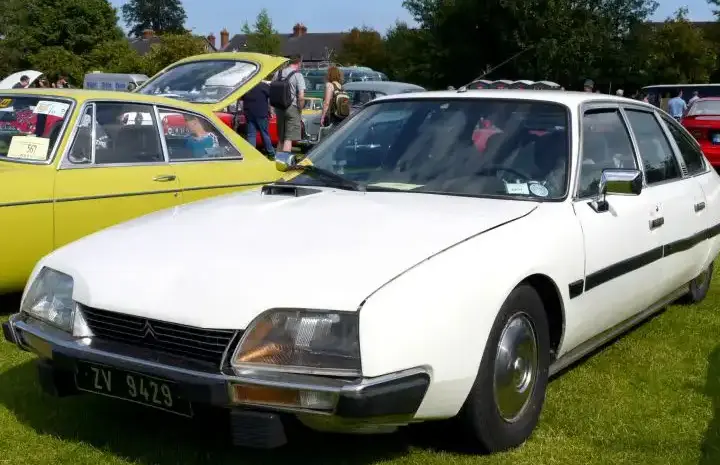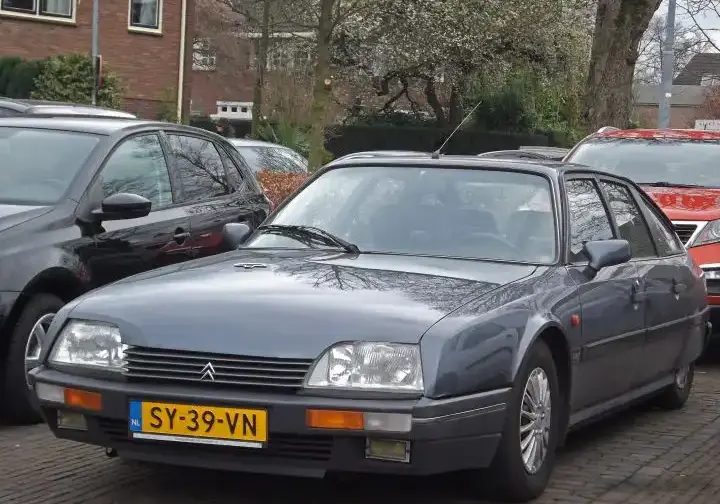
Technical Specifications
| Brand | Citroen |
| Model | CX |
| Generation | CX II |
| Type (Engine) | 25 Ri (138 Hp) |
| Start of production | 1985 |
| End of production | 1989 |
| Powertrain Architecture | Internal Combustion engine |
| Body type | Hatchback |
| Seats | 5 |
| Doors | 5 |
| Fuel consumption (urban) | 13.6 l/100 km (17.3 US mpg, 20.8 UK mpg, 7.4 km/l) |
| Fuel consumption (extra urban) | 7.3 l/100 km (32.2 US mpg, 38.7 UK mpg, 13.7 km/l) |
| Fuel consumption (combined) | 10 l/100 km (23.5 US mpg, 28.2 UK mpg, 10 km/l) |
| Fuel Type | Petrol (Gasoline) |
| Acceleration 0 – 100 km/h | 9.2 sec |
| Acceleration 0 – 62 mph | 9.2 sec |
| Acceleration 0 – 60 mph | 8.7 sec |
| Maximum speed | 201 km/h (124.9 mph) |
| Weight-to-power ratio | 9.9 kg/Hp, 100.7 Hp/tonne |
| Weight-to-torque ratio | 6.5 kg/Nm, 154 Nm/tonne |
| Power | 138 Hp @ 5000 rpm |
| Power per litre | 55.2 Hp/l |
| Torque | 211 Nm @ 4000 rpm (155.63 lb.-ft. @ 4000 rpm) |
| Engine layout | Front, Transverse |
| Engine Model/Code | M25.659 |
| Engine displacement | 2500 cm3 (152.56 cu. in.) |
| Number of cylinders | 4 |
| Engine configuration | Inline |
| Cylinder Bore | 93 mm (3.66 in.) |
| Piston Stroke | 92 mm (3.62 in.) |
| Compression ratio | 8.75:1 |
| Number of valves per cylinder | 2 |
| Fuel injection system | Multi-port manifold injection |
| Engine aspiration | Naturally aspirated engine |
| Engine oil capacity | 5.5 l (5.81 US qt | 4.84 UK qt) |
| Coolant | 12.5 l (13.21 US qt | 11 UK qt) |
| Kerb Weight | 1370 kg (3020.33 lbs.) |
| Max. weight | 1885 kg (4155.71 lbs.) |
| Max load | 515 kg (1135.38 lbs.) |
| Trunk (boot) space – minimum | 485 l (17.13 cu. ft.) |
| Trunk (boot) space – maximum | 507 l (17.9 cu. ft.) |
| Fuel tank capacity | 68 l (17.96 US gal | 14.96 UK gal) |
| Max. roof load | 80 kg (176.37 lbs.) |
| Permitted trailer load with brakes (12%) | 1300 kg (2866.01 lbs.) |
| Permitted trailer load without brakes | 685 kg (1510.17 lbs.) |
| Permitted towbar download | 100 kg (220.46 lbs.) |
| Length | 4650 mm (183.07 in.) |
| Width | 1770 mm (69.69 in.) |
| Height | 1360 mm (53.54 in.) |
| Wheelbase | 2845 mm (112.01 in.) |
| Front track | 1520 mm (59.84 in.) |
| Rear (Back) track | 1370 mm (53.94 in.) |
| Ride height (ground clearance) | 160 mm (6.3 in.) |
| Drag coefficient (Cd) | 0.35 |
| Minimum turning circle (turning diameter) | 12.50 m (41.01 ft.) |
| Drivetrain Architecture | The Internal combustion engine (ICE) drives the front wheels of the vehicle. |
| Drive wheel | Front wheel drive |
| Number of gears and type of gearbox | 5 gears, manual transmission |
| Front suspension | Hydro-pneumatic element |
| Rear suspension | Hydro-pneumatic element |
| Front brakes | Ventilated discs |
| Rear brakes | Disc |
| Assisting systems | ABS (Anti-lock braking system) |
| Steering type | Steering rack and pinion |
| Power steering | Hydraulic Steering |
| Tires size | 195/70 R14 |
| Wheel rims size | 5.5J x 14 |
The Citroen CX II 25 Ri, produced between 1985 and 1989, represented a significant refinement of the innovative CX series, continuing Citroen’s long-standing tradition of advanced automotive engineering. Positioned as a mid-range offering within the CX II lineup, the 25 Ri combined a 2.5-liter inline-four engine with a five-speed manual transmission, offering a compelling balance of performance and comfort. It built upon the original CX launched in 1974, addressing some of the earlier model’s shortcomings while retaining the distinctive styling and hydropneumatic suspension that defined the car. The CX II series, including the 25 Ri, aimed to modernize the CX for the late 1980s, improving reliability and responding to evolving market demands.
Powertrain & Engine Architecture
The Citroen CX II 25 Ri was powered by the M25.659 engine, a 2.5-liter inline-four cylinder gasoline engine. This engine featured a cast iron block and an aluminum cylinder head, employing a single overhead camshaft (SOHC) design with two valves per cylinder. Fuel delivery was managed by a Bosch multi-port fuel injection system, contributing to improved efficiency and smoother operation compared to earlier carbureted Citroen engines. The engine produced 138 horsepower at 5000 rpm and 211 Nm (155.63 lb-ft) of torque at 4000 rpm. The five-speed manual transmission was a key component, offering precise gear changes and allowing the driver to effectively utilize the engine’s power band. The transmission’s gear ratios were tuned for a balance between acceleration and fuel economy, with a relatively long fifth gear for comfortable highway cruising.
Driving Characteristics
The CX II 25 Ri offered a unique driving experience largely due to Citroen’s renowned hydropneumatic suspension system. This system provided an exceptionally smooth and comfortable ride, absorbing bumps and imperfections in the road with remarkable effectiveness. The steering was light and precise, although it lacked the direct feel of some contemporary cars. The 2.5-liter engine provided adequate performance for everyday driving, with the 0-60 mph sprint taking approximately 8.7 seconds. While not a sports car, the CX II 25 Ri was capable of maintaining highway speeds with ease. Compared to the more powerful CX 25 GTI, the 25 Ri offered a more relaxed driving experience, prioritizing comfort over outright performance. The manual transmission allowed for greater driver control compared to the optional automatic, and many enthusiasts preferred it for its responsiveness.
Equipment & Trim Levels
The CX II 25 Ri came reasonably well-equipped as standard. Interior features typically included comfortable cloth upholstery, a basic stereo system, and power-assisted steering. The dashboard layout was characteristically Citroen, featuring a unique combination of analog gauges and switches. Optional extras included leather upholstery, air conditioning, and a more advanced stereo system. The 25 Ri occupied a middle ground in the CX II range, offering more features than the base models but lacking the luxury appointments of the top-of-the-line versions.
Chassis & Braking
The CX II featured a monocoque chassis construction, providing a good balance of strength and rigidity. The hydropneumatic suspension system, a Citroen hallmark, utilized self-leveling spheres and adjustable ride height. The front suspension employed double wishbones, while the rear suspension utilized a trailing arm design. Braking duties were handled by ventilated discs at the front and solid discs at the rear. An anti-lock braking system (ABS) was included as standard, enhancing safety and control during hard braking. The CX II’s tires were typically 195/70 R14, providing a good compromise between grip and ride comfort.
Market Reception & Comparison
The Citroen CX II 25 Ri was generally well-received by automotive critics, who praised its comfortable ride, innovative suspension system, and distinctive styling. However, some criticisms were leveled at its somewhat unconventional controls and occasionally complex maintenance requirements. Compared to other cars in its class, such as the Peugeot 505 or the Ford Granada, the CX II offered a more unique and sophisticated driving experience. Fuel economy was reasonable for the time, averaging around 23.5 US mpg in combined driving. Reliability was a mixed bag, with the hydropneumatic suspension system requiring periodic maintenance and occasional repairs.
Legacy
The Citroen CX II 25 Ri, while not a high-volume seller, remains a fondly remembered car among enthusiasts. Its innovative technology and distinctive styling have earned it a cult following. Today, well-maintained examples are sought after by collectors and classic car enthusiasts. The hydropneumatic suspension system, while complex, is considered a masterpiece of automotive engineering. The M25.659 engine, while not particularly powerful by modern standards, is known for its durability and relatively straightforward maintenance. Finding parts can be challenging, but a dedicated network of Citroen specialists and suppliers continues to support owners of these classic cars.