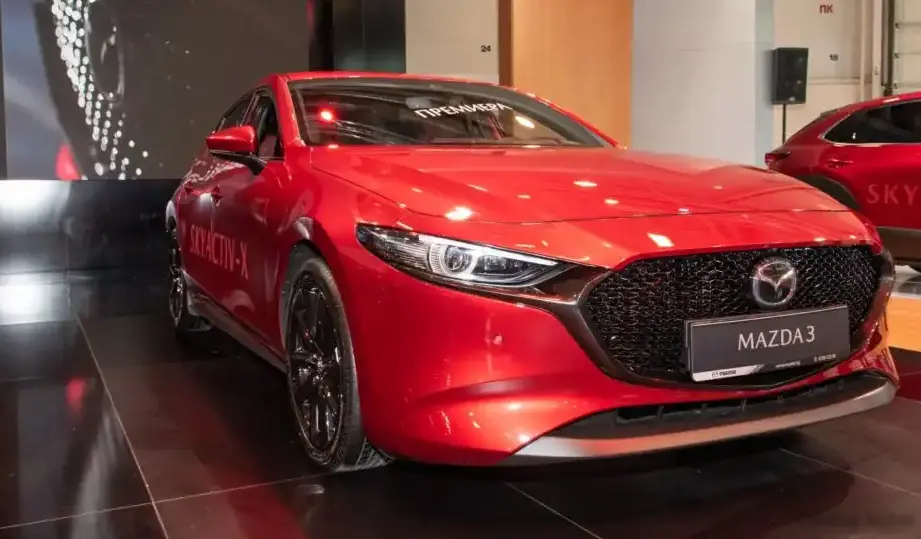
The Mazda 3 IV Hatchback 2.0 SkyActiv-X M Hybrid (180 Hp) represents a significant step forward in Mazda’s engineering, blending a traditionally gasoline engine with mild hybrid technology. Produced from 2019 to 2021, this variant occupied a mid-to-upper position within the fourth generation (BP) Mazda 3 lineup, built on the 1HX platform. It aimed to deliver a balance of performance, fuel efficiency, and refinement, appealing to drivers seeking a more engaging experience than traditional compact hatchbacks. This model was primarily marketed in Europe and other global markets, with a focus on meeting increasingly stringent emissions regulations while maintaining Mazda’s signature driving dynamics.
Technical Specifications
| Brand | Mazda |
| Model | 3 |
| Generation | IV Hatchback |
| Type (Engine) | 2.0 SkyActiv-X M Hybrid (180 Hp) |
| Start of production | 2019 |
| End of production | 2021 |
| Powertrain Architecture | MHEV (Mild Hybrid Electric Vehicle) |
| Body type | Hatchback |
| Seats | 5 |
| Doors | 5 |
| Combined fuel consumption (WLTP) | 5.5-5.8 l/100 km (42.8 – 40.6 US mpg) |
| CO2 emissions (WLTP) | 125-131 g/km |
| Fuel consumption (urban) | 4.9-5.1 l/100 km (48 – 46.1 US mpg) |
| Fuel consumption (extra urban) | 4.1-4.2 l/100 km (57.4 – 56 US mpg) |
| Fuel consumption (combined) | 4.4-4.5 l/100 km (53.5 – 52.3 US mpg) |
| CO2 emissions | 100-103 g/km |
| Fuel Type | Petrol (Gasoline) |
| Acceleration 0 – 100 km/h | 8.2 sec |
| Acceleration 0 – 62 mph | 8.2 sec |
| Acceleration 0 – 60 mph | 7.8 sec |
| Maximum speed | 216 km/h (134.22 mph) |
| Emission standard | Euro 6d |
| Weight-to-power ratio | 7.3 kg/Hp |
| Weight-to-torque ratio | 5.9 kg/Nm |
| Power | 180 Hp @ 6000 rpm |
| Torque | 224 Nm @ 3000 rpm (165.21 lb.-ft. @ 3000 rpm) |
| Engine layout | Front, Transverse |
| Engine displacement | 1998 cm3 (121.93 cu. in.) |
| Number of cylinders | 4 |
| Engine configuration | Inline |
| Cylinder Bore | 83.5 mm (3.29 in.) |
| Piston Stroke | 91.2 mm (3.59 in.) |
| Compression ratio | 16.3:1 |
| Number of valves per cylinder | 4 |
| Fuel injection system | Direct injection |
| Engine aspiration | Naturally aspirated |
| Engine oil capacity | 4.6 l (4.86 US qt | 4.05 UK qt) |
| Coolant capacity | 6.9 l (7.29 US qt | 6.07 UK qt) |
| Kerb Weight | 1320-1411 kg (2910.1 – 3110.72 lbs.) |
| Max. weight | 1929 kg (4252.72 lbs.) |
| Max load | 518-609 kg (1141.99 – 1342.62 lbs.) |
| Trunk (boot) space – minimum | 351 l (12.4 cu. ft.) |
| Trunk (boot) space – maximum | 1026 l (36.23 cu. ft.) |
| Fuel tank capacity | 51 l (13.47 US gal | 11.22 UK gal) |
| Max. roof load | 75 kg (165.35 lbs.) |
| Permitted trailer load with brakes (8%) | 1300 kg (2866.01 lbs.) |
| Permitted trailer load with brakes (12%) | 1300 kg (2866.01 lbs.) |
| Permitted trailer load without brakes | 600 kg (1322.77 lbs.) |
| Permitted towbar download | 75 kg (165.35 lbs.) |
| Length | 4460 mm (175.59 in.) |
| Width | 1795 mm (70.67 in.) |
| Width including mirrors | 2028 mm (79.84 in.) |
| Height | 1435 mm (56.5 in.) |
| Wheelbase | 2725 mm (107.28 in.) |
| Ride height (ground clearance) | 135 mm (5.31 in.) |
| Minimum turning circle | 10.6 m (34.78 ft.) |
| Drivetrain Architecture | ICE drives front wheels |
| Drive wheel | Front wheel drive |
| Number of gears | 6 |
| Gearbox type | Manual transmission |
| Front suspension | Independent type McPherson |
| Rear suspension | Torsion |
| Front brakes | Disc |
| Rear brakes | Disc |
| Assisting systems | ABS (Anti-lock braking system) |
| Steering type | Steering rack and pinion |
| Power steering | Electric |
| Tires size | 205/60 R16; 215/45 R18 |
| Wheel rims size | 16; 18 |
INTRODUCTION
The Mazda 3 IV, launched in 2019, represented a complete redesign of Mazda’s popular compact car. The 2.0 SkyActiv-X M Hybrid variant was a key offering, showcasing Mazda’s innovative engine technology. SkyActiv-X is a unique gasoline engine that utilizes spark-controlled compression ignition (SPCI), aiming to combine the benefits of gasoline and diesel engines – efficiency and low emissions with responsive performance. The “M Hybrid” designation indicates a 24V mild hybrid system, adding a small electric motor and battery to assist the engine during acceleration and enable smoother start-stop functionality. This particular trim level aimed to provide a balance between fuel economy and driving enjoyment, positioning itself as a step up from the base 1.5-liter engine while remaining more accessible than the higher-performance options.
Powertrain & Engine Architecture
At the heart of this Mazda 3 is the 1998cc (121.93 cu. in.) SkyActiv-X engine, designated as the X20M-VVT. This engine is notable for its high compression ratio of 16.3:1, achieved through precise control of the combustion process. Unlike traditional gasoline engines that rely solely on spark plugs for ignition, SkyActiv-X uses a combination of spark ignition and compression ignition. During light loads, the engine operates primarily on compression ignition, improving fuel efficiency. When more power is needed, spark plugs assist in initiating combustion. The engine features direct injection and a variable valve timing system (VVT) to optimize performance across the rev range. The mild hybrid system consists of a 24V electric motor integrated with the engine and a small lithium-ion battery. This system provides a boost during acceleration, reducing the load on the engine and improving fuel economy. The standard transmission for this variant was a 6-speed manual gearbox, offering precise shifts and a direct connection to the engine.
Driving Characteristics
The 180 hp and 224 Nm (165.21 lb.-ft.) of torque delivered by the SkyActiv-X engine, coupled with the 6-speed manual transmission, provide a surprisingly engaging driving experience. While not as overtly powerful as some turbocharged competitors, the engine offers a broad torque curve, making it responsive in everyday driving situations. The mild hybrid system contributes to smooth acceleration from a standstill and helps to fill in any gaps in the torque curve. The gear ratios are well-matched, allowing the engine to operate efficiently at highway speeds. Compared to the base 1.5-liter engine, the 2.0 SkyActiv-X offers noticeably more power and a more refined driving experience. However, it doesn’t quite match the performance of the higher-output turbocharged engines available in the Mazda 3 range. The steering is precise and well-weighted, typical of Mazda’s commitment to driving dynamics, and the chassis feels balanced and composed.
Equipment & Trim Levels
The 2.0 SkyActiv-X M Hybrid typically came equipped with a generous level of standard features. Depending on the specific market and optional packages, this could include Mazda’s infotainment system with an 8.8-inch display, Apple CarPlay and Android Auto integration, a rearview camera, and a suite of advanced safety features such as lane departure warning, lane keep assist, and automatic emergency braking. Interior upholstery was typically cloth, with higher trims offering leather options. Dashboard materials were generally of good quality, reflecting Mazda’s focus on creating a premium interior feel. Available options included a sunroof, heated seats, a premium audio system, and adaptive cruise control.
Chassis & Braking
The Mazda 3 IV utilizes a McPherson strut front suspension and a torsion beam rear suspension. This setup provides a good balance between ride comfort and handling precision. The chassis is relatively lightweight, contributing to the car’s agility. The braking system consists of disc brakes on all four wheels, providing ample stopping power. ABS (Anti-lock Braking System) is standard, along with electronic brake-force distribution (EBD) and brake assist. The steering system is an electric power steering (EPS) system, offering precise and responsive steering feel.
Market Reception & Comparison
The Mazda 3 IV SkyActiv-X M Hybrid was generally well-received by automotive critics. It was praised for its innovative engine technology, fuel efficiency, and engaging driving dynamics. However, some reviewers noted that the engine’s performance wasn’t as dramatic as some competitors, and the mild hybrid system provided only a modest improvement in fuel economy. Compared to the 1.5-liter engine, the SkyActiv-X offered a significant upgrade in performance and refinement. Compared to the higher-output turbocharged engines, it provided a more balanced combination of fuel economy and performance. The SkyActiv-X engine also offered a potential advantage in terms of long-term reliability, as it is less complex than a turbocharged engine.
Legacy
The SkyActiv-X engine represents a bold step in Mazda’s pursuit of innovative engine technology. While the mild hybrid system in this variant provides only a modest improvement in fuel economy, it demonstrates Mazda’s commitment to reducing emissions. The SkyActiv-X engine has proven to be relatively reliable, with few widespread issues reported. In the used car market, the 2.0 SkyActiv-X M Hybrid Mazda 3 IV holds its value well, appealing to buyers seeking a fuel-efficient and engaging compact hatchback. Its unique engine technology and Mazda’s reputation for quality and reliability make it a desirable option for those looking for a car that stands out from the crowd.