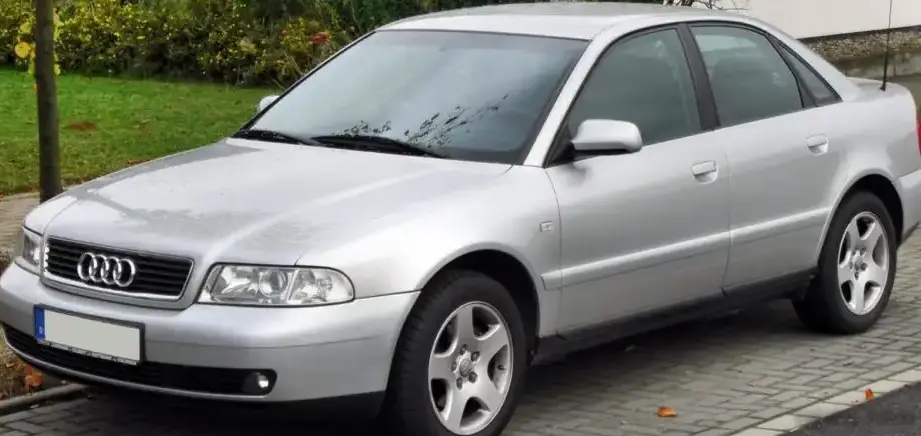
The Audi A4 (B5) 2.8 V6 30V quattro Tiptronic, produced from 1999 to 2000, represents a significant iteration of Audi’s popular compact executive car. This variant, part of the facelifted B5 generation (Typ 8D), occupied a premium position within the A4 lineup, offering a blend of performance, luxury, and all-weather capability. It was primarily marketed in Europe and North America as a sophisticated alternative to rivals like the BMW 3 Series and Mercedes-Benz C-Class. The introduction of the Tiptronic transmission alongside the potent V6 engine aimed to broaden the A4’s appeal to drivers seeking a more relaxed yet engaging driving experience.
Technical Specifications
| Brand | Audi |
| Model | A4 |
| Generation | A4 (B5, Typ 8D, facelift 1999) |
| Type (Engine) | 2.8 V6 30V (193 Hp) quattro Tiptronic |
| Start of production | 1999 |
| End of production | 2000 |
| Powertrain Architecture | Internal Combustion engine |
| Body type | Sedan |
| Seats | 5 |
| Doors | 4 |
| Fuel consumption (urban) | 16.1 l/100 km (14.6 US mpg, 17.5 UK mpg, 6.2 km/l) |
| Fuel consumption (extra urban) | 7.9 l/100 km (29.8 US mpg, 35.8 UK mpg, 12.7 km/l) |
| Fuel consumption (combined) | 10.9 l/100 km (21.6 US mpg, 25.9 UK mpg, 9.2 km/l) |
| Fuel Type | Petrol (Gasoline) |
| Acceleration 0 – 100 km/h | 9.3 sec |
| Acceleration 0 – 62 mph | 9.3 sec |
| Acceleration 0 – 60 mph | 8.8 sec |
| Maximum speed | 233 km/h (144.78 mph) |
| Weight-to-power ratio | 7.7 kg/Hp, 129.5 Hp/tonne |
| Weight-to-torque ratio | 5.3 kg/Nm, 187.9 Nm/tonne |
| Power | 193 Hp @ 6000 rpm |
| Power per litre | 69.6 Hp/l |
| Torque | 280 Nm @ 3200 rpm (206.52 lb.-ft. @ 3200 rpm) |
| Engine layout | Front, Longitudinal |
| Engine Model/Code | AMX, APR, AQD |
| Engine displacement | 2771 cm3 (169.1 cu. in.) |
| Number of cylinders | 6 |
| Engine configuration | V-engine |
| Cylinder Bore | 82.5 mm (3.25 in.) |
| Piston Stroke | 86.4 mm (3.4 in.) |
| Compression ratio | 10.6:1 |
| Number of valves per cylinder | 5 |
| Fuel injection system | Multi-port manifold injection |
| Engine aspiration | Naturally aspirated engine |
| Valvetrain | DOHC |
| Engine oil capacity | 5.7 l (6.02 US qt, 5.02 UK qt) |
| Coolant | 8 l (8.45 US qt, 7.04 UK qt) |
| Kerb Weight | 1490 kg (3284.89 lbs.) |
| Max. weight | 1970 kg (4343.11 lbs.) |
| Max load | 480 kg (1058.22 lbs.) |
| Trunk (boot) space – minimum | 440 l (15.54 cu. ft.) |
| Fuel tank capacity | 60 l (15.85 US gal, 13.2 UK gal) |
| Length | 4479 mm (176.34 in.) |
| Width | 1733 mm (68.23 in.) |
| Height | 1415 mm (55.71 in.) |
| Wheelbase | 2607 mm (102.64 in.) |
| Front track | 1498 mm (58.98 in.) |
| Rear (Back) track | 1477 mm (58.15 in.) |
| Drag coefficient (Cd) | 0.31 |
| Minimum turning circle | 11.1 m (36.42 ft.) |
| Drive wheel | All wheel drive (4×4) |
| Number of gears and type of gearbox | 5 gears, automatic transmission Tiptronic |
| Front suspension | Wishbone |
| Rear suspension | Double wishbone |
| Front brakes | Ventilated discs |
| Rear brakes | Disc |
| Assisting systems | ABS (Anti-lock braking system) |
| Steering type | Steering rack and pinion |
| Power steering | Hydraulic Steering |
| Tires size | 205/60 R15 |
| Wheel rims size | 15 |
INTRODUCTION
The Audi A4 B5 facelift, introduced in 1999, brought with it a series of refinements to the already successful A4 platform. The 2.8 V6 30V quattro Tiptronic variant was positioned as a premium offering, bridging the gap between the more affordable 1.8T models and the high-performance S4. This model combined the robust 2.8-liter V6 engine with Audi’s quattro all-wheel-drive system and a five-speed Tiptronic automatic transmission. The facelift included revised styling cues, such as new headlights and taillights, along with interior upgrades aimed at enhancing the overall driving experience. It was built on the Volkswagen Group’s 1HX0/A3 platform.
Powertrain & Engine Architecture
At the heart of the A4 2.8 V6 quattro Tiptronic lies the AMX (and variants APR, AQD) 2.8-liter V6 engine. This engine is a naturally aspirated, 30-valve (five valves per cylinder) unit, known for its smooth power delivery and relatively high specific output. It utilizes a multi-port fuel injection system, delivering fuel directly into the intake ports. The engine’s architecture features a double overhead camshaft (DOHC) design, optimizing valve timing for improved performance across the rev range. The Tiptronic transmission is a five-speed automatic with a manual shift mode, allowing drivers to exert more control over gear selection. This transmission uses a torque converter and electronic controls to provide smooth and efficient gear changes. The transmission was designed to handle the engine’s 280 Nm (206.52 lb-ft) of torque effectively.
Driving Characteristics
The 2.8 V6 Tiptronic offered a distinctly different driving experience compared to the standard A4 models. While not as overtly sporty as the manual transmission versions or the S4, it provided a comfortable and refined ride with ample power for everyday driving and highway cruising. The Tiptronic transmission, while offering manual control, wasn’t as responsive as a traditional manual gearbox. Gear ratios were tuned for a balance between acceleration and fuel economy. The quattro all-wheel-drive system provided excellent traction in all weather conditions, enhancing stability and confidence. Acceleration from 0-60 mph took approximately 8.8 seconds, and the car had a top speed of 233 km/h (144.78 mph). The engine’s torque curve provided strong mid-range acceleration, making overtaking maneuvers relatively effortless.
Equipment & Trim Levels
The 2.8 V6 quattro Tiptronic typically came well-equipped, reflecting its premium positioning. Standard features included leather upholstery, power-adjustable front seats, automatic climate control, a premium sound system, and alloy wheels. Optional extras included a sunroof, navigation system, and upgraded interior trim options. The interior design was characterized by Audi’s typically understated elegance, with a focus on ergonomics and build quality. The dashboard layout was clean and functional, with intuitive controls. The trim level often included wood or aluminum accents, adding a touch of sophistication to the cabin.
Chassis & Braking
The A4 B5 featured a fully independent suspension system, with wishbone suspension at the front and a double wishbone setup at the rear. This configuration provided a comfortable ride while maintaining good handling characteristics. The quattro all-wheel-drive system distributed power between the front and rear axles as needed, optimizing traction and stability. Braking duties were handled by ventilated discs at the front and solid discs at the rear, equipped with ABS (Anti-lock Braking System) as standard. The braking system provided adequate stopping power for the car’s weight and performance.
Market Reception & Comparison
The Audi A4 2.8 V6 quattro Tiptronic was generally well-received by automotive critics. It was praised for its refined engine, comfortable ride, and all-weather capability. However, some critics noted that the Tiptronic transmission wasn’t as engaging as a manual gearbox. Compared to the 1.8T models, the 2.8 V6 offered significantly more power and a more luxurious driving experience, but at a higher price point. Compared to the S4, it offered a more comfortable ride and better fuel economy, but lacked the S4’s outright performance. Fuel economy was rated at around 10.9 l/100 km (21.6 US mpg), which was typical for a V6-powered car of that era.
Legacy
The Audi A4 B5 2.8 V6 quattro Tiptronic has proven to be a relatively reliable vehicle, although maintenance costs can be higher than for the 1.8T models due to the more complex V6 engine and all-wheel-drive system. The Tiptronic transmission, while generally durable, can be prone to issues if not properly maintained. Today, these cars are sought after by enthusiasts who appreciate their classic Audi styling and robust engineering. Finding well-maintained examples can be challenging, but they offer a compelling blend of performance, luxury, and all-weather capability for a reasonable price in the used car market. The 2.8 V6 engine, when properly cared for, can provide many years of reliable service.