
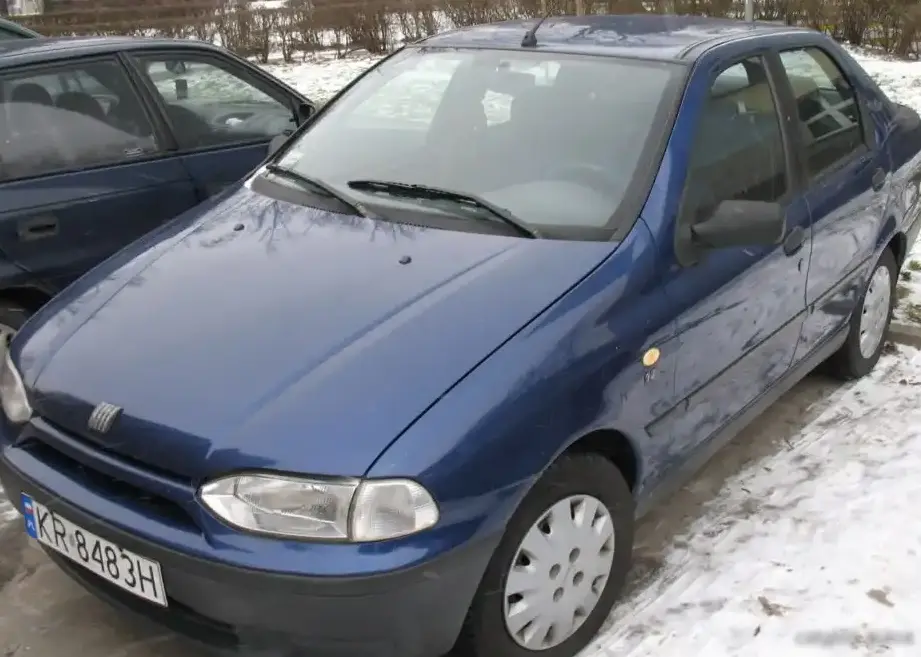
The Fiat Siena (178) 1.7 TD, produced between 1996 and 2000, represented an economical diesel-powered option within the broader Siena range. The Siena, launched in 1995, was designed as a budget-friendly, practical sedan aimed primarily at emerging markets, particularly in Latin America and Europe. This 1.7 TD variant occupied the lower end of the lineup, offering a balance between fuel efficiency and affordability. It was positioned as an alternative to the gasoline-powered versions, appealing to buyers prioritizing low running costs. The 178 designation refers to the project code for this generation of the Siena.
Technical Specifications
| Brand | Fiat |
| Model | Siena |
| Generation | Siena (178) |
| Type (Engine) | 1.7 TD (72 Hp) |
| Start of production | 1996 |
| End of production | 2000 |
| Powertrain Architecture | Internal Combustion engine |
| Body type | Sedan |
| Seats | 5 |
| Doors | 4 |
| Fuel Type | Diesel |
| Acceleration 0 – 100 km/h | 14.8 sec |
| Acceleration 0 – 62 mph | 14.8 sec |
| Acceleration 0 – 60 mph | 14.1 sec |
| Maximum speed | 164 km/h (101.9 mph) |
| Weight-to-power ratio | 14.8 kg/Hp |
| Weight-to-torque ratio | 7.8 kg/Nm |
| Power | 72 Hp @ 4500 rpm |
| Power per litre | 42.4 Hp/l |
| Torque | 137 Nm @ 2500 rpm (101.05 lb.-ft. @ 2500 rpm) |
| Engine layout | Front, Transverse |
| Engine Model/Code | 176 A5.000 |
| Engine displacement | 1698 cm3 (103.62 cu. in.) |
| Number of cylinders | 4 |
| Engine configuration | Inline |
| Cylinder Bore | 82.6 mm (3.25 in.) |
| Piston Stroke | 79.2 mm (3.12 in.) |
| Compression ratio | 20.3:1 |
| Number of valves per cylinder | 2 |
| Fuel injection system | Precombustion chamber injection |
| Engine aspiration | Turbocharger |
| Engine oil capacity | 4.3 l (4.54 US qt | 3.78 UK qt) |
| Coolant capacity | 7.1 l (7.5 US qt | 6.25 UK qt) |
| Kerb Weight | 1065 kg (2347.92 lbs.) |
| Trunk (boot) space – minimum | 500 l (17.66 cu. ft.) |
| Trunk (boot) space – maximum | 850 l (30.02 cu. ft.) |
| Fuel tank capacity | 48 l (12.68 US gal | 10.56 UK gal) |
| Length | 4100 mm (161.42 in.) |
| Width | 1614 mm (63.54 in.) |
| Height | 1440 mm (56.69 in.) |
| Wheelbase | 2360 mm (92.91 in.) |
| Front track | 1388 mm (54.65 in.) |
| Rear (Back) track | 1378 mm (54.25 in.) |
| Drivetrain Architecture | Front wheel drive |
| Number of gears and type of gearbox | 5 gears, manual transmission |
| Front suspension | Coil spring |
| Rear suspension | Coil spring |
| Front brakes | Disc |
| Rear brakes | Drum |
| Assisting systems | ABS (Anti-lock braking system) |
| Steering type | Steering rack and pinion |
| Power steering | Hydraulic Steering |
| Tires size | 175/70 R13 |
Powertrain & Engine Architecture
The heart of the Siena 1.7 TD was the 176 A5.000 engine, a 1.7-liter inline-four cylinder diesel. This engine utilized a precombustion chamber injection system, a common technology for diesel engines of the era. This system involved injecting fuel into a precombustion chamber connected to the main cylinder, promoting more complete combustion and reducing noise. The engine was turbocharged, which significantly boosted power output for its displacement. The turbocharger helped to overcome the inherent limitations of naturally aspirated diesel engines, providing increased torque and improved acceleration. The engine produced 72 horsepower at 4500 rpm and 137 Nm (101 lb-ft) of torque at 2500 rpm. The high compression ratio of 20.3:1 was typical for diesel engines, contributing to their thermal efficiency. The engine was transversely mounted in the front of the vehicle, driving the front wheels.
Driving Characteristics
The 1.7 TD Siena, with its 72 horsepower and 137 Nm of torque, offered modest performance. Acceleration from 0 to 100 km/h (0-62 mph) took approximately 14.8 seconds, and top speed was around 164 km/h (102 mph). Compared to the gasoline-powered Siena variants, the 1.7 TD prioritized fuel economy over outright speed. The five-speed manual transmission was well-suited to the engine’s characteristics, allowing drivers to keep the engine in its optimal torque band. While not a sporty vehicle, the 1.7 TD provided adequate power for everyday driving and was particularly well-suited for long distances where fuel efficiency was paramount. The turbocharger did provide a noticeable boost in power once spooled up, but there was some degree of turbo lag.
Equipment & Trim Levels
The 1.7 TD Siena typically came with a relatively basic level of equipment, reflecting its position as an entry-level model. Standard features generally included power steering, central locking, and a basic instrument cluster. Interior upholstery was typically cloth, and the dashboard was constructed from durable plastics. Optional extras could include air conditioning, power windows, and a radio/cassette player. Trim levels varied depending on the market, but the 1.7 TD was generally offered in a single, fairly standardized configuration. The focus was on providing a functional and reliable vehicle at an affordable price point.
Chassis & Braking
The Siena 1.7 TD utilized a relatively simple chassis design. Front suspension consisted of coil springs, while the rear suspension also employed coil springs. The front brakes were discs, providing adequate stopping power, while the rear brakes were drums, a cost-saving measure common in this class of vehicle. An Anti-lock Braking System (ABS) was often included as standard equipment, enhancing safety. The steering system was a rack and pinion setup with hydraulic power assistance, providing reasonably precise steering feel. The vehicle rode on 175/70 R13 tires.
Market Reception & Comparison
The Fiat Siena 1.7 TD was generally well-received in markets where fuel economy and affordability were key considerations. Critics praised its low running costs and practicality, but noted its modest performance. Compared to the gasoline-powered Siena variants, the 1.7 TD offered significantly better fuel economy, making it a popular choice for high-mileage drivers. Compared to other diesel-powered sedans in its class, the Siena 1.7 TD offered a competitive price point and a reasonable level of equipment. However, some competitors offered more refined interiors or more powerful engines.
Legacy
The Fiat Siena 1.7 TD, while not a particularly groundbreaking vehicle, played an important role in providing affordable transportation to a wide range of customers. The 176 A5.000 engine proved to be relatively durable and reliable, and many examples are still on the road today. In the used car market, the Siena 1.7 TD is often sought after by buyers looking for a simple, economical, and dependable vehicle. Its straightforward mechanical design makes it relatively easy to maintain and repair, and parts availability is generally good. While it may not offer the performance or features of more modern vehicles, the Siena 1.7 TD remains a practical and affordable option for those seeking a no-frills sedan.
