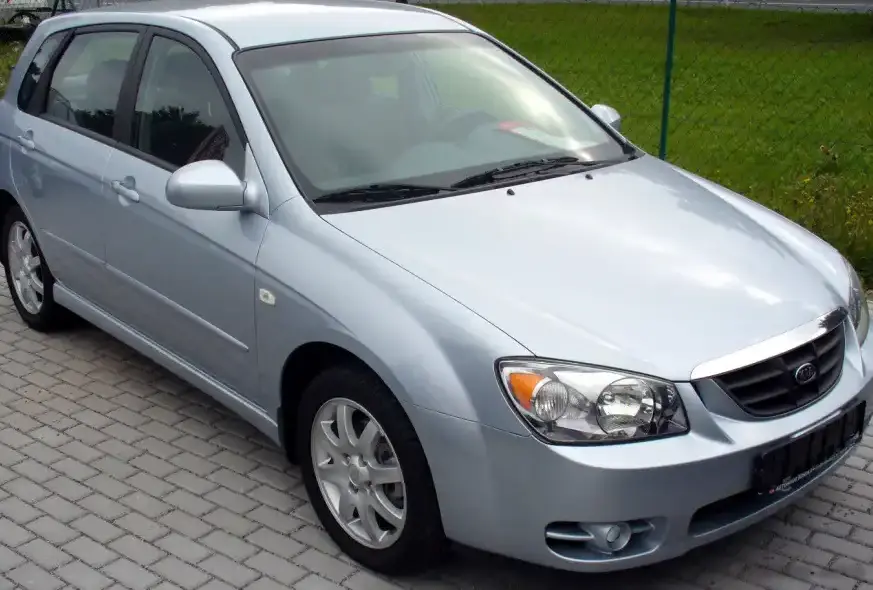
The Kia Cerato, known as the Spectra in some markets, represented Kia’s entry into the competitive compact car segment. The first generation Cerato hatchback, produced from 2004 to 2006, aimed to offer a value-oriented alternative to established Japanese and European rivals. The 1.6-liter engine paired with a four-speed automatic transmission was a key variant, positioned as the entry-level automatic option within the Cerato hatchback range. It targeted buyers seeking affordability and ease of use over outright performance.
Technical Specifications
| Brand | Kia |
| Model | Cerato |
| Generation | Cerato I Hatchback |
| Type (Engine) | 1.6 (105 Hp) Automatic |
| Start of production | 2004 |
| End of production | 2006 |
| Powertrain Architecture | Internal Combustion engine |
| Body type | Hatchback |
| Seats | 5 |
| Doors | 5 |
| Fuel consumption (urban) | 10.9 l/100 km (21.6 US mpg) |
| Fuel consumption (extra urban) | 6 l/100 km (39.2 US mpg) |
| Fuel consumption (combined) | 7.8 l/100 km (30.2 US mpg) |
| CO2 emissions | 187 g/km |
| Fuel Type | Petrol (Gasoline) |
| Acceleration 0 – 100 km/h | 13 sec |
| Acceleration 0 – 62 mph | 13 sec |
| Acceleration 0 – 60 mph | 12.4 sec |
| Maximum speed | 173 km/h (107.5 mph) |
| Emission standard | Euro 4 |
| Weight-to-power ratio | 11.6 kg/Hp |
| Weight-to-torque ratio | 8.5 kg/Nm |
| Power | 105 Hp @ 5800 rpm |
| Torque | 143 Nm @ 4500 rpm (105.47 lb.-ft. @ 4500 rpm) |
| Engine layout | Front, Transverse |
| Engine Model/Code | Alpha II / G4ED |
| Engine displacement | 1599 cm3 (97.58 cu. in.) |
| Number of cylinders | 4 |
| Engine configuration | Inline |
| Cylinder Bore | 76.5 mm (3.01 in.) |
| Piston Stroke | 87 mm (3.43 in.) |
| Compression ratio | 10:1 |
| Number of valves per cylinder | 4 |
| Fuel injection system | Multi-port manifold injection |
| Engine aspiration | Naturally aspirated |
| Engine oil capacity | 3.3 l (3.49 US qt | 2.9 UK qt) |
| Coolant capacity | 8.1 l (8.56 US qt | 7.13 UK qt) |
| Kerb Weight | 1220 kg (2689.64 lbs.) |
| Max. weight | 1740 kg (3836.04 lbs.) |
| Max load | 520 kg (1146.4 lbs.) |
| Trunk (boot) space – minimum | 228 l (8.05 cu. ft.) |
| Trunk (boot) space – maximum | 1046 l (36.94 cu. ft.) |
| Fuel tank capacity | 55 l (14.53 US gal | 12.1 UK gal) |
| Length | 4340 mm (170.87 in.) |
| Width | 1735 mm (68.31 in.) |
| Height | 1470 mm (57.87 in.) |
| Wheelbase | 2610 mm (102.76 in.) |
| Front track | 1495 mm (58.86 in.) |
| Rear track | 1485 mm (58.46 in.) |
| Drag coefficient (Cd) | 0.33 |
| Minimum turning circle | 10.1 m (33.14 ft.) |
| Drivetrain | Front wheel drive |
| Number of gears | 4 |
| Gearbox type | Automatic transmission |
| Front brakes | Ventilated discs |
| Rear brakes | Disc |
| Assisting systems | ABS (Anti-lock braking system) |
| Steering type | Steering rack and pinion |
| Tires size | 205/50 R16 |
| Wheel rims size | 16 |
INTRODUCTION
The Kia Cerato I Hatchback, launched in 2004, was a significant step for Kia in establishing a presence in the European and other international markets. Built on the 1HX0/A3 platform (shared with the Hyundai Elantra), the Cerato aimed to provide a modern, practical, and affordable option for buyers seeking a compact hatchback. The 1.6-liter engine with an automatic transmission was a popular choice for those prioritizing convenience and ease of driving, particularly in urban environments. This variant occupied the lower-mid range of the Cerato hatchback lineup, offering a balance between price and features.
Powertrain & Engine Architecture
The heart of this Cerato variant is the Kia Alpha II engine, specifically the G4ED code. This 1.6-liter inline-four cylinder engine utilizes a naturally aspirated configuration and a multi-port fuel injection system. The engine produces 105 horsepower at 5800 rpm and 143 Nm (105.47 lb.-ft.) of torque at 4500 rpm. The engine features a double overhead camshaft (DOHC) valvetrain with four valves per cylinder, contributing to reasonable efficiency and responsiveness for its class. The four-speed automatic transmission was a conventional hydraulic unit, offering smooth but not particularly quick shifts. It was chosen for its simplicity and reliability, rather than sporting performance. This transmission lacked the manual override features common in later automatic gearboxes.
Driving Characteristics
The 1.6-liter automatic Cerato offered a comfortable, if uninspiring, driving experience. Acceleration from 0-60 mph took around 12.4 seconds, and 0-100 km/h in 13 seconds, making it noticeably slower than versions equipped with the manual transmission or the larger 1.8-liter engine. The automatic transmission’s gear ratios were geared towards fuel economy and smooth cruising, rather than aggressive acceleration. The engine felt strained when pushed hard, particularly when overtaking or climbing hills. However, for everyday commuting and city driving, the powertrain provided adequate performance. The steering was light and easy, making it maneuverable in tight spaces, but lacked significant feedback.
Equipment & Trim Levels
The 1.6-liter automatic Cerato typically came equipped with a reasonable level of standard features. These generally included air conditioning, power windows, central locking, and a basic audio system. Interior upholstery was typically cloth, and the dashboard featured a functional, if somewhat plain, design. Optional extras available for this trim level often included alloy wheels, a sunroof, and upgraded audio systems. Safety features were relatively basic for the time, typically including ABS brakes and dual front airbags. Higher trim levels offered features like side airbags and a more comprehensive audio system.
Chassis & Braking
The Cerato hatchback utilized a front-wheel-drive layout with a MacPherson strut front suspension and a torsion beam rear suspension. This setup provided a comfortable ride quality, but didn’t offer particularly engaging handling. The front brakes were ventilated discs, providing adequate stopping power, while the rear brakes were solid discs. The ABS (Anti-lock Braking System) was standard, enhancing safety during emergency braking situations. The suspension was tuned for comfort, prioritizing ride quality over sporty handling. Stabilizer bars were present, but relatively thin compared to those found on higher-performance variants.
Market Reception & Comparison
The 1.6-liter automatic Cerato was generally well-received as a value-for-money option. Critics praised its affordability and practicality, but noted its lack of performance compared to rivals like the Volkswagen Golf or Ford Focus. Fuel economy was considered average for its class, with combined figures around 30.2 US mpg. Compared to the 1.8-liter versions of the Cerato, the 1.6-liter automatic offered lower running costs but significantly reduced performance. The 1.8L manual was the choice for drivers prioritizing a more engaging driving experience. The 1.6L automatic appealed to buyers who valued ease of use and affordability above all else.
Legacy
The Kia Cerato I Hatchback 1.6 Automatic, while not a performance icon, proved to be a reliable and affordable vehicle. The Alpha II engine, while not known for its sophistication, was generally durable and relatively inexpensive to maintain. The four-speed automatic transmission, though dated by modern standards, also proved to be reasonably reliable. Today, these Ceratos are relatively common in the used car market, often appealing to first-time buyers or those seeking a budget-friendly transportation option. While not highly sought after by enthusiasts, they represent a solid and dependable choice for those prioritizing practicality and affordability.