Technical Specifications
| Brand | Mazda |
| Model | 3 |
| Generation | IV Hatchback |
| Type (Engine) | 2.0 SkyActiv-X M Hybrid (180 Hp) AWD Skyactiv-Drive |
| Start of production | 2019 |
| End of production | 2021 |
| Powertrain Architecture | MHEV (Mild Hybrid Electric Vehicle) |
| Body type | Hatchback |
| Seats | 5 |
| Doors | 5 |
| Combined fuel consumption (WLTP) | 6.9 l/100 km (34.1 US mpg, 40.9 UK mpg, 14.5 km/l) |
| CO2 emissions (WLTP) | 157 g/km |
| Fuel consumption (urban) | 6.6 l/100 km (35.6 US mpg, 42.8 UK mpg, 15.2 km/l) |
| Fuel consumption (extra urban) | 4.9 l/100 km (48 US mpg, 57.6 UK mpg, 20.4 km/l) |
| Fuel consumption (combined) | 5.5 l/100 km (42.8 US mpg, 51.4 UK mpg, 18.2 km/l) |
| CO2 emissions | 125 g/km |
| Fuel Type | Petrol (Gasoline) |
| Acceleration 0 – 100 km/h | 8.9 sec |
| Acceleration 0 – 62 mph | 8.9 sec |
| Acceleration 0 – 60 mph | 8.5 sec |
| Maximum speed | 214 km/h (132.97 mph) |
| Emission standard | Euro 6d-Temp |
| Weight-to-power ratio | 7.8 kg/Hp, 127.8 Hp/tonne |
| Weight-to-torque ratio | 6.3 kg/Nm, 159 Nm/tonne |
| Power | 180 Hp @ 6000 rpm |
| Power per litre | 90.1 Hp/l |
| Torque | 224 Nm @ 3000 rpm (165.21 lb.-ft. @ 3000 rpm) |
| Engine layout | Front, Transverse |
| Engine displacement | 1998 cm3 (121.93 cu. in.) |
| Number of cylinders | 4 |
| Engine configuration | Inline |
| Cylinder Bore | 83.5 mm (3.29 in.) |
| Piston Stroke | 91.2 mm (3.59 in.) |
| Compression ratio | 16.3:1 |
| Number of valves per cylinder | 4 |
| Fuel injection system | Direct injection |
| Engine aspiration | Naturally aspirated |
| Engine oil capacity | 4.6 l (4.86 US qt, 4.05 UK qt) |
| Coolant capacity | 6.9 l (7.29 US qt, 6.07 UK qt) |
| Kerb Weight | 1409-1499 kg (3106.31 – 3304.73 lbs.) |
| Max. weight | 2013 kg (4437.91 lbs.) |
| Max load | 514-604 kg (1133.18 – 1331.59 lbs.) |
| Trunk (boot) space – minimum | 351 l (12.4 cu. ft.) |
| Trunk (boot) space – maximum | 1026 l (36.23 cu. ft.) |
| Fuel tank capacity | 48 l (12.68 US gal, 10.56 UK gal) |
| Max. roof load | 75 kg (165.35 lbs.) |
| Permitted trailer load with brakes (8%) | 1300 kg (2866.01 lbs.) |
| Permitted trailer load with brakes (12%) | 1300 kg (2866.01 lbs.) |
| Permitted trailer load without brakes | 600 kg (1322.77 lbs.) |
| Permitted towbar download | 75 kg (165.35 lbs.) |
| Length | 4460 mm (175.59 in.) |
| Width | 1795 mm (70.67 in.) |
| Width including mirrors | 2028 mm (79.84 in.) |
| Height | 1435 mm (56.5 in.) |
| Wheelbase | 2725 mm (107.28 in.) |
| Ride height (ground clearance) | 135 mm (5.31 in.) |
| Minimum turning circle | 10.6 m (34.78 ft.) |
| Drivetrain Architecture | ICE drives front wheels, rear wheels driven by clutch |
| Drive wheel | All wheel drive (4×4) |
| Number of gears | 6 |
| Gearbox type | Automatic transmission |
| Front suspension | Independent type McPherson |
| Rear suspension | Torsion |
| Front brakes | Disc |
| Rear brakes | Disc |
| Assisting systems | ABS (Anti-lock braking system) |
| Steering type | Steering rack and pinion |
| Power steering | Electric |
| Tires size | 205/60 R16; 215/45 R18 |
| Wheel rims size | 16; 18 |
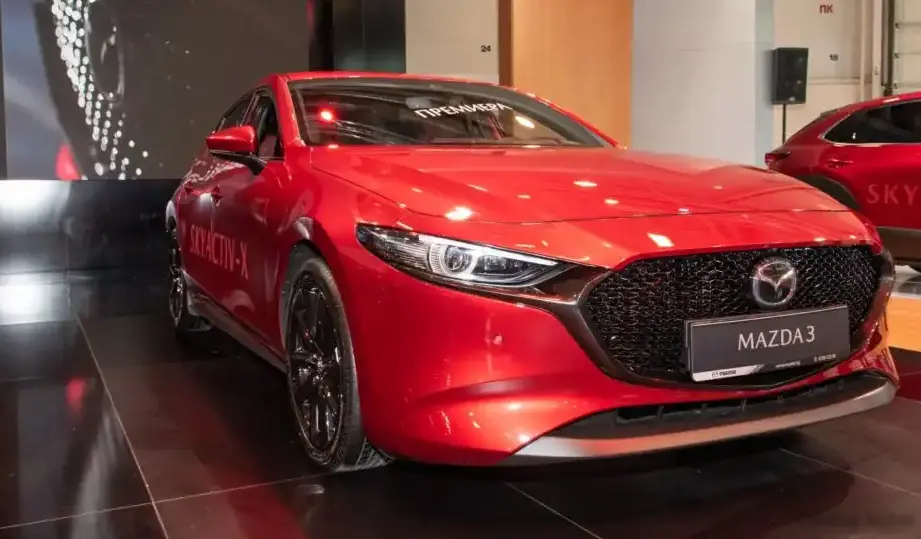
The Mazda 3 IV, launched in 2019, marked a departure from previous generations with its adoption of the SkyActiv-X engine. This 2.0-liter, four-cylinder engine utilizes a unique combustion process – Spark Controlled Compression Ignition (SPCCI) – aiming to combine the benefits of gasoline and diesel engines: high compression for efficiency and gasoline’s cleaner emissions. The M Hybrid system, a 24V mild-hybrid setup, further enhances fuel economy by providing a small amount of electric assistance during acceleration and enabling extended engine stop-start functionality. The addition of all-wheel drive (AWD) through Mazda’s i-Activ AWD system, which uses a multi-plate clutch to seamlessly engage the rear wheels when needed, provided enhanced traction and stability, particularly in inclement weather. This specific 180 hp AWD automatic configuration positioned itself as a mid-range offering within the Mazda 3 lineup, appealing to buyers who desired a balance of performance, fuel economy, and all-weather capability.
Powertrain & Engine Architecture
The heart of this Mazda 3 variant is the PE-VPH 2.0-liter SkyActiv-X engine. Unlike traditional gasoline engines, SkyActiv-X utilizes SPCCI, where the air-fuel mixture is compressed to the point of auto-ignition, triggered by a spark plug. This allows for leaner combustion and improved thermal efficiency. The engine features direct injection, a high compression ratio of 16.3:1, and a sophisticated valve control system. The mild-hybrid system consists of a 24V electric motor and a small lithium-ion battery. This system doesn’t provide full electric drive but assists the engine during acceleration, reducing load and improving fuel economy. The Skyactiv-Drive automatic transmission is a six-speed unit designed for smooth and responsive shifting. It utilizes a torque converter and carefully calibrated gear ratios to optimize performance and efficiency. The transmission is programmed to adapt to driving conditions and driver input, offering both automatic and manual shift modes.
Driving Characteristics
The 180 hp SkyActiv-X engine paired with the six-speed automatic delivers a refined and surprisingly engaging driving experience. While not overtly powerful, the engine provides adequate acceleration, reaching 0-60 mph in approximately 8.5 seconds. The torque curve is relatively flat, offering usable power throughout the rev range. The automatic transmission shifts smoothly and efficiently, although it can sometimes feel hesitant during quick overtaking maneuvers. The i-Activ AWD system provides excellent traction and stability, inspiring confidence in various road conditions. Compared to the base 2.5-liter naturally aspirated engine, the SkyActiv-X offers better fuel economy but slightly less outright power. Against the diesel variants available in Europe, the SkyActiv-X provides a more refined and quieter driving experience, albeit with potentially slightly higher running costs depending on fuel prices.
Equipment & Trim Levels
The 2.0 SkyActiv-X M Hybrid AWD typically came equipped with a generous level of standard features. These included Mazda’s infotainment system with an 8.8-inch display, Apple CarPlay and Android Auto integration, a rearview camera, and a suite of advanced safety features such as lane departure warning, lane-keep assist, and automatic emergency braking. Interior upholstery was typically cloth or a combination of cloth and leatherette, depending on the specific trim package. Optional extras included a premium Bose sound system, a sunroof, heated front seats, and adaptive cruise control. Higher trim levels offered more luxurious interior appointments and additional convenience features.
Chassis & Braking
The Mazda 3 IV utilizes a front McPherson strut and rear torsion beam suspension setup. This configuration provides a good balance of ride comfort and handling precision. The AWD system adds weight, but Mazda engineers carefully tuned the suspension to maintain the car’s agile character. Braking duties are handled by disc brakes on all four wheels, providing ample stopping power. The inclusion of ABS, electronic brakeforce distribution (EBD), and brake assist further enhances safety. Stabilizer bars are fitted to both the front and rear axles to reduce body roll during cornering.
Market Reception & Comparison
The Mazda 3 IV SkyActiv-X M Hybrid AWD was generally well-received by automotive critics. Praise was given for its innovative engine technology, refined driving dynamics, and stylish interior. However, some reviewers noted that the SkyActiv-X engine could be somewhat noisy at higher revs and that the automatic transmission wasn’t always as responsive as some competitors. Compared to other C-segment hatchbacks, the Mazda 3 offered a more premium feel and a more engaging driving experience. Fuel economy was competitive, although not class-leading. Reliability reports have been generally positive, with few major issues reported with the SkyActiv-X engine or the M Hybrid system.
Legacy
The Mazda 3 IV SkyActiv-X M Hybrid AWD represents a significant step forward in Mazda’s pursuit of efficient and engaging driving experiences. The SkyActiv-X engine, while not without its quirks, demonstrated Mazda’s commitment to innovative engine technology. In the used car market, these models hold their value relatively well, thanks to their reputation for reliability and their unique powertrain. The combination of all-wheel drive, mild-hybrid technology, and a refined driving experience continues to appeal to buyers seeking a sophisticated and practical compact hatchback.