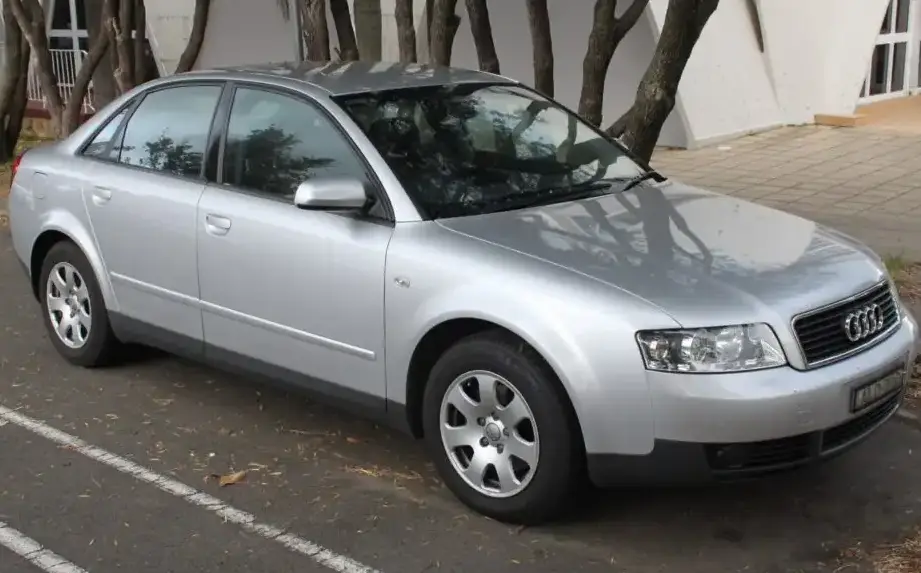
The Audi A4 (B6) 1.6i, produced from June 2000 to November 2004, represented the entry point into the B6 generation of Audi’s popular compact executive car. Positioned as a more affordable option within the A4 range, it served as a key model for attracting buyers seeking Audi’s build quality and refinement without the higher price tag of the more powerful engines. This variant was primarily sold in Europe and other markets where smaller displacement engines were favored due to taxation and fuel economy considerations. It was a significant offering in a segment dominated by the BMW 3 Series and Mercedes-Benz C-Class.
Technical Specifications
| Brand | Audi |
| Model | A4 |
| Generation | A4 (B6 8E) |
| Type (Engine) | 1.6i (102 Hp) |
| Start of production | June, 2000 |
| End of production | November, 2004 |
| Powertrain Architecture | Internal Combustion engine |
| Body type | Sedan |
| Seats | 5 |
| Doors | 4 |
| Fuel consumption (urban) | 10.8 l/100 km (21.8 US mpg, 26.2 UK mpg, 9.3 km/l) |
| Fuel consumption (extra urban) | 6 l/100 km (39.2 US mpg, 47.1 UK mpg, 16.7 km/l) |
| Fuel consumption (combined) | 7.7 l/100 km (30.5 US mpg, 36.7 UK mpg, 13 km/l) |
| Fuel Type | Petrol (Gasoline) |
| Acceleration 0 – 100 km/h | 12.6 sec |
| Acceleration 0 – 62 mph | 12.6 sec |
| Acceleration 0 – 60 mph | 12 sec |
| Maximum speed | 190 km/h (118.06 mph) |
| Weight-to-power ratio | 12.7 kg/Hp, 78.8 Hp/tonne |
| Weight-to-torque ratio | 8.8 kg/Nm, 114.3 Nm/tonne |
| Power | 102 Hp @ 5600 rpm |
| Power per litre | 63.9 Hp/l |
| Torque | 148 Nm @ 3800 rpm (109.16 lb.-ft. @ 3800 rpm) |
| Engine layout | Front, Longitudinal |
| Engine Model/Code | ALZ |
| Engine displacement | 1595 cm3 (97.33 cu. in.) |
| Number of cylinders | 4 |
| Engine configuration | Inline |
| Cylinder Bore | 81 mm (3.19 in.) |
| Piston Stroke | 77.4 mm (3.05 in.) |
| Compression ratio | 10.3:1 |
| Number of valves per cylinder | 2 |
| Fuel injection system | Multi-port manifold injection |
| Engine aspiration | Naturally aspirated engine |
| Valvetrain | SOHC |
| Engine oil capacity | 3.5 l (3.7 US qt | 3.08 UK qt) |
| Coolant | 7.5 l (7.93 US qt | 6.6 UK qt) |
| Kerb Weight | 1295 kg (2854.99 lbs.) |
| Max. weight | 1845 kg (4067.53 lbs.) |
| Max load | 550 kg (1212.54 lbs.) |
| Trunk (boot) space – minimum | 445 l (15.72 cu. ft.) |
| Trunk (boot) space – maximum | 720 l (25.43 cu. ft.) |
| Fuel tank capacity | 70 l (18.49 US gal | 15.4 UK gal) |
| Length | 4548 mm (179.06 in.) |
| Width | 1772 mm (69.76 in.) |
| Height | 1428 mm (56.22 in.) |
| Wheelbase | 2650 mm (104.33 in.) |
| Front track | 1528 mm (60.16 in.) |
| Rear (Back) track | 1526 mm (60.08 in.) |
| Drag coefficient (Cd) | 0.28 |
| Minimum turning circle | 11.1 m (36.42 ft.) |
| Drivetrain Architecture | The Internal combustion engine (ICE) drives the front wheels of the vehicle. |
| Drive wheel | Front wheel drive |
| Number of gears | 5 gears, manual transmission |
| Front suspension | Independent multi-link suspension |
| Rear suspension | Independent multi-link suspension |
| Front brakes | Ventilated discs |
| Rear brakes | Disc |
| Assisting systems | ABS (Anti-lock braking system) |
| Steering type | Steering rack and pinion |
| Power steering | Hydraulic Steering |
| Tires size | 195/65 R15 |
| Wheel rims size | 6.5J x 15 |
Powertrain & Engine Architecture
The Audi A4 1.6i (B6) utilized the ALZ engine code, a 1.6-liter inline-four cylinder gasoline engine. This engine was part of Audi’s EA827 family, known for its relatively simple design and durability. It featured a single overhead camshaft (SOHC) valvetrain operating two valves per cylinder. Fuel delivery was managed by a multi-port fuel injection system, providing adequate, though not exceptional, combustion efficiency. The engine produced 102 horsepower at 5600 rpm and 148 Nm (109 lb-ft) of torque at 3800 rpm. The engine was mounted longitudinally in the front of the vehicle, driving the front wheels. The standard transmission was a five-speed manual gearbox, although an optional four-speed automatic transmission was available, impacting performance and fuel economy.
Driving Characteristics
The 1.6i A4 offered a comfortable, but not particularly sporty, driving experience. Acceleration was modest, taking around 12.6 seconds to reach 62 mph (100 km/h). The engine felt somewhat strained when pushed hard, especially when fully loaded or tackling inclines. The five-speed manual transmission allowed for reasonable control, but the automatic version, while offering convenience, further diminished acceleration and responsiveness. Compared to the more powerful 1.8T and 2.0 versions of the A4 B6, the 1.6i lacked the punch needed for spirited driving. However, its lighter weight and less stressed engine contributed to better fuel economy.
Equipment & Trim Levels
The 1.6i A4 typically came with a base level of equipment, focusing on essential comfort and safety features. Standard items included power windows, central locking, dual front airbags, and ABS brakes. Interior upholstery was typically cloth, and the dashboard featured a straightforward design. Optional extras included alloy wheels, a sunroof, air conditioning, and an upgraded audio system. The trim level was generally considered the entry-level offering, appealing to buyers prioritizing affordability and practicality over luxury features. Higher trim levels, such as the SE or Sport, were available with the more powerful engines and offered a more comprehensive equipment list.
Chassis & Braking
The A4 B6 featured fully independent multi-link suspension on both the front and rear axles, providing a comfortable ride and good handling characteristics. The 1.6i models typically used smaller diameter wheels and tires (195/65 R15) compared to the higher-spec variants. Braking was handled by ventilated discs on the front wheels and solid discs on the rear. ABS (Anti-lock Braking System) was standard, enhancing safety during emergency braking situations. The suspension setup was tuned for comfort rather than outright performance, prioritizing ride quality over sharp handling.
Market Reception & Comparison
The Audi A4 1.6i was generally well-received as an affordable and practical entry point into the Audi brand. Critics acknowledged its build quality and comfortable ride, but often noted its lack of outright performance. Compared to the 1.8T and 2.0 models, the 1.6i offered significantly lower running costs due to its smaller engine and improved fuel economy (around 30.5 US mpg combined). However, the higher-powered variants provided a more engaging driving experience and were better suited for long-distance journeys or frequent highway use. The 1.6i was often seen as a sensible choice for urban commuters and those prioritizing fuel efficiency.
Legacy
The Audi A4 B6 1.6i has proven to be a relatively reliable vehicle, particularly when well-maintained. The ALZ engine is known for its durability, and the simple design makes it relatively easy to repair. In the used car market, these models are often sought after by buyers looking for an affordable and dependable Audi. While not as desirable as the more powerful variants, the 1.6i offers a cost-effective way to experience Audi ownership. Common issues include wear and tear on suspension components and occasional problems with the fuel injection system, but these are generally manageable with regular maintenance.