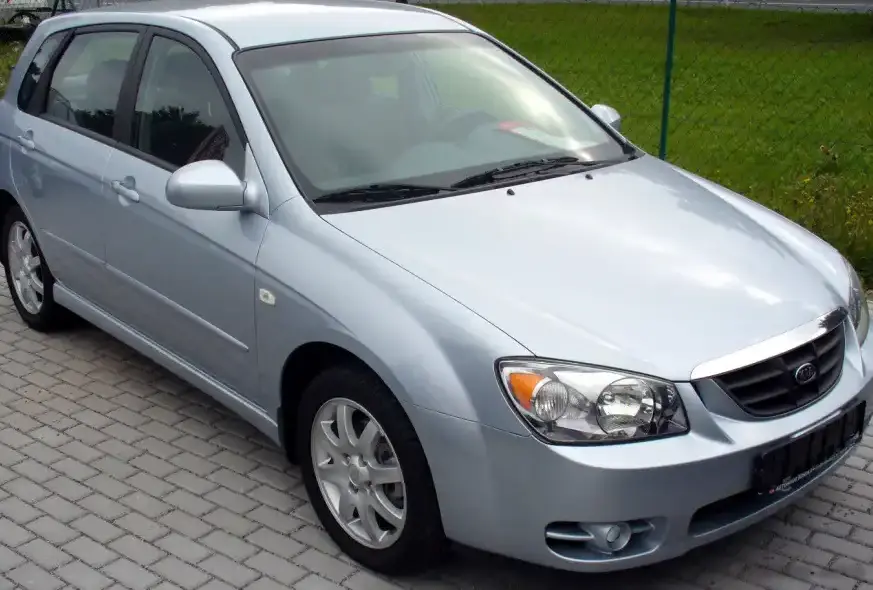
Technical Specifications
| Brand | Kia |
| Model | Cerato |
| Generation | Cerato I Hatchback |
| Type (Engine) | 2.0 (143 Hp) |
| Start of production | 2004 |
| End of production | 2006 |
| Powertrain Architecture | Internal Combustion engine |
| Body type | Hatchback |
| Seats | 5 |
| Doors | 5 |
| Fuel consumption (urban) | 10.3 l/100 km (22.8 US mpg) |
| Fuel consumption (extra urban) | 5.9 l/100 km (39.9 US mpg) |
| Fuel consumption (combined) | 7.5 l/100 km (31.4 US mpg) |
| CO2 emissions | 180 g/km |
| Fuel Type | Petrol (Gasoline) |
| Acceleration 0 – 100 km/h | 9 sec |
| Acceleration 0 – 62 mph | 9 sec |
| Acceleration 0 – 60 mph | 8.6 sec |
| Maximum speed | 208 km/h (129.25 mph) |
| Emission standard | Euro 4 |
| Weight-to-power ratio | 8.7 kg/Hp |
| Weight-to-torque ratio | 6.7 kg/Nm |
| Power | 143 Hp @ 6000 rpm |
| Torque | 186 Nm @ 4500 rpm (137.19 lb.-ft. @ 4500 rpm) |
| Engine layout | Front, Transverse |
| Engine Model/Code | Beta II / G4GC |
| Engine displacement | 1975 cm3 (120.52 cu. in.) |
| Number of cylinders | 4 |
| Engine configuration | Inline |
| Cylinder Bore | 82 mm (3.23 in.) |
| Piston Stroke | 93.5 mm (3.68 in.) |
| Compression ratio | 10.1:1 |
| Number of valves per cylinder | 4 |
| Fuel injection system | Multi-port manifold injection |
| Engine aspiration | Naturally aspirated engine |
| Valvetrain | DOHC |
| Engine oil capacity | 4 l (4.23 US qt | 3.52 UK qt) |
| Coolant capacity | 8.14 l (8.6 US qt | 7.16 UK qt) |
| Kerb Weight | 1250 kg (2755.78 lbs.) |
| Max. weight | 1783 kg (3930.84 lbs.) |
| Max load | 533 kg (1175.06 lbs.) |
| Trunk (boot) space – minimum | 228 l (8.05 cu. ft.) |
| Trunk (boot) space – maximum | 1046 l (36.94 cu. ft.) |
| Fuel tank capacity | 55 l (14.53 US gal | 12.1 UK gal) |
| Length | 4340 mm (170.87 in.) |
| Width | 1735 mm (68.31 in.) |
| Height | 1470 mm (57.87 in.) |
| Wheelbase | 2610 mm (102.76 in.) |
| Front track | 1495 mm (58.86 in.) |
| Rear (Back) track | 1485 mm (58.46 in.) |
| Drag coefficient (Cd) | 0.33 |
| Minimum turning circle | 10.1 m (33.14 ft.) |
| Drivetrain Architecture | Front wheel drive |
| Number of gears | 5 |
| Gearbox type | Manual transmission |
| Front brakes | Ventilated discs |
| Rear brakes | Disc |
| Assisting systems | ABS (Anti-lock braking system) |
| Steering type | Steering rack and pinion |
| Tires size | 205/50 R16 |
| Wheel rims size | 16 |
The Kia Cerato I Hatchback 2.0, manufactured from 2004 to 2006, marked a significant step forward for Kia in the competitive compact car segment. Positioned as a more upscale offering within the Cerato range, it aimed to attract buyers seeking a blend of practicality, style, and a more engaging driving experience than typically associated with the brand at the time. Built on the 1HX0 platform – shared with the Hyundai Elantra – the Cerato hatchback distinguished itself with its increased cargo versatility compared to the sedan counterpart. The 2.0-liter engine, paired with a five-speed manual transmission, occupied a mid-range position in the lineup, offering a noticeable performance upgrade over the base 1.6-liter model while remaining more accessible than any potential future performance-oriented trims.
Powertrain & Engine Architecture
The Cerato 2.0’s engine was the Beta II series, specifically the G4GC code. This 1.975-liter (120.52 cubic inches) inline-four cylinder engine featured a robust cast iron block and an aluminum cylinder head, a common configuration for engines of this era balancing durability and weight. Fuel delivery was handled by a multi-port fuel injection (MPI) system, injecting fuel into the intake ports immediately before the intake valves. The engine employed a double overhead camshaft (DOHC) valvetrain with four valves per cylinder, optimizing airflow for improved power output. A compression ratio of 10.1:1 was typical for naturally aspirated engines of the time, contributing to a good balance of power and efficiency. The five-speed manual transmission was a conventional design, known for its reliability and straightforward maintenance. It featured gear ratios carefully selected to provide a balance between responsive acceleration and comfortable highway cruising.
Driving Characteristics
Behind the wheel, the Cerato 2.0 with the five-speed manual offered a surprisingly spirited driving experience. Producing 143 horsepower and 186 Nm (137 lb-ft) of torque, the engine provided ample power for daily commutes and even some enthusiastic driving. Acceleration from 0 to 60 mph was achieved in approximately 8.6 seconds, a respectable figure for a compact car of its time. The manual transmission allowed drivers to fully utilize the engine’s powerband, resulting in a more engaging and responsive feel. Compared to the 1.6-liter engine, the 2.0-liter delivered significantly more low-end torque, making it easier to accelerate from a stop and tackle inclines. The suspension, while not particularly sophisticated, provided a comfortable ride on most road surfaces. Steering was reasonably precise, though lacking the feedback found in some more performance-focused vehicles.
Equipment & Trim Levels
The Cerato 2.0 typically came equipped with standard features such as air conditioning, power windows and door locks, and an AM/FM radio with a CD player. Higher trim levels often included upgrades like alloy wheels, a power sunroof, and enhanced interior upholstery. The interior design prioritized functionality and durability over outright luxury, featuring a straightforward layout and robust materials. Seats were generally comfortable and provided adequate support for longer journeys. Optional extras available included a premium sound system and, on some models, side airbags.
Chassis & Braking
The Cerato hatchback’s chassis featured a MacPherson strut front suspension and a torsion beam rear suspension. This configuration struck a balance between ride comfort and handling capability. The front brakes were ventilated discs, providing effective stopping power, while the rear brakes utilized solid discs. An Anti-lock Braking System (ABS) was standard equipment, enhancing safety by preventing wheel lockup during emergency braking situations. The steering system employed a rack-and-pinion design, offering reasonably precise steering control. The standard tire size was 205/50 R16, providing a good compromise between grip and ride quality.
Market Reception & Comparison
The Kia Cerato 2.0 was generally well-received by automotive reviewers as a solid and affordable compact car. It was praised for its spacious interior, comfortable ride, and the noticeable performance improvement offered by the 2.0-liter engine. However, some critics pointed out that the interior materials weren’t quite as refined as those found in established competitors like the Honda Civic or Toyota Corolla. Fuel economy was competitive for the class, averaging around 31.4 US mpg in combined driving. Compared to the base 1.6-liter Cerato, the 2.0-liter offered a significant performance boost, but at a slightly higher price point and with marginally reduced fuel efficiency. Many buyers considered the extra cost worthwhile for the added power and refinement.
Legacy
The Kia Cerato I Hatchback 2.0 has proven to be a relatively reliable vehicle, with a significant number still in operation today. The Beta II engine is known for its durability, and the five-speed manual transmission is also generally trouble-free. Routine maintenance requirements include regular oil changes, timing belt replacement (typically between 60,000 and 100,000 miles), and spark plug replacement. In the used car market, the Cerato 2.0 represents a compelling value proposition for buyers seeking an affordable and practical compact car. While it may lack the brand prestige of some competitors, it offers a solid driving experience and a reputation for dependability, making it a sensible choice for budget-conscious consumers.