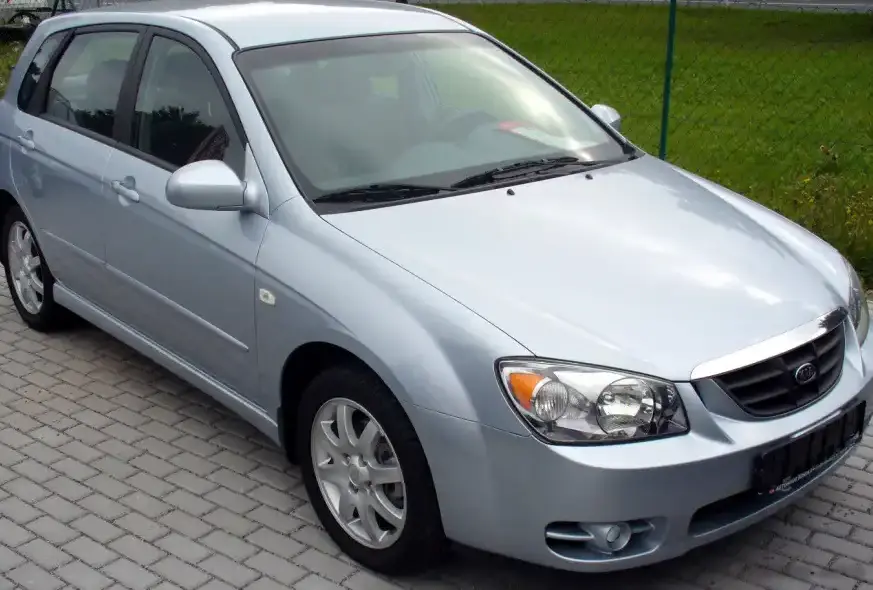
The Kia Cerato, known as the Spectra in some markets, represented Kia’s entry into the competitive compact sedan segment. Introduced for the 2004 model year (as a 2005 model), the first generation Cerato (LD) aimed to offer a more refined and feature-rich alternative to established players. Production of the 1.5 CRDi variant, equipped with a diesel engine and 102 horsepower, spanned from 2005 to 2006. This model was primarily targeted towards European and Asian markets where diesel engines were favored for their fuel efficiency. Within the Cerato I Sedan lineup, the 1.5 CRDi occupied the lower to mid-range position, offering a balance between economy and acceptable performance.
Technical Specifications
| Brand | Kia |
| Model | Cerato |
| Generation | Cerato I Sedan |
| Type (Engine) | 1.5 CRDi (102 Hp) |
| Start of production | 2005 |
| End of production | 2006 |
| Powertrain Architecture | Internal Combustion engine |
| Body type | Sedan |
| Seats | 5 |
| Doors | 4 |
| Fuel consumption (urban) | 6.4 l/100 km (36.8 US mpg) |
| Fuel consumption (extra urban) | 4 l/100 km (58.8 US mpg) |
| Fuel consumption (combined) | 4.9 l/100 km (48 US mpg) |
| CO2 emissions | 128 g/km |
| Fuel Type | Diesel |
| Acceleration 0 – 100 km/h | 12.5 sec |
| Acceleration 0 – 62 mph | 12.5 sec |
| Acceleration 0 – 60 mph | 11.9 sec |
| Maximum speed | 175 km/h (108.74 mph) |
| Emission standard | Euro 3 |
| Weight-to-power ratio | 12.5 kg/Hp |
| Weight-to-torque ratio | 5.4 kg/Nm |
| Power | 102 Hp @ 4000 rpm |
| Torque | 235 Nm @ 2000 rpm (173.33 lb.-ft. @ 2000 rpm) |
| Engine layout | Front, Transverse |
| Engine Model/Code | D4FA |
| Engine displacement | 1493 cm3 (91.11 cu. in.) |
| Number of cylinders | 4 |
| Engine configuration | Inline |
| Cylinder Bore | 75 mm (2.95 in.) |
| Piston Stroke | 84.5 mm (3.33 in.) |
| Compression ratio | 17.8:1 |
| Number of valves per cylinder | 4 |
| Fuel injection system | Diesel Commonrail |
| Engine aspiration | Turbocharger, Intercooler |
| Engine oil capacity | 5.3 l (5.6 US qt | 4.66 UK qt) |
| Coolant capacity | 8.1 l (8.56 US qt | 7.13 UK qt) |
| Kerb Weight | 1270 kg (2799.87 lbs.) |
| Max. weight | 1805 kg (3979.34 lbs.) |
| Max load | 535 kg (1179.47 lbs.) |
| Trunk (boot) space – minimum | 381 l (13.45 cu. ft.) |
| Fuel tank capacity | 55 l (14.53 US gal | 12.1 UK gal) |
| Length | 4480 mm (176.38 in.) |
| Width | 1735 mm (68.31 in.) |
| Height | 1470 mm (57.87 in.) |
| Wheelbase | 2610 mm (102.76 in.) |
| Front track | 1495 mm (58.86 in.) |
| Rear (Back) track | 1485 mm (58.46 in.) |
| Drag coefficient (Cd) | 0.32 |
| Minimum turning circle | 10.1 m (33.14 ft.) |
| Drivetrain Architecture | Front wheel drive |
| Number of gears | 5 gears, manual transmission |
| Front brakes | Ventilated discs |
| Rear brakes | Disc |
| Assisting systems | ABS (Anti-lock braking system) |
| Steering type | Steering rack and pinion |
| Tires size | 195/60 R15 |
| Wheel rims size | 15 |
INTRODUCTION
The Kia Cerato I Sedan 1.5 CRDi, produced between 2005 and 2006, was a key variant in Kia’s efforts to establish itself as a credible competitor in the global compact car market. Built on the LD platform, it offered a diesel-powered option for buyers prioritizing fuel economy. This model was particularly significant in Europe and Asia, where diesel engines enjoyed considerable popularity due to government incentives and lower fuel costs. The 1.5 CRDi trim aimed to provide an affordable and efficient transportation solution, appealing to budget-conscious consumers and those covering significant distances.
Powertrain & Engine Architecture
At the heart of the 1.5 CRDi Cerato lies the D4FA engine, a 1.5-liter inline-four cylinder diesel. This engine utilizes a common rail direct injection system, delivering fuel directly into the combustion chamber at extremely high pressure. This technology, coupled with a turbocharger and intercooler, allows for a good balance of power and efficiency. The engine produces 102 horsepower at 4000 rpm and 235 Nm (173 lb-ft) of torque at 2000 rpm. The engine features four valves per cylinder and a compression ratio of 17.8:1, contributing to its efficiency. The 1.5 CRDi was typically paired with a five-speed manual transmission, optimized for fuel economy and smooth operation. While an automatic transmission was offered on other Cerato trims, it wasn’t generally available with the 1.5 CRDi engine.
Driving Characteristics
The 1.5 CRDi Cerato offered a driving experience focused on practicality and fuel efficiency rather than outright performance. Acceleration from 0 to 100 km/h (0-62 mph) took approximately 12.5 seconds, which was slower than the gasoline-powered variants. However, the engine’s strong low-end torque made it reasonably capable for everyday driving and overtaking maneuvers. The five-speed manual transmission provided adequate control, although the gear ratios were geared towards maximizing fuel economy. Compared to the higher-output 1.6L gasoline engine, the 1.5 CRDi felt less responsive, but it compensated with significantly better fuel consumption. The suspension was tuned for comfort, providing a relatively smooth ride, although it wasn’t particularly sporty.
Equipment & Trim Levels
The 1.5 CRDi trim level typically included standard features such as air conditioning, power steering, central locking, and an integrated audio system. Interior upholstery was generally cloth, and the dashboard featured a functional, if somewhat basic, design. Optional extras included alloy wheels, upgraded audio systems, and power windows. Safety features typically included dual front airbags and ABS (Anti-lock Braking System). The overall interior ambiance was geared towards practicality and value, rather than luxury.
Chassis & Braking
The Cerato I Sedan utilized a front-wheel-drive layout with a MacPherson strut front suspension and a torsion beam rear suspension. The front brakes were ventilated discs, providing adequate stopping power, while the rear brakes were solid discs. The suspension setup was tuned for comfort and stability, prioritizing ride quality over sporty handling. The steering was a rack and pinion system, offering reasonable precision. The 1.5 CRDi variant, due to its lower weight compared to some of the larger-engined models, benefited from slightly improved handling characteristics.
Market Reception & Comparison
The Kia Cerato 1.5 CRDi was generally well-received in markets where diesel engines were popular. Critics praised its fuel efficiency and affordability, but noted its relatively modest performance. Compared to the 1.6L gasoline version, the 1.5 CRDi offered significantly better fuel economy – around 4.9 l/100km combined – but at the expense of acceleration. The 1.5 CRDi was positioned as a more economical alternative to the gasoline models, appealing to buyers who prioritized running costs over driving excitement. It also offered a competitive alternative to other compact diesel sedans from brands like Volkswagen and Ford.
Legacy
The Kia Cerato I Sedan 1.5 CRDi, while not a performance icon, played a crucial role in establishing Kia as a viable competitor in the compact car segment. The D4FA engine proved to be relatively reliable, although, like all diesel engines, it required regular maintenance and careful fuel quality. In the used car market, these models are often sought after for their fuel efficiency and affordability. However, potential buyers should be aware of the age-related wear and tear common to older diesel engines, including potential issues with the turbocharger and fuel injection system. The 1.5 CRDi Cerato remains a testament to Kia’s early efforts to offer a compelling and value-driven product to a global audience.