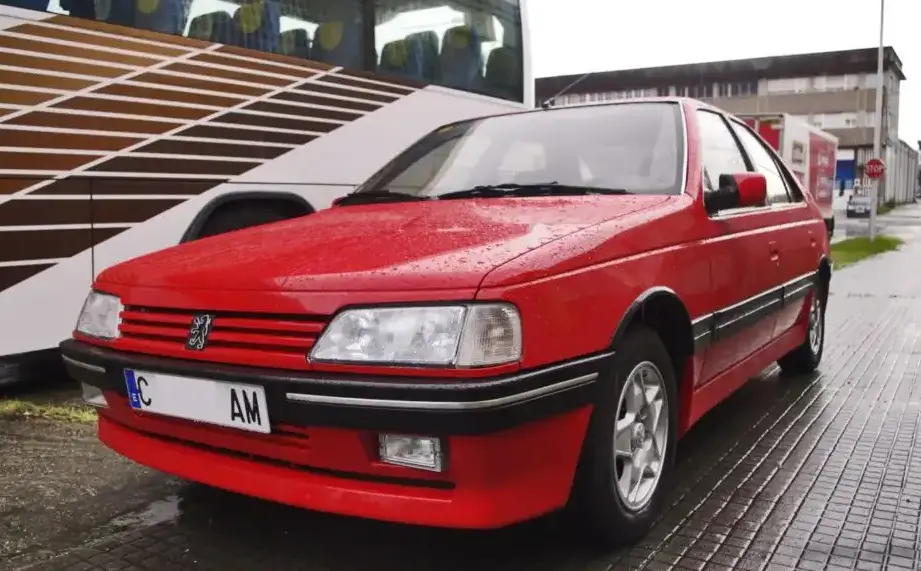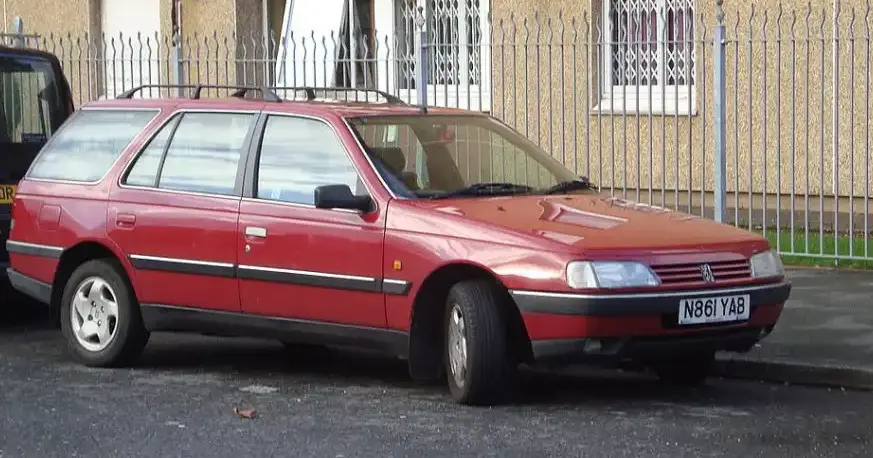
The Peugeot 405 Break 2.0 (121 hp) represents a significant iteration of Peugeot’s popular mid-size family car, produced from 1992 to 1996. Part of the 15E series, which denotes the facelifted version of the original 405, this variant combined the practicality of a station wagon (estate) body style with a fuel-injected 2.0-liter gasoline engine. Positioned as a mid-range offering within the 405 Break lineup, it aimed to provide a balance between performance, fuel economy, and family-oriented functionality. The 405, in general, was a crucial model for Peugeot, representing a move towards more modern design and engineering, and the Break version further expanded its appeal to buyers needing increased cargo capacity.
Technical Specifications
| Brand | Peugeot |
| Model | 405 |
| Generation | 405 I Break (15E, facelift 1992) |
| Type (Engine) | 2.0 (121 Hp) |
| Start of production | 1992 |
| End of production | 1996 |
| Powertrain Architecture | Internal Combustion engine |
| Body type | Station wagon (estate) |
| Seats | 5 |
| Doors | 5 |
| Fuel consumption (extra urban) | 6.3 l/100 km (37.3 US mpg, 44.8 UK mpg, 15.9 km/l) |
| Fuel Type | Petrol (Gasoline) |
| Acceleration 0 – 100 km/h | 11.8 sec |
| Acceleration 0 – 62 mph | 11.8 sec |
| Acceleration 0 – 60 mph | 11.2 sec |
| Maximum speed | 192 km/h (119.3 mph) |
| Weight-to-power ratio | 9.4 kg/Hp, 106.5 Hp/tonne |
| Weight-to-torque ratio | 6.3 kg/Nm, 157.6 Nm/tonne |
| Power | 121 Hp @ 5750 rpm |
| Power per litre | 60.6 Hp/l |
| Torque | 179 Nm @ 2750 rpm (132.02 lb.-ft. @ 2750 rpm) |
| Engine layout | Front, Transverse |
| Engine Model/Code | RFX XU10J2C |
| Engine displacement | 1998 cm3 (121.93 cu. in.) |
| Number of cylinders | 4 |
| Engine configuration | Inline |
| Cylinder Bore | 86 mm (3.39 in.) |
| Piston Stroke | 86 mm (3.39 in.) |
| Compression ratio | 9.5:1 |
| Number of valves per cylinder | 2 |
| Engine aspiration | Naturally aspirated engine |
| Valvetrain | OHC |
| Engine oil capacity | 4.5 l (4.76 US qt | 3.96 UK qt) |
| Coolant | 7 l (7.4 US qt | 6.16 UK qt) |
| Kerb Weight | 1136 kg (2504.45 lbs.) |
| Max. weight | 1650 kg (3637.63 lbs.) |
| Max load | 514 kg (1133.18 lbs.) |
| Trunk (boot) space – minimum | 814 l (28.75 cu. ft.) |
| Trunk (boot) space – maximum | 1640 l (57.92 cu. ft.) |
| Fuel tank capacity | 70 l (18.49 US gal | 15.4 UK gal) |
| Permitted trailer load with brakes (12%) | 1200 kg (2645.55 lbs.) |
| Length | 4398 mm (173.15 in.) |
| Width | 1714 mm (67.48 in.) |
| Height | 1445 mm (56.89 in.) |
| Wheelbase | 2669 mm (105.08 in.) |
| Front track | 1450 mm (57.09 in.) |
| Rear (Back) track | 1443 mm (56.81 in.) |
| Front overhang | 817 mm (32.17 in.) |
| Rear overhang | 912 mm (35.91 in.) |
| Minimum turning circle | 10.55 m (34.61 ft.) |
| Drivetrain Architecture | The Internal combustion engine (ICE) drives the front wheels of the vehicle. |
| Drive wheel | Front wheel drive |
| Number of gears and type of gearbox | 5 gears, manual transmission |
| Front suspension | Independent, type McPherson with coil spring and anti-roll bar |
| Rear suspension | Torsion |
| Front brakes | Ventilated discs |
| Rear brakes | Disc |
| Assisting systems | ABS (Anti-lock braking system) |
| Steering type | Steering rack and pinion |
| Power steering | Hydraulic Steering |
| Tires size | 185/65 R14 |
| Wheel rims size | 14 |
Powertrain & Engine Architecture
The heart of the 405 Break 2.0 was the RFX XU10J2C engine, a 1.998-liter inline-four cylinder gasoline engine. This engine was a mainstay of Peugeot and Citroën vehicles throughout the 1980s and 1990s. It featured a single overhead camshaft (OHC) design operating two valves per cylinder. Fuel delivery was managed by Bosch Motronic MP1.5 multi-point fuel injection, a significant upgrade over earlier carburetor-equipped models, contributing to improved fuel efficiency and smoother operation. The XU10J2C engine was known for its robust construction and relatively simple design, making it reasonably reliable and straightforward to maintain. The engine’s 9.5:1 compression ratio helped extract a respectable 121 horsepower at 5750 rpm and 179 Nm (132 lb-ft) of torque at 2750 rpm. The engine was transversely mounted in the front of the vehicle, driving the front wheels through a five-speed manual transmission.
Driving Characteristics
The 405 Break 2.0 offered a comfortable and composed driving experience, though not particularly sporty. The 121 hp engine provided adequate power for everyday driving and highway cruising, but acceleration was not its strong suit, taking around 11.8 seconds to reach 62 mph. The five-speed manual transmission was well-matched to the engine’s characteristics, allowing drivers to keep the engine in its optimal power band. Compared to the more powerful 405 models, such as those equipped with the 2.0-liter 16-valve engine, the 2.0 8-valve version felt less responsive. However, it offered better fuel economy and a more relaxed driving experience. The torsion beam rear suspension provided a comfortable ride, but didn’t offer the same level of handling precision as more sophisticated independent rear suspension setups.
Equipment & Trim Levels
The 405 Break 2.0 typically came equipped with a reasonable level of standard features for its time. These included power steering, central locking, electric front windows, and an adjustable steering column. Interior upholstery was typically cloth, with a practical and durable finish. Optional extras included a sunroof, air conditioning, and upgraded audio systems. The dashboard layout was functional and ergonomically designed, with clear instrumentation. Trim levels varied depending on the market, but generally, the 2.0-liter model occupied a mid-range position, offering a step up in terms of equipment and refinement compared to the base models.
Chassis & Braking
The 405 Break featured an independent McPherson strut front suspension with coil springs and an anti-roll bar, providing a good balance of ride comfort and handling. The rear suspension utilized a torsion beam setup, which was cost-effective and provided adequate stability for most driving conditions. Braking was handled by ventilated discs at the front and solid discs at the rear. An Anti-lock Braking System (ABS) was standard, enhancing safety by preventing wheel lockup during hard braking. The steering was a rack-and-pinion system with hydraulic power assistance, providing light and precise steering feel.
Market Reception & Comparison
The Peugeot 405 Break 2.0 was generally well-received by automotive critics as a practical and reliable family car. It was praised for its spacious interior, comfortable ride, and fuel efficiency. However, some critics noted that its performance was not particularly exciting compared to some of its rivals. Compared to other 405 variants, the 2.0-liter model offered a good compromise between performance and economy. The 1.6-liter models were more affordable but lacked power, while the higher-output 2.0-liter 16-valve and V6 models were more expensive and less fuel-efficient. The 405 Break competed with other European station wagons such as the Ford Mondeo Estate, Vauxhall/Opel Vectra Estate, and Renault 19 Estate.
Legacy
The Peugeot 405 Break 2.0 has proven to be a durable and reliable vehicle, with many examples still on the road today. The XU10J2C engine is known for its longevity and relatively simple maintenance requirements. However, like any older vehicle, it is susceptible to age-related issues such as corrosion and wear and tear on rubber components. In the used car market, the 405 Break 2.0 is often sought after by enthusiasts and those looking for a classic French car with practical appeal. Its combination of spaciousness, comfort, and reliability has ensured its continued popularity among those who appreciate a well-built and thoughtfully designed vehicle.