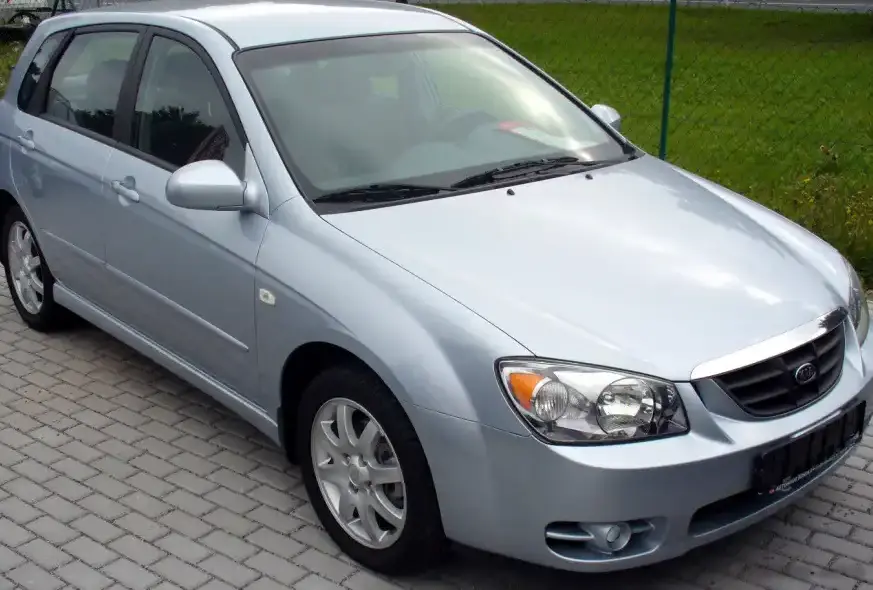
The Kia Cerato, known as the Spectra in some markets, represented Kia’s entry into the competitive compact sedan segment. Introduced for the 2004 model year as a replacement for the Spectra, the first generation Cerato (BD) aimed to offer a more refined and modern alternative to established rivals like the Honda Civic and Toyota Corolla. The 2.0-liter variant, producing 143 horsepower, was a key component of the Cerato lineup, positioned as a mid-range offering that balanced performance and affordability. Production of this first-generation Cerato continued through 2006, establishing a foundation for Kia’s growing presence in the North American market.
Technical Specifications
| Brand | Kia |
| Model | Cerato |
| Generation | Cerato I Sedan |
| Type (Engine) | 2.0 (143 Hp) |
| Start of production | 2004 |
| End of production | 2006 |
| Powertrain Architecture | Internal Combustion engine |
| Body type | Sedan |
| Seats | 5 |
| Doors | 4 |
| Fuel consumption (urban) | 10.2 l/100 km (23.1 US mpg) |
| Fuel consumption (extra urban) | 5.9 l/100 km (39.9 US mpg) |
| Fuel consumption (combined) | 7.5 l/100 km (31.4 US mpg) |
| CO2 emissions | 180 g/km |
| Fuel Type | Petrol (Gasoline) |
| Acceleration 0 – 100 km/h | 9 sec |
| Acceleration 0 – 62 mph | 9 sec |
| Acceleration 0 – 60 mph | 8.6 sec |
| Maximum speed | 208 km/h (129.25 mph) |
| Emission standard | Euro 4 |
| Weight-to-power ratio | 8.6 kg/Hp |
| Weight-to-torque ratio | 6.6 kg/Nm |
| Power | 143 Hp @ 6000 rpm |
| Torque | 186 Nm @ 4500 rpm (137.19 lb.-ft. @ 4500 rpm) |
| Engine layout | Front, Transverse |
| Engine Model/Code | Beta II / G4GC |
| Engine displacement | 1975 cm3 (120.52 cu. in.) |
| Number of cylinders | 4 |
| Engine configuration | Inline |
| Cylinder Bore | 82 mm (3.23 in.) |
| Piston Stroke | 93.5 mm (3.68 in.) |
| Compression ratio | 10.1:1 |
| Number of valves per cylinder | 4 |
| Fuel injection system | Multi-port manifold injection |
| Engine aspiration | Naturally aspirated engine |
| Valvetrain | DOHC |
| Engine oil capacity | 4 l (4.23 US qt | 3.52 UK qt) |
| Coolant capacity | 8.14 l (8.6 US qt | 7.16 UK qt) |
| Kerb Weight | 1225 kg (2700.66 lbs.) |
| Max. weight | 1770 kg (3902.18 lbs.) |
| Max load | 545 kg (1201.52 lbs.) |
| Trunk (boot) space – minimum | 381 l (13.45 cu. ft.) |
| Fuel tank capacity | 55 l (14.53 US gal | 12.1 UK gal) |
| Length | 4480 mm (176.38 in.) |
| Width | 1735 mm (68.31 in.) |
| Height | 1470 mm (57.87 in.) |
| Wheelbase | 2610 mm (102.76 in.) |
| Front track | 1495 mm (58.86 in.) |
| Rear (Back) track | 1485 mm (58.46 in.) |
| Drag coefficient (Cd) | 0.32 |
| Minimum turning circle | 10.1 m (33.14 ft.) |
| Drivetrain Architecture | Front wheel drive |
| Drive wheel | Front wheel drive |
| Number of gears | 5 gears, manual transmission |
| Front brakes | Ventilated discs |
| Rear brakes | Disc |
| Assisting systems | ABS (Anti-lock braking system) |
| Steering type | Steering rack and pinion |
| Tires size | 205/50 R16 |
| Wheel rims size | 16 |
Powertrain & Engine Architecture
The heart of the 2004-2006 Kia Cerato 2.0 was the Beta II engine, specifically the G4GC code. This 1.975-liter inline-four cylinder engine utilized a naturally aspirated configuration and a multi-port fuel injection system. The Beta II engine family was a mainstay for Hyundai-Kia, known for its relative simplicity and durability. The DOHC (Double Overhead Camshaft) valvetrain, with four valves per cylinder, helped to optimize breathing and contribute to the engine’s 143 horsepower output at 6000 rpm and 186 Nm (137.19 lb-ft) of torque at 4500 rpm. The engine’s 10.1:1 compression ratio was a typical value for the time, balancing performance and fuel efficiency. The five-speed manual transmission was the standard offering, providing direct control over the engine’s power.
Driving Characteristics
The Cerato 2.0 with the five-speed manual offered adequate, though not exhilarating, performance. Acceleration from 0-60 mph took approximately 8.6 seconds, and top speed was rated at 129.25 mph. The engine felt reasonably responsive in everyday driving situations, with sufficient torque for merging onto highways and passing slower vehicles. Compared to the base 1.6-liter engine, the 2.0-liter provided a noticeable improvement in acceleration and overall drivability. While not as sporty as some competitors, the Cerato 2.0 offered a comfortable and predictable driving experience. The manual transmission’s gear ratios were well-spaced, allowing the driver to keep the engine in its optimal power band.
Equipment & Trim Levels
The 2.0-liter Cerato typically came with a reasonable level of standard equipment. Features included air conditioning, power windows and locks, and an AM/FM stereo. Higher trim levels added options such as alloy wheels, a sunroof, and upgraded interior upholstery. Interior materials were generally durable, though not particularly luxurious. The dashboard layout was functional and straightforward, prioritizing ease of use over aesthetic flair. Optional extras included a CD player, cruise control, and a more advanced sound system.
Chassis & Braking
The Cerato’s chassis was a typical front-wheel-drive configuration, utilizing a MacPherson strut suspension in the front and a multi-link suspension in the rear. The suspension tuning prioritized ride comfort over sporty handling. The front brakes were ventilated discs, providing adequate stopping power, while the rear brakes were solid discs. ABS (Anti-lock Braking System) was standard, enhancing safety. The Cerato’s steering was a rack-and-pinion system, offering reasonable precision and feedback. The 205/50 R16 tires provided a good balance of grip and ride comfort.
Market Reception & Comparison
The Kia Cerato 2.0 was generally well-received by automotive critics as a solid, value-oriented compact sedan. It was praised for its spacious interior, comfortable ride, and competitive price. However, it was often criticized for its somewhat bland styling and lack of refinement compared to more established rivals. Fuel economy was considered average for the class, with combined figures around 31.4 US mpg. Compared to the base 1.6-liter Cerato, the 2.0-liter offered a significant performance upgrade, making it a more appealing choice for drivers who prioritized acceleration and highway cruising ability. Reliability was generally good, though some owners reported minor issues with the engine’s fuel injectors and sensors.
Legacy
The Kia Cerato 2.0, while not a groundbreaking vehicle, played an important role in establishing Kia as a credible competitor in the compact sedan segment. The Beta II engine proved to be a durable and reliable powerplant, and many examples are still on the road today. In the used car market, the Cerato 2.0 represents a relatively affordable and practical option for buyers seeking a dependable and fuel-efficient vehicle. Its simplicity and readily available parts make it a relatively easy car to maintain. While it may lack the prestige of some of its rivals, the Cerato 2.0 offers a compelling combination of value, reliability, and practicality.