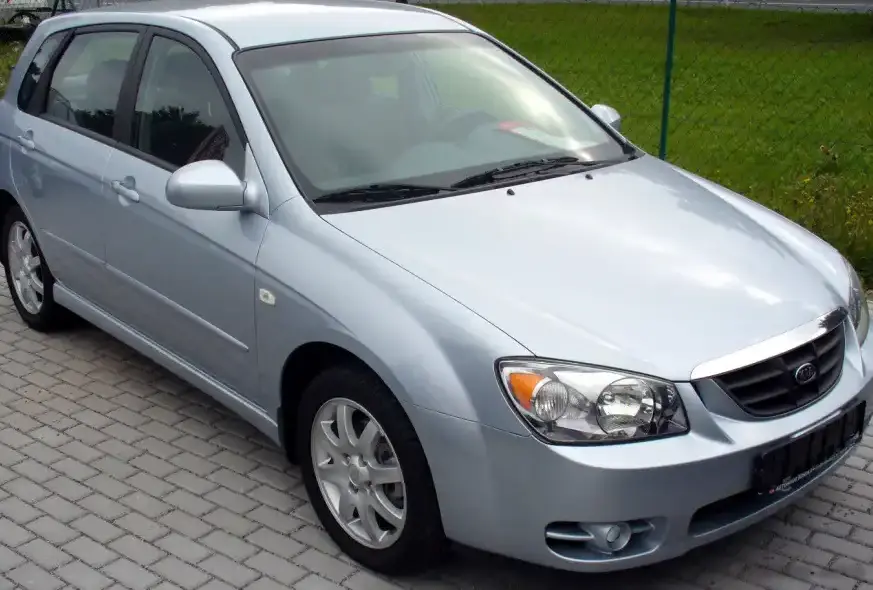
The Kia Cerato II Koup 1.6, produced between 2009 and 2012, represented Kia’s entry into the compact coupe market. Positioned as a more stylish alternative to the Cerato sedan, the Koup aimed to attract younger buyers with its two-door body style and sporty aspirations. This particular 1.6-liter variant served as the base engine option for the Koup in many markets, offering a balance between affordability and reasonable performance. It was part of the second generation of the Cerato (also known as the Forte in some regions), built on the TD platform, and offered a distinct aesthetic from its four-door sibling. The Koup aimed to provide a more engaging driving experience than the standard Cerato, though the 1.6L engine focused more on fuel efficiency than outright speed.
Technical Specifications
| Brand | Kia |
| Model | Cerato |
| Generation | Cerato II Koup |
| Type (Engine) | 1.6 (126 Hp) |
| Start of production | 2009 |
| End of production | 2012 |
| Powertrain Architecture | Internal Combustion engine |
| Body type | Coupe |
| Seats | 5 |
| Doors | 2 |
| Fuel Type | Petrol (Gasoline) |
| Power | 126 Hp @ 6300 rpm |
| Power per litre | 79.2 Hp/l |
| Torque | 156 Nm @ 4200 rpm / 115.06 lb.-ft. @ 4200 rpm |
| Engine layout | Front, Transverse |
| Engine Model/Code | Gamma/G4FC |
| Engine displacement | 1591 cm3 / 97.09 cu. in. |
| Number of cylinders | 4 |
| Engine configuration | Inline |
| Cylinder Bore | 77 mm / 3.03 in. |
| Piston Stroke | 85.4 mm / 3.36 in. |
| Compression ratio | 10.5:1 |
| Number of valves per cylinder | 4 |
| Fuel injection system | Multi-port manifold injection |
| Engine aspiration | Naturally aspirated engine |
| Valvetrain | DOHC, CVVT |
| Engine oil capacity | 3.7 l / 3.91 US qt | 3.26 UK qt |
| Coolant | 5.8 l / 6.13 US qt | 5.1 UK qt |
| Fuel tank capacity | 52 l / 13.74 US gal | 11.44 UK gal |
| Length | 4480 mm / 176.38 in. |
| Width | 1765 mm / 69.49 in. |
| Height | 1400 mm / 55.12 in. |
| Wheelbase | 2650 mm / 104.33 in. |
| Front track | 1560 mm / 61.42 in. |
| Rear track | 1564 mm / 61.57 in. |
| Front overhang | 895 mm / 35.24 in. |
| Rear overhang | 935 mm / 36.81 in. |
| Ride height (ground clearance) | 140 mm / 5.51 in. |
| Minimum turning circle | 10.8 m / 35.43 ft. |
| Drivetrain Architecture | Front wheel drive |
| Number of gears and type of gearbox | 6 gears, manual transmission |
| Front suspension | Independent, type McPherson with coil spring and anti-roll bar |
| Rear suspension | Transverse stabilizer, Coil spring, Torsion |
| Front brakes | Ventilated discs |
| Rear brakes | Disc |
| Assisting systems | ABS (Anti-lock braking system) |
| Steering type | Steering rack and pinion |
| Tires size | 205/55 R16 91H |
| Wheel rims size | 6J x 16 ET48 |
Powertrain & Engine Architecture
The heart of the Cerato Koup 1.6 was the Kia Gamma engine, specifically the G4FC code. This 1.6-liter inline-four engine utilized a multi-point fuel injection system and a double overhead camshaft (DOHC) valvetrain with continuously variable valve timing (CVVT) on both intake and exhaust camshafts. The CVVT system was crucial for optimizing engine performance and fuel efficiency across a wider range of engine speeds. The engine’s 10.5:1 compression ratio was a typical value for naturally aspirated gasoline engines of this era, balancing power output with fuel economy. The six-speed manual transmission was the standard offering, providing drivers with direct control over gear selection. The engine was designed for reliability and ease of maintenance, reflecting Kia’s growing focus on build quality during this period.
Driving Characteristics
The 126 horsepower and 156 Nm (115 lb-ft) of torque produced by the 1.6-liter engine translated to adequate, but not exhilarating, performance. Acceleration was best described as leisurely, with a 0-60 mph time estimated around 10-11 seconds. The six-speed manual transmission helped to keep the engine in its optimal power band, but the Koup 1.6 wasn’t designed for spirited driving. Compared to the more powerful engines available in the Koup lineup (such as the 2.0-liter), the 1.6 offered a more economical driving experience. The gear ratios were tuned for fuel efficiency, resulting in a comfortable cruising experience on the highway, but requiring more frequent downshifts when overtaking or climbing hills. The front-wheel-drive configuration provided predictable handling, but lacked the dynamic capabilities of all-wheel-drive systems.
Equipment & Trim Levels
The base 1.6-liter Koup typically came equipped with standard features such as air conditioning, power windows and locks, and a basic audio system. Interior upholstery was generally cloth, with a relatively simple dashboard layout. Optional extras included alloy wheels, a sunroof, upgraded audio systems, and a leather-wrapped steering wheel. Higher trim levels added features like automatic climate control, keyless entry, and more premium interior materials. The Koup aimed to offer a good value proposition, providing a stylish coupe body style with a reasonable level of equipment at an affordable price point.
Chassis & Braking
The Cerato Koup 1.6 utilized a McPherson strut front suspension and a torsion beam rear suspension. This setup provided a comfortable ride quality, but wasn’t particularly sporty. The front suspension incorporated a stabilizer bar to reduce body roll during cornering. Braking duties were handled by ventilated discs at the front and solid discs at the rear, equipped with an Anti-lock Braking System (ABS) as standard. The braking system was adequate for the car’s weight and performance, but lacked the stopping power of more advanced braking systems found on higher-performance vehicles.
Market Reception & Comparison
The Kia Cerato Koup 1.6 was generally well-received as an affordable and stylish coupe. Critics praised its design and value for money, but noted that the 1.6-liter engine lacked the power to deliver a truly engaging driving experience. Compared to other compact coupes on the market, such as the Honda Civic Coupe or the Volkswagen Scirocco, the Koup offered a more budget-friendly option. Fuel economy was a strong point for the 1.6-liter variant, making it an attractive choice for drivers prioritizing efficiency. Reliability was also considered to be good, with the Gamma engine proving to be relatively durable.
Legacy
The Kia Cerato Koup 1.6, while not a performance icon, played a significant role in establishing Kia as a more desirable brand. The Gamma engine proved to be a reliable and fuel-efficient powerplant, and the Koup’s stylish design helped to attract a new generation of buyers to the Kia brand. On the used car market today, the Koup 1.6 remains an affordable and practical option for those seeking a stylish coupe. Maintenance costs are generally low, and parts availability is good. While it may not offer the performance of its more powerful siblings, the 1.6-liter variant provides a comfortable and economical driving experience, making it a solid choice for everyday transportation.