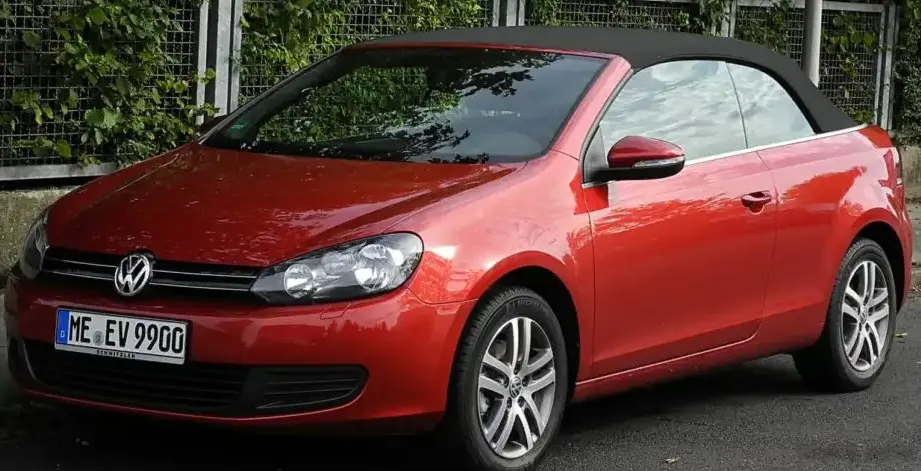
The Volkswagen Golf VI Cabriolet GTI 2.0 TSI, produced between 2012 and 2015, represented a compelling blend of open-air motoring and the renowned GTI performance ethos. Positioned as the performance flagship of the Golf VI Cabriolet range, it offered a more dynamic driving experience than the standard models. This variant was part of the larger Golf VI series (built from 2008-2013), which itself was based on the A5 platform, also known internally as the 1K platform. The Cabriolet version, introduced later in the lifecycle, aimed to capitalize on the enduring popularity of open-top cars, offering a stylish and sporty alternative within the compact convertible segment.
Technical Specifications
| Brand | Volkswagen |
| Model | Golf |
| Generation | Golf VI Cabriolet |
| Type (Engine) | GTI 2.0 TSI (210 Hp) |
| Start of production | 2012 |
| End of production | 2015 |
| Powertrain Architecture | Internal Combustion engine |
| Body type | Cabriolet |
| Seats | 4 |
| Doors | 2 |
| Fuel consumption (economy) – urban (NEDC) | 10.4 l/100 km (22.6 US mpg, 27.2 UK mpg, 9.6 km/l) |
| Fuel consumption (economy) – extra urban (NEDC) | 6 l/100 km (39.2 US mpg, 47.1 UK mpg, 16.7 km/l) |
| Fuel consumption (economy) – combined (NEDC) | 7.6 l/100 km (30.9 US mpg, 37.2 UK mpg, 13.2 km/l) |
| CO2 emissions (NEDC) | 177 g/km |
| Fuel Type | Petrol (Gasoline) |
| Acceleration 0 – 100 km/h | 7.3 sec |
| Acceleration 0 – 62 mph | 7.3 sec |
| Acceleration 0 – 60 mph | 6.9 sec |
| Maximum speed | 237 km/h (147.26 mph) |
| Emission standard | Euro 5 |
| Weight-to-power ratio | 6.9 kg/Hp, 144 Hp/tonne |
| Weight-to-torque ratio | 5.2 kg/Nm, 192 Nm/tonne |
| Power | 210 Hp @ 5300-6200 rpm |
| Power per litre | 105.8 Hp/l |
| Torque | 280 Nm @ 1700-5200 rpm (206.52 lb.-ft. @ 1700-5200 rpm) |
| Engine layout | Front, Transverse |
| Engine Model/Code | CCZB |
| Engine displacement | 1984 cm3 (121.07 cu. in.) |
| Number of cylinders | 4 |
| Engine configuration | Inline |
| Cylinder Bore | 82.5 mm (3.25 in.) |
| Piston Stroke | 92.8 mm (3.65 in.) |
| Compression ratio | 9.6:1 |
| Number of valves per cylinder | 4 |
| Fuel injection system | Direct injection |
| Engine aspiration | Turbocharger, Intercooler |
| Valvetrain | DOHC |
| Engine oil capacity | 4.7 l (4.97 US qt | 4.14 UK qt) |
| Kerb Weight | 1458 kg (3214.34 lbs.) |
| Max. weight | 1960 kg (4321.06 lbs.) |
| Max load | 502 kg (1106.72 lbs.) |
| Trunk (boot) space – minimum | 250 l (8.83 cu. ft.) |
| Fuel tank capacity | 55 l (14.53 US gal | 12.1 UK gal) |
| Permitted trailer load with brakes (12%) | 1400 kg (3086.47 lbs.) |
| Permitted trailer load without brakes | 750 kg (1653.47 lbs.) |
| Permitted towbar download | 75 kg (165.35 lbs.) |
| Length | 4258 mm (167.64 in.) |
| Width | 1782 mm (70.16 in.) |
| Width including mirrors | 2044 mm (80.47 in.) |
| Height | 1414 mm (55.67 in.) |
| Wheelbase | 2578 mm (101.5 in.) |
| Front track | 1533 mm (60.35 in.) |
| Rear (Back) track | 1514 mm (59.61 in.) |
| Ride height (ground clearance) | 130 mm (5.12 in.) |
| Minimum turning circle (turning diameter) | 10.9 m (35.76 ft.) |
| Approach angle | 11.7° |
| Departure angle | 14.1° |
| Ramp-over (brakeover) angle | 9.7° |
| Drivetrain Architecture | The Internal combustion engine (ICE) drives the front wheels of the vehicle. |
| Drive wheel | Front wheel drive |
| Number of gears and type of gearbox | 6 gears, manual transmission |
| Front suspension | Independent type McPherson, Transverse stabilizer |
| Rear suspension | Independent multi-link suspension, Transverse stabilizer |
| Front brakes | Ventilated discs |
| Rear brakes | Disc |
| Assisting systems | ABS (Anti-lock braking system) |
| Steering type | Steering rack and pinion |
| Power steering | Electric Steering |
| Tires size | 225/40 R18 |
| Wheel rims size | 7.5J x 18 |
Powertrain & Engine Architecture
At the heart of the Golf VI Cabriolet GTI was the CCZB engine code, a 2.0-liter turbocharged inline-four cylinder gasoline engine. This engine was a member of the EA888 family, known for its robust design and tuning potential. The CCZB featured direct fuel injection (FSI) and an intercooled turbocharger, allowing it to produce 210 horsepower and 280 Nm (206.52 lb-ft) of torque. The engine utilized a dual overhead camshaft (DOHC) valvetrain with four valves per cylinder, optimizing airflow for improved performance. The six-speed manual transmission was standard, providing precise gear changes and enhancing the driving experience. The engine’s turbocharger provided strong low-end torque, making it responsive in everyday driving situations.
Driving Characteristics
The Golf VI Cabriolet GTI offered a noticeably more engaging driving experience compared to the base Cabriolet models. The 210 hp engine provided brisk acceleration, with a 0-60 mph time of around 6.9 seconds. While not a dedicated sports car, the GTI delivered ample power for confident overtaking and spirited driving. The manual transmission allowed for greater driver control, while the well-tuned suspension minimized body roll during cornering. The Cabriolet’s chassis was reinforced compared to the standard Golf to compensate for the lack of a fixed roof, resulting in a surprisingly rigid and stable platform. However, the added weight of the convertible top mechanism and reinforcement did slightly impact handling compared to the Golf GTI hatchback.
Equipment & Trim Levels
The GTI trim level came well-equipped as standard. Interior features included sport seats upholstered in the classic GTI tartan fabric, a leather-wrapped steering wheel, and aluminum pedal caps. Standard exterior features included 18-inch alloy wheels, a rear spoiler, and distinctive GTI badging. Optional extras included bi-xenon headlights, a premium sound system, and a navigation system. The interior dashboard layout was typical of the Golf VI, with a functional and ergonomic design. The GTI also featured unique instrument cluster graphics and ambient lighting.
Chassis & Braking
The Golf VI Cabriolet GTI utilized an independent McPherson strut suspension at the front and a multi-link suspension at the rear. This setup provided a good balance between ride comfort and handling precision. Stabilizer bars were fitted to both axles to reduce body roll. The braking system consisted of ventilated discs at the front and solid discs at the rear, providing adequate stopping power. Anti-lock braking system (ABS) was standard, enhancing safety and control during emergency braking situations.
Market Reception & Comparison
The Golf VI Cabriolet GTI was generally well-received by automotive critics. It was praised for its sporty handling, powerful engine, and stylish design. However, some reviewers noted that the Cabriolet body style added weight and compromised structural rigidity compared to the hatchback version. Compared to other compact convertibles of the time, such as the Mazda MX-5 and BMW Z4, the Golf GTI offered a more practical and versatile package, with a larger interior and more usable trunk space. Fuel economy was reasonable for a performance-oriented convertible, averaging around 30.9 US mpg in combined driving.
Legacy
The Golf VI Cabriolet GTI remains a popular choice among enthusiasts seeking a stylish and engaging open-top driving experience. The CCZB engine is known for its reliability, provided it is properly maintained. Common maintenance items include regular oil changes, spark plug replacements, and turbocharger inspections. Today, well-maintained examples command a reasonable price on the used car market, reflecting their enduring appeal and the Golf GTI’s strong reputation. The Golf VI Cabriolet GTI represents a significant chapter in the Golf’s history, successfully combining the GTI’s performance DNA with the freedom of open-air motoring.