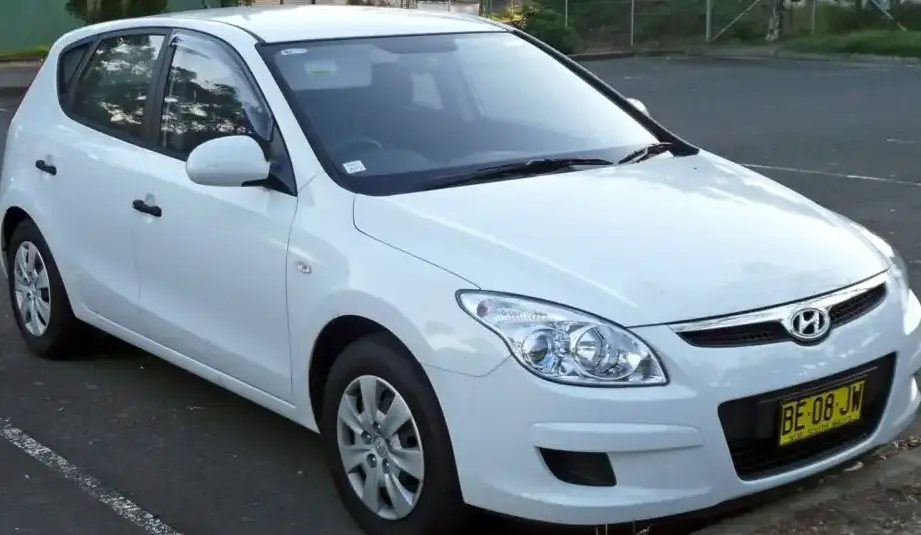
The Hyundai i30 III Fastback, specifically the 1.0 T-GDI (100 hp) DCT variant, represents an entry point into the third generation of Hyundai’s globally successful compact car. Introduced with the facelift in June 2024, this model combines the sleek fastback body style with a downsized turbocharged engine and a dual-clutch transmission. It’s positioned as a fuel-efficient and accessible option within the i30 lineup, targeting buyers prioritizing economy and practicality over outright performance. The i30 III, built on the PQ35 platform (shared with the Kia Ceed and Hyundai Elantra), aimed to elevate Hyundai’s presence in the competitive European C-segment, and the Fastback body style offered a more coupe-like aesthetic compared to the traditional hatchback.
Technical Specifications
| Brand | Hyundai |
| Model | i30 |
| Generation | i30 III Fastback (facelift 2024) |
| Type (Engine) | 1.0 T-GDI (100 Hp) DCT |
| Start of production | June, 2024 |
| Powertrain Architecture | Internal Combustion engine |
| Body type | Fastback |
| Seats | 5 |
| Doors | 5 |
| Fuel consumption at Low speed (WLTP) | 7.8 l/100 km (30.2 US mpg, 36.2 UK mpg, 12.8 km/l) |
| Fuel consumption at Medium speed (WLTP) | 5.5 l/100 km (42.8 US mpg, 51.4 UK mpg, 18.2 km/l) |
| Fuel consumption at high speed (WLTP) | 4.8 l/100 km (49 US mpg, 58.9 UK mpg, 20.8 km/l) |
| Fuel consumption at very high speed (WLTP) | 6.0 l/100 km (39.2 US mpg, 47.1 UK mpg, 16.7 km/l) |
| Combined fuel consumption (WLTP) | 5.8 l/100 km (40.6 US mpg, 48.7 UK mpg, 17.2 km/l) |
| CO2 emissions (WLTP) | 130 g/km |
| Fuel Type | Petrol (Gasoline) |
| Acceleration 0 – 100 km/h | 13.3 sec |
| Acceleration 0 – 62 mph | 13.3 sec |
| Acceleration 0 – 60 mph | 12.6 sec |
| Maximum speed | 178 km/h (110.6 mph) |
| Emission standard | Euro 6e |
| Weight-to-power ratio | 12.8 kg/Hp, 78 Hp/tonne |
| Weight-to-torque ratio | 7.5 kg/Nm, 134.2 Nm/tonne |
| Power | 100 Hp @ 6000 rpm |
| Power per litre | 100.2 Hp/l |
| Torque | 172 Nm @ 1500-4000 rpm (126.86 lb.-ft. @ 1500-4000 rpm) |
| Engine layout | Front, Transverse |
| Engine Model/Code | G3LE |
| Engine displacement | 998 cm3 (60.9 cu. in.) |
| Number of cylinders | 3 |
| Engine configuration | Inline |
| Cylinder Bore | 71 mm (2.8 in.) |
| Piston Stroke | 84 mm (3.31 in.) |
| Compression ratio | 10.5:1 |
| Number of valves per cylinder | 4 |
| Fuel injection system | Direct injection |
| Engine aspiration | Turbocharger, Intercooler |
| Valvetrain | DOHC |
| Engine oil capacity | 3.6 l (3.8 US qt | 3.17 UK qt) |
| Coolant | 5.9 l (6.23 US qt | 5.19 UK qt) |
| Kerb Weight | 1282-1423 kg (2826.33 – 3137.18 lbs.) |
| Max. weight | 1850 kg (4078.55 lbs.) |
| Max load | 427-568 kg (941.37 – 1252.23 lbs.) |
| Trunk (boot) space – minimum | 450 l (15.89 cu. ft.) |
| Trunk (boot) space – maximum | 1351 l (47.71 cu. ft.) |
| Fuel tank capacity | 50 l (13.21 US gal | 11 UK gal) |
| Max. roof load | 80 kg (176.37 lbs.) |
| Permitted trailer load with brakes (12%) | 710 kg (1565.28 lbs.) |
| Permitted trailer load without brakes | 510 kg (1124.36 lbs.) |
| Length | 4455 mm (175.39 in.) |
| Width | 1795 mm (70.67 in.) |
| Height | 1425 mm (56.1 in.) |
| Wheelbase | 2650 mm (104.33 in.) |
| Front track | 1555-1565 mm (61.22 – 61.61 in.) |
| Rear (Back) track | 1563-1576 mm (61.54 – 62.05 in.) |
| Front overhang | 905 mm (35.63 in.) |
| Rear overhang | 900 mm (35.43 in.) |
| Ride height (ground clearance) | 135 mm (5.31 in.) |
| Minimum turning circle (turning diameter) | 10.6 m (34.78 ft.) |
| Drivetrain Architecture | The Internal combustion engine (ICE) drives the front wheels of the vehicle. |
| Drive wheel | Front wheel drive |
| Number of gears and type of gearbox | 7 gears, automatic transmission DCT |
| Front suspension | Independent type McPherson |
| Rear suspension | Independent multi-link suspension |
| Front brakes | Ventilated discs |
| Rear brakes | Disc |
| Assisting systems | ABS (Anti-lock braking system) |
| Steering type | Steering rack and pinion |
| Power steering | Electric Steering |
| Tires size | 205/55 R16; 225/45 R17; 225/40 R18 |
| Wheel rims size | 6.5J x 16; 7.0J x 17; 7.5J x 18 |
Powertrain & Engine Architecture
The heart of this i30 variant is Hyundai’s G3LE, a 1.0-liter turbocharged three-cylinder engine. This engine falls under the Kappa family, known for its compact size and efficiency. The G3LE utilizes direct fuel injection and a single scroll turbocharger with an intercooler to deliver 100 horsepower at 6000 rpm and 172 Nm (126.86 lb-ft) of torque between 1500 and 4000 rpm. The engine features a double overhead camshaft (DOHC) valvetrain with four valves per cylinder. Paired with this engine is a 7-speed dual-clutch transmission (DCT). This DCT provides quicker and smoother gear changes compared to a traditional automatic, contributing to improved fuel economy and a more engaging driving experience. The DCT’s programming prioritizes efficiency, with taller gear ratios designed for highway cruising.
Driving Characteristics
The 1.0 T-GDI with the DCT delivers adequate performance for everyday driving. Acceleration from 0-60 mph takes around 12.6 seconds, and top speed is rated at 178 km/h (110.6 mph). While not sporty, the engine provides sufficient power for merging onto highways and overtaking slower traffic. The DCT transmission is responsive, but can exhibit some hesitation at low speeds. Compared to higher-output i30 variants, such as those with the 1.6-liter gasoline engine, this version feels less powerful, particularly when fully loaded. However, the lighter engine weight contributes to better handling and a more balanced feel. The gear ratios are tuned for fuel efficiency, meaning the engine can feel strained when demanding rapid acceleration.
Equipment & Trim Levels
The 1.0 T-GDI DCT typically comes standard with a respectable level of equipment. This includes air conditioning, a touchscreen infotainment system with Apple CarPlay and Android Auto compatibility, Bluetooth connectivity, and a suite of safety features such as lane keeping assist, forward collision avoidance assist, and automatic emergency braking. Interior upholstery is typically cloth, with options for upgraded materials available. Higher trim levels add features like a larger touchscreen, navigation system, heated seats, and a sunroof. The Fastback body style itself adds a degree of visual flair compared to the standard hatchback.
Chassis & Braking
The i30 Fastback utilizes a McPherson strut front suspension and a multi-link rear suspension. This setup provides a comfortable ride quality while maintaining reasonable handling characteristics. The front brakes are ventilated discs, while the rear brakes are solid discs. ABS (Anti-lock Braking System) is standard. The suspension tuning is geared towards comfort, with a focus on absorbing bumps and providing a stable ride. Stabilizer bars are fitted to both the front and rear axles to reduce body roll during cornering.
Market Reception & Comparison
The 1.0 T-GDI DCT i30 Fastback was generally well-received by critics as a practical and economical choice. Its fuel efficiency, particularly in combined driving cycles, was a major selling point. Compared to the 1.4 T-GDI variant, the 1.0 T-GDI offered similar fuel economy with a slightly lower purchase price, making it attractive to budget-conscious buyers. However, some reviewers noted the engine could feel underpowered in certain situations. Compared to diesel-powered i30 models, the 1.0 T-GDI offered a smoother and quieter driving experience, but with slightly higher running costs.
Legacy
The G3LE engine, while relatively new, has proven to be generally reliable. The DCT transmission, however, can be prone to occasional issues if not properly maintained. Regular servicing, including fluid changes, is crucial for ensuring the longevity of the transmission. In the used car market, the 1.0 T-GDI i30 Fastback represents a good value proposition for buyers seeking a fuel-efficient and stylish compact car. Its relatively low running costs and modern features make it a competitive option in its segment. The combination of the downsized engine and DCT transmission reflects Hyundai’s commitment to improving fuel economy and reducing emissions.