
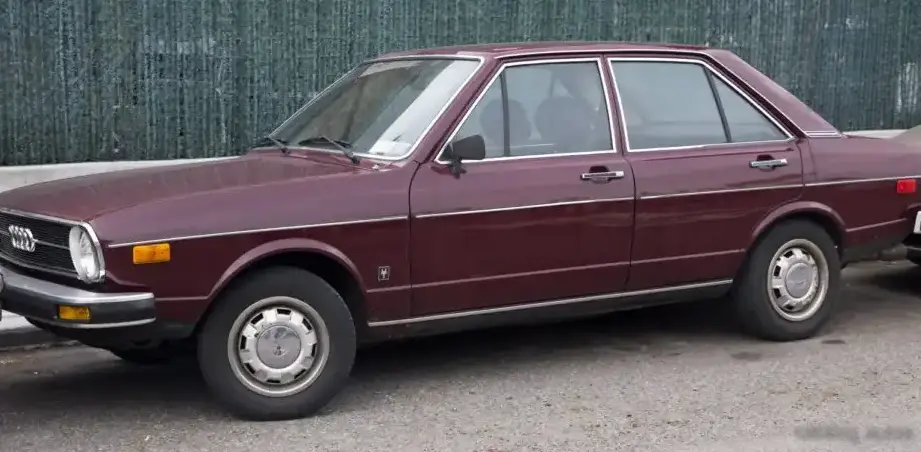
The Audi Fox (B1) 1.5, produced between 1973 and 1979, represented Audi’s entry into the compact sedan market, primarily aimed at European and North American consumers. Positioned as a more affordable and practical alternative to larger Audi models, the Fox was based on the Volkswagen Golf’s platform (though with distinct Audi styling and features). The 1.5-liter, 75 horsepower variant served as the base engine option, offering a balance of fuel economy and usability for everyday driving. It was the foundational model for the B1 Fox range, upon which more powerful and luxurious trims were built.
Technical Specifications
| Brand | Audi |
| Model | Fox |
| Generation | Fox (B1) |
| Type (Engine) | 1.5 (75 Hp) |
| Start of production | 1973 |
| End of production | 1979 |
| Powertrain Architecture | Internal Combustion engine |
| Body type | Sedan |
| Seats | 5 |
| Doors | 4 |
| Fuel Type | Petrol (Gasoline) |
| Power | 75 Hp @ 6000 rpm |
| Power per litre | 51 Hp/l |
| Engine displacement | 1471 cm3 |
| 89.77 cu. in. | |
| Number of cylinders | 4 |
| Engine configuration | Inline |
| Cylinder Bore | 76.5 mm |
| 3.01 in. | |
| Piston Stroke | 80 mm |
| 3.15 in. | |
| Compression ratio | 8.2:1 |
| Number of valves per cylinder | 2 |
| Fuel injection system | Carburettor |
| Engine aspiration | Naturally aspirated engine |
| Valvetrain | SOHC |
| Engine oil capacity | 2.8 l |
| 2.96 US qt | 2.46 UK qt | |
| Coolant | 6.2 l |
| 6.55 US qt | 5.46 UK qt | |
| Trunk (boot) space – minimum | 439 l |
| 15.5 cu. ft. | |
| Fuel tank capacity | 45 l |
| 11.89 US gal | 9.9 UK gal | |
| Length | 4369 mm |
| 172.01 in. | |
| Width | 1643 mm |
| 64.69 in. | |
| Height | 1361 mm |
| 53.58 in. | |
| Wheelbase | 2469 mm |
| 97.2 in. | |
| Front track | 1339 mm |
| 52.72 in. | |
| Rear (Back) track | 1334 mm |
| 52.52 in. | |
| Minimum turning circle (turning diameter) | 9.8 m |
| 32.15 ft. | |
| Drivetrain Architecture | The Internal combustion engine (ICE) drives the front wheels of the vehicle. |
| Drive wheel | Front wheel drive |
| Number of gears and type of gearbox | 4 gears, manual transmission |
| Front suspension | Independent type McPherson |
| Rear suspension | Trailing arm, Torsion |
| Front brakes | Disc, 238.76 mm |
| Rear brakes | Drum, 199.39 mm |
| Steering type | Steering rack and pinion |
| Wheel rims size | 5J x 13 |
Powertrain & Engine Architecture
The heart of the Audi Fox 1.5 was the Type GA engine, a 1471cc inline four-cylinder unit. This engine featured a single overhead camshaft (SOHC) valvetrain operating two valves per cylinder. Fuel delivery was managed by a Solex C35 PHH carburetor, a common setup for the era. The engine’s 8.2:1 compression ratio was a compromise between performance and the fuel quality available at the time. The engine was mounted longitudinally in the front of the vehicle, driving the front wheels. The four-speed manual transmission was the standard offering, providing a relatively simple and robust drivetrain. The engine’s design prioritized reliability and ease of maintenance over outright power.
Driving Characteristics
The 75 horsepower output of the 1.5-liter engine translated to modest, but adequate, performance. Acceleration was not brisk, and the Fox 1.5 was best suited for relaxed cruising and city driving. The four-speed manual transmission offered a reasonable spread of gears, but the engine lacked the torque to make frequent downshifts unnecessary. Compared to the later 1.6-liter and five-cylinder versions of the Fox, the 1.5 felt noticeably underpowered, particularly when fully loaded or tackling inclines. However, its lighter weight compared to those models did offer some advantage in handling. The steering, utilizing a rack and pinion system, was reasonably precise, contributing to a predictable driving experience.
Equipment & Trim Levels
The base Audi Fox 1.5 was relatively sparsely equipped, reflecting its position as the entry-level model. Standard features typically included cloth upholstery, basic instrumentation (speedometer, fuel gauge, temperature gauge), and manually operated windows and door locks. The interior was functional and durable, prioritizing practicality over luxury. Optional extras included a radio, upgraded upholstery, and a sunroof. Higher trim levels, such as the Fox L and Fox GL, added features like more comfortable seats, additional chrome trim, and improved sound insulation. The base 1.5 model was often seen as a blank canvas for buyers who wanted to add their own personal touches.
Chassis & Braking
The Audi Fox B1 utilized a McPherson strut independent suspension at the front, providing a comfortable ride and reasonable handling. The rear suspension employed a trailing arm torsion beam setup, which was cost-effective and space-efficient. Braking duties were handled by disc brakes at the front and drum brakes at the rear. While adequate for the vehicle’s weight and performance, the drum brakes on the rear wheels were a point of criticism compared to the all-disc setups found on higher-spec models. The steering system was a rack and pinion, offering a direct feel. Wheel size was typically 5J x 13 inches, fitted with relatively narrow tires.
Market Reception & Comparison
The Audi Fox 1.5 was generally well-received as a practical and affordable compact car. Critics praised its build quality and handling, but noted its modest performance. Compared to its Volkswagen Golf sibling, the Fox offered a slightly more refined interior and a more upscale image, justifying its higher price point. The 1.5-liter engine was considered adequate for most drivers, but those seeking more power often opted for the 1.6-liter or five-cylinder versions. Fuel economy was a strong point, making the Fox 1.5 an attractive option for budget-conscious buyers. Reliability was generally good, although the carburetor required periodic adjustment and maintenance.
Legacy
The Audi Fox (B1) 1.5 played a significant role in establishing Audi as a maker of quality compact cars in both Europe and North America. While the 1.5-liter engine is now considered underpowered by modern standards, it was a reliable and durable unit that provided years of service for many owners. Today, well-maintained examples of the Fox 1.5 are sought after by classic car enthusiasts, particularly those who appreciate the simplicity and charm of 1970s automotive engineering. Parts availability can be a challenge, but a dedicated community of owners and suppliers helps to keep these cars on the road. The Fox B1 laid the groundwork for Audi’s future success in the compact car segment, and remains a fondly remembered vehicle for many.
