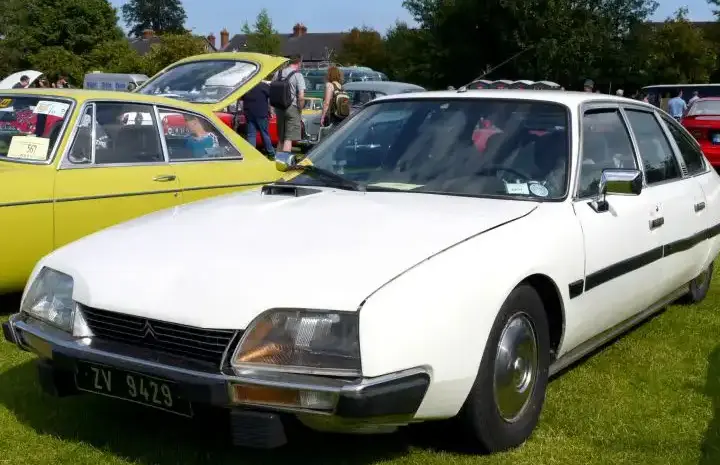
The Citroën CX II Prestige 25 GTi Automatic, produced between 1987 and 1989, represented a luxurious and technologically advanced offering within the second generation (CX II) of Citroën’s flagship sedan. Positioned as a premium trim level, it combined a 2.5-liter inline-four engine with a three-speed automatic transmission, targeting buyers who desired comfort and refinement alongside respectable performance. The CX II, building upon the innovative CX platform introduced in 1974, continued Citroën’s tradition of hydropneumatic suspension and distinctive styling. This variant aimed to provide a more accessible entry point into the GTi experience compared to the more potent, manual transmission versions.
Technical Specifications
| Brand | Citroen |
| Model | CX |
| Generation | CX II |
| Type | Prestige 25 GTi (123 Hp) Automatic |
| Start of production | 1987 |
| End of production | 1989 |
| Powertrain Architecture | Internal Combustion engine |
| Body type | Hatchback |
| Seats | 5 |
| Doors | 5 |
| Fuel Type | Petrol (Gasoline) |
| Acceleration 0 – 100 km/h | 14.7 sec |
| Acceleration 0 – 62 mph | 14.7 sec |
| Acceleration 0 – 60 mph | 14 sec |
| Maximum speed | 187 km/h (116.2 mph) |
| Weight-to-power ratio | 11.8 kg/Hp, 84.8 Hp/tonne |
| Weight-to-torque ratio | 7.6 kg/Nm, 131.7 Nm/tonne |
| Power | 123 Hp @ 5100 rpm |
| Power per litre | 49.2 Hp/l |
| Torque | 191 Nm @ 4000 rpm (140.87 lb.-ft. @ 4000 rpm) |
| Maximum engine speed | 6000 rpm |
| Engine layout | Front, Transverse |
| Engine Model/Code | M25.668 |
| Engine displacement | 2500 cm3 (152.56 cu. in.) |
| Number of cylinders | 4 |
| Engine configuration | Inline |
| Cylinder Bore | 93 mm (3.66 in.) |
| Piston Stroke | 92 mm (3.62 in.) |
| Compression ratio | 8.75:1 |
| Number of valves per cylinder | 2 |
| Fuel injection system | Multi-port manifold injection |
| Engine aspiration | Naturally aspirated engine |
| Engine oil capacity | 5.5 l (5.81 US qt | 4.84 UK qt) |
| Coolant | 12.5 l (13.21 US qt | 11 UK qt) |
| Kerb Weight | 1450 kg (3196.7 lbs.) |
| Max. weight | 1920 kg (4232.88 lbs.) |
| Max load | 470 kg (1036.17 lbs.) |
| Trunk (boot) space – minimum | 485 l (17.13 cu. ft.) |
| Trunk (boot) space – maximum | 507 l (17.9 cu. ft.) |
| Fuel tank capacity | 68 l (17.96 US gal | 14.96 UK gal) |
| Length | 4900 mm (192.91 in.) |
| Width | 1770 mm (69.69 in.) |
| Height | 1375 mm (54.13 in.) |
| Wheelbase | 3095 mm (121.85 in.) |
| Front track | 1522 mm (59.92 in.) |
| Rear (Back) track | 1368 mm (53.86 in.) |
| Ride height (ground clearance) | 160 mm (6.3 in.) |
| Drag coefficient (Cd) | 0.34 |
| Minimum turning circle | 13.40 m (43.96 ft.) |
| Drivetrain Architecture | The Internal combustion engine (ICE) drives the front wheels of the vehicle. |
| Drive wheel | Front wheel drive |
| Number of gears and type of gearbox | 3 gears, automatic transmission |
| Front suspension | Hydro-pneumatic element |
| Rear suspension | Hydro-pneumatic element |
| Front brakes | Ventilated discs |
| Rear brakes | Disc |
| Assisting systems | ABS (Anti-lock braking system) |
| Steering type | Steering rack and pinion |
| Power steering | Hydraulic Steering |
| Tires size | 195/70 R14 |
| Wheel rims size | 5.5J x 14 |
Powertrain & Engine Architecture
The Prestige 25 GTi Automatic was powered by Citroën’s M25.668 engine, a 2.5-liter inline-four cylinder gasoline engine. This engine featured a cast iron block and an aluminum cylinder head, employing a single overhead camshaft (SOHC) design with two valves per cylinder. Fuel delivery was managed by a Bosch multi-port fuel injection system, contributing to improved efficiency and drivability compared to earlier carbureted Citroën engines. The engine produced 123 horsepower at 5100 rpm and 191 Nm (140.87 lb-ft) of torque at 4000 rpm. The three-speed automatic transmission, while providing convenience, was a key differentiator from the more performance-oriented manual transmission variants. This automatic was designed to offer smooth shifts, prioritizing comfort over outright acceleration.
Driving Characteristics
The CX II 25 GTi Automatic offered a comfortable and refined driving experience, but its performance was noticeably different from its manual counterparts. The three-speed automatic transmission, while smooth, resulted in slower acceleration – approximately 14.7 seconds to 62 mph. The gear ratios were optimized for cruising rather than spirited driving. The hydropneumatic suspension, a hallmark of Citroën vehicles, provided an exceptionally smooth ride, absorbing bumps and imperfections in the road with ease. However, the added weight of the automatic transmission and its associated components slightly impacted handling compared to the lighter manual versions. The power delivery was linear, but the engine lacked the responsiveness of the higher-output 2.5-liter engines found in the manual GTi models.
Equipment & Trim Levels
The Prestige trim level of the CX II 25 GTi Automatic included a generous array of standard features. Interior appointments typically included comfortable cloth upholstery, power windows, central locking, and a high-quality audio system. The dashboard featured a distinctive Citroën design with a comprehensive instrument cluster. Optional extras included leather upholstery, a sunroof, and upgraded audio systems. The Prestige trim aimed to provide a luxurious and well-equipped experience, appealing to buyers who valued comfort and convenience.
Chassis & Braking
The CX II utilized Citroën’s renowned hydropneumatic suspension system, providing self-leveling and adjustable ride height. This system, combined with the car’s aerodynamic design, contributed to its exceptional ride quality and stability. The front suspension employed independent hydropneumatic elements, while the rear suspension also utilized a hydropneumatic setup. Braking duties were handled by ventilated discs at the front and solid discs at the rear. An Anti-lock Braking System (ABS) was included as standard equipment, enhancing safety and control during emergency braking situations. The steering was a rack-and-pinion system with hydraulic power assistance, providing precise and effortless steering.
Market Reception & Comparison
The Citroën CX II 25 GTi Automatic received mixed reviews. Critics praised the car’s ride comfort, innovative suspension, and luxurious interior. However, the automatic transmission was often criticized for detracting from the sporty character of the GTi designation. Compared to the manual transmission versions, the automatic offered less engaging driving experience and slower acceleration. Fuel economy was reasonable for the time, but not exceptional. Reliability was generally good, although the complexity of the hydropneumatic suspension system could lead to occasional maintenance issues. The 25 GTi Automatic positioned itself as a comfortable and refined grand tourer, appealing to buyers who prioritized comfort over outright performance.
Legacy
The Citroën CX II 25 GTi Automatic, while not the most sought-after variant of the CX II, remains a fascinating example of Citroën’s engineering prowess. The hydropneumatic suspension system continues to be admired for its innovative design and exceptional ride quality. Today, well-maintained examples are becoming increasingly collectible, appealing to enthusiasts who appreciate the car’s unique character and technological sophistication. The longevity of the M25 engine, when properly maintained, is respectable, but the hydropneumatic system requires specialized knowledge and can be expensive to repair. The CX II 25 GTi Automatic represents a unique blend of luxury, comfort, and innovation, cementing its place in automotive history.