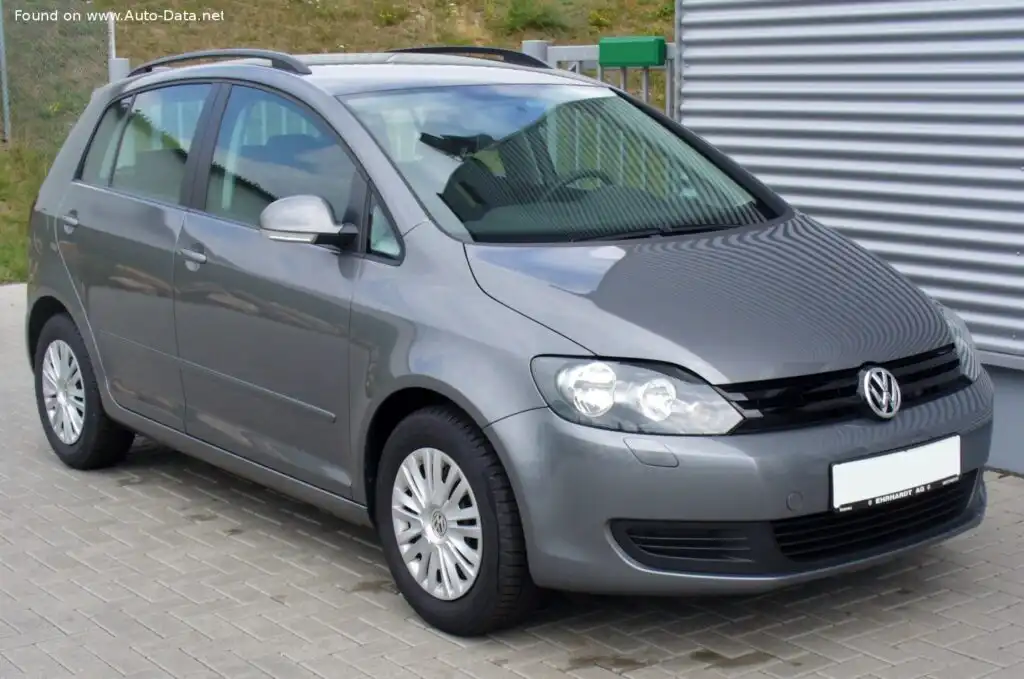
The Volkswagen Golf VI Plus 1.4, producing 80 horsepower, was a variant of the Golf VI Plus model manufactured between December 2008 and January 2014. Positioned as an entry-level offering within the Plus range – a stretched, more spacious version of the standard Golf VI – it aimed to provide affordable family transportation. The Golf VI Plus itself was based on the A5 platform (internally designated 1HX0/A3), offering increased rear passenger legroom and a larger cargo capacity compared to the standard Golf VI hatchback. This variant specifically targeted buyers prioritizing economy and practicality over outright performance.
Technical Specifications
| Brand | Volkswagen |
| Model | Golf |
| Generation | Golf VI Plus |
| Type (Engine) | 1.4 (80 Hp) |
| Start of production | December, 2008 |
| End of production | January, 2014 |
| Powertrain Architecture | Internal Combustion engine |
| Body type | Minivan |
| Seats | 5 |
| Doors | 5 |
| Fuel consumption (urban) | 8.7 l/100 km (27 US mpg, 32.5 UK mpg, 11.5 km/l) |
| Fuel consumption (extra urban) | 5.4 l/100 km (43.6 US mpg, 52.3 UK mpg, 18.5 km/l) |
| Fuel consumption (combined) | 6.6 l/100 km (35.6 US mpg, 42.8 UK mpg, 15.2 km/l) |
| Fuel Type | Petrol (Gasoline) |
| Acceleration 0 – 100 km/h | 14.9 sec |
| Acceleration 0 – 62 mph | 14.9 sec |
| Acceleration 0 – 60 mph | 14.2 sec |
| Maximum speed | 169 km/h (105.01 mph) |
| Weight-to-power ratio | 16.7 kg/Hp, 59.8 Hp/tonne |
| Weight-to-torque ratio | 10.1 kg/Nm, 98.7 Nm/tonne |
| Power | 80 Hp @ 5000 rpm |
| Power per litre | 57.6 Hp/l |
| Torque | 132 Nm @ 3800 rpm (97.36 lb.-ft. @ 3800 rpm) |
| Engine layout | Front, Transverse |
| Engine Model/Code | CGGA |
| Engine displacement | 1390 cm3 (84.82 cu. in.) |
| Number of cylinders | 4 |
| Engine configuration | Inline |
| Fuel injection system | Multi-port manifold injection |
| Engine aspiration | Naturally aspirated engine |
| Engine oil capacity | 3.2 l (3.38 US qt | 2.82 UK qt) |
| Coolant | 5.6 l (5.92 US qt | 4.93 UK qt) |
| Kerb Weight | 1337 kg (2947.58 lbs.) |
| Max. weight | 1890 kg (4166.74 lbs.) |
| Max load | 553 kg (1219.16 lbs.) |
| Trunk (boot) space – minimum | 395 l (13.95 cu. ft.) |
| Trunk (boot) space – maximum | 1450 l (51.21 cu. ft.) |
| Fuel tank capacity | 55 l (14.53 US gal | 12.1 UK gal) |
| Length | 4204 mm (165.51 in.) |
| Width | 1759 mm (69.25 in.) |
| Height | 1592 mm (62.68 in.) |
| Wheelbase | 2578 mm (101.5 in.) |
| Front track | 1541 mm (60.67 in.) |
| Rear (Back) track | 1517 mm (59.72 in.) |
| Minimum turning circle | 10.8 m (35.43 ft.) |
| Drivetrain Architecture | The Internal combustion engine (ICE) drives the front wheels of the vehicle. |
| Drive wheel | Front wheel drive |
| Number of gears and type of gearbox | 5 gears, manual transmission |
| Assisting systems | ABS (Anti-lock braking system) |
| Steering type | Steering rack and pinion |
| Power steering | Electric Steering |
Powertrain & Engine Architecture
The Golf VI Plus 1.4 (80 Hp) was powered by the CGGA engine code, a 1.4-liter inline-four cylinder gasoline engine. This engine was a common sight in Volkswagen Group vehicles of the era, known for its relatively simple design and focus on fuel efficiency. It utilized a multi-port fuel injection system, delivering fuel directly into the intake ports rather than directly into the combustion chamber. The engine featured a single overhead camshaft (SOHC) valvetrain, operating two valves per cylinder. The 80 horsepower output was achieved at 5000 rpm, with a peak torque of 132 Nm (97.36 lb-ft) available at 3800 rpm. The engine’s modest output was paired with a five-speed manual transmission, the standard configuration for this trim level. While an automatic transmission was available on other Golf Plus models, it wasn’t offered with this specific 1.4-liter, 80 hp engine.
Driving Characteristics
The 1.4-liter, 80 hp engine in the Golf VI Plus delivered modest performance. Acceleration from 0-60 mph took approximately 14.2 seconds, and top speed was limited to 169 km/h (105 mph). The five-speed manual transmission was geared to prioritize fuel economy, resulting in relatively tall gear ratios. This meant that the engine often needed to be revved to extract maximum performance, particularly when overtaking or climbing hills. Compared to the more powerful 1.4 TSI (turbocharged stratified injection) variants or the diesel options, the 80 hp model felt noticeably slower. However, the engine was smooth and relatively refined for its size, and the manual transmission provided a direct and engaging driving experience. The power delivery was linear, making it predictable and easy to control.
Equipment & Trim Levels
The 1.4 (80 Hp) Golf VI Plus typically represented the base trim level. Standard equipment generally included power windows, central locking, ABS brakes, and a basic audio system. Interior upholstery was typically cloth, and the dashboard featured a functional but relatively plain design. Air conditioning was often an optional extra, as were alloy wheels and more advanced audio systems. The Golf VI Plus, even in base trim, offered a reasonably well-equipped interior for its price point, focusing on practicality and usability. Optional extras could include parking sensors, a multi-function steering wheel, and upgraded seat fabrics.
Chassis & Braking
The Golf VI Plus 1.4 utilized a MacPherson strut front suspension and a torsion beam rear suspension. This setup was common for vehicles in this class, offering a good balance between ride comfort and handling. The front brakes were ventilated discs, while the rear brakes were typically drum brakes, a cost-saving measure for the entry-level model. Stabilizer bars were fitted to both the front and rear axles to reduce body roll during cornering. The steering was electrically assisted, providing light and precise control. The suspension was tuned for comfort, prioritizing a smooth ride over sporty handling.
Market Reception & Comparison
The Golf VI Plus 1.4 (80 Hp) received mixed reviews. Critics generally praised its fuel economy and practicality, but criticized its lack of performance. It was often seen as a sensible choice for buyers prioritizing affordability and low running costs over driving excitement. Compared to the more powerful Golf Plus variants, such as the 1.4 TSI or the 2.0 TDI, the 1.4 80 hp model offered significantly less performance but also a lower purchase price and potentially lower maintenance costs. Fuel economy was a strong point, with combined figures around 6.6 l/100 km (35.6 US mpg), making it an attractive option for those covering long distances.
Legacy
The CGGA 1.4-liter engine, while not known for its blistering performance, proved to be relatively reliable. Common issues were generally minor, such as oil leaks or sensor failures. The Golf VI Plus 1.4 (80 Hp) remains a relatively affordable option on the used car market. Its simplicity and fuel efficiency continue to appeal to buyers seeking a practical and economical family vehicle. However, potential buyers should be aware of its limited performance and the possibility of age-related wear and tear. The Golf VI Plus, in general, is considered a well-built and durable vehicle, and the 1.4 80 hp variant offers a cost-effective entry point into the Volkswagen range.