
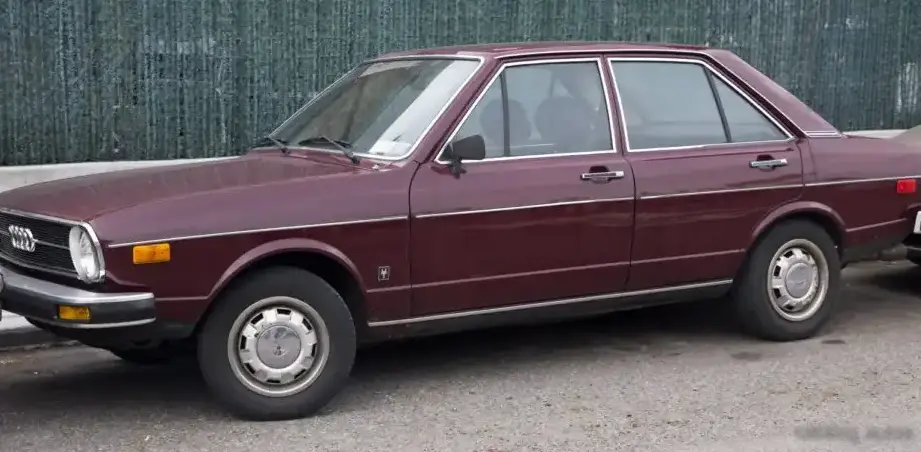
The Audi Fox (B1) 1.6, produced between 1973 and 1979, marked Audi’s initial foray into the compact sedan market, primarily targeting European and North American consumers. Positioned as a more accessible and pragmatic alternative to Audi’s larger models, the Fox was built upon the Volkswagen Golf’s platform – though distinguished by unique Audi styling and features. The 1.6-liter, 81 horsepower variant served as the base engine option, striking a balance between fuel economy and everyday usability. It was instrumental in solidifying Audi’s reputation for producing well-engineered, front-wheel-drive vehicles.
Technical Specifications
| Brand | Audi |
| Model | Fox |
| Generation | Fox (B1) |
| Type (Engine) | 1.6 (81 Hp) |
| Start of production | 1973 |
| End of production | 1979 |
| Powertrain Architecture | Internal Combustion engine |
| Body type | Sedan |
| Seats | 5 |
| Doors | 4 |
| Fuel Type | Petrol (Gasoline) |
| Power | 81 Hp @ 5800 rpm |
| Power per litre | 51 Hp/l |
| Engine displacement | 1588 cm3 |
| Engine displacement (US) | 96.91 cu. in. |
| Number of cylinders | 4 |
| Engine configuration | Inline |
| Cylinder Bore | 79.5 mm |
| Cylinder Bore (US) | 3.13 in. |
| Piston Stroke | 80 mm |
| Piston Stroke (US) | 3.15 in. |
| Compression ratio | 8.2:1 |
| Number of valves per cylinder | 2 |
| Fuel injection system | Multi-port manifold injection |
| Engine aspiration | Naturally aspirated engine |
| Valvetrain | SOHC |
| Engine oil capacity | 2.8 l |
| Engine oil capacity (US) | 2.96 US qt | 2.46 UK qt |
| Coolant | 6.2 l |
| Coolant (US) | 6.55 US qt | 5.46 UK qt |
| Trunk (boot) space – minimum | 530 l |
| Trunk (boot) space – minimum (US) | 18.72 cu. ft. |
| Fuel tank capacity | 45 l |
| Fuel tank capacity (US) | 11.89 US gal | 9.9 UK gal |
| Length | 4369 mm |
| Length (US) | 172.01 in. |
| Width | 1643 mm |
| Width (US) | 64.69 in. |
| Height | 1359 mm |
| Height (US) | 53.5 in. |
| Wheelbase | 2469 mm |
| Wheelbase (US) | 97.2 in. |
| Front track | 1339 mm |
| Front track (US) | 52.72 in. |
| Rear (Back) track | 1334 mm |
| Rear (Back) track (US) | 52.52 in. |
| Minimum turning circle (turning diameter) | 9.8 m |
| Minimum turning circle (turning diameter) (US) | 32.15 ft. |
| Drivetrain Architecture | The Internal combustion engine (ICE) drives the front wheels of the vehicle. |
| Drive wheel | Front wheel drive |
| Number of gears and type of gearbox | 4 gears, manual transmission |
| Front suspension | Independent type McPherson |
| Rear suspension | Trailing arm, Torsion |
| Front brakes | Disc, 238.76 mm |
| Rear brakes | Drum, 199.39 mm |
| Steering type | Steering rack and pinion |
| Wheel rims size | 5J x 13 |
Powertrain & Engine Architecture
The Audi Fox 1.6’s powertrain centered around an inline four-cylinder engine, internally designated as the Type 827. This engine featured a single overhead camshaft (SOHC) valvetrain operating two valves per cylinder. The 1588cc displacement was achieved through a bore of 79.5mm and a stroke of 80mm. Fuel delivery was managed by a multi-port manifold injection system, a relatively sophisticated feature for its time, contributing to improved fuel efficiency and smoother operation compared to carbureted engines. The engine utilized a compression ratio of 8.2:1. The engine was mounted longitudinally in the front of the vehicle, powering the front wheels. A four-speed manual transmission was the standard configuration, providing a direct mechanical link between the engine and the wheels.
Driving Characteristics
The 81 horsepower output of the 1.6-liter engine in the Fox translated to modest, yet sufficient, performance for everyday driving. Acceleration wasn’t particularly quick, and overtaking maneuvers required careful consideration. The four-speed manual transmission offered a reasonable gear spread, but the engine lacked the torque to deliver strong acceleration in higher gears. Compared to the later, more potent 1.8-liter versions and even the diesel variants, the 1.6 felt noticeably underpowered, especially when carrying a full load of passengers and luggage. However, its lighter weight and simpler mechanicals made it feel more nimble and responsive in urban driving conditions. The gear ratios were optimized for fuel economy rather than outright speed.
Equipment & Trim Levels
The base Audi Fox 1.6 was relatively sparsely equipped, reflecting its position as the entry-level model. Standard features typically included cloth upholstery, basic instrumentation – encompassing a speedometer, fuel gauge, and temperature gauge – and manually operated windows and door locks. The interior was functional and durable, prioritizing practicality over luxury. Optional extras included a radio, upgraded upholstery materials, and a sunroof. Trim levels were fairly limited; the emphasis was on providing a basic, reliable transportation solution. The dashboard layout was straightforward and intuitive, with clearly labeled controls.
Chassis & Braking
The Audi Fox B1 employed a front-wheel-drive layout, featuring an independent McPherson strut suspension at the front and a trailing arm torsion beam suspension at the rear. This suspension setup provided a comfortable ride quality, although it wasn’t designed for particularly sporty handling. Braking was handled by disc brakes at the front and drum brakes at the rear. The front discs measured 238.76mm in diameter, while the rear drums were 199.39mm. Steering was accomplished via a rack and pinion system, offering precise and responsive handling. The relatively light weight of the 1.6-liter model contributed to its balanced handling characteristics.
Market Reception & Comparison
The Audi Fox 1.6 was generally well-received as a practical and affordable compact sedan. Critics lauded its build quality, handling, and fuel efficiency. However, the engine’s lack of power was a frequent criticism, particularly when compared to competitors offering larger displacement engines. Compared to the subsequent 1.8-liter Fox, the 1.6 offered superior fuel economy but significantly less performance. The diesel variants, while slower, provided even greater fuel savings. The 1.6-liter model appealed to buyers who prioritized economy and reliability over outright speed and performance.
Legacy
The Audi Fox 1.6, while not the most powerful or glamorous variant, played a crucial role in establishing Audi’s foothold in the compact car segment. The engine itself proved to be remarkably durable and reliable, with numerous examples still in operation today. In the used car market, the 1.6-liter Fox is often sought after by enthusiasts seeking a simple, affordable, and classic Audi. Maintenance is generally straightforward, and parts availability remains reasonable. The Fox B1, in all its iterations, is fondly remembered as a well-engineered and practical car that helped define Audi’s reputation for quality and innovation.
