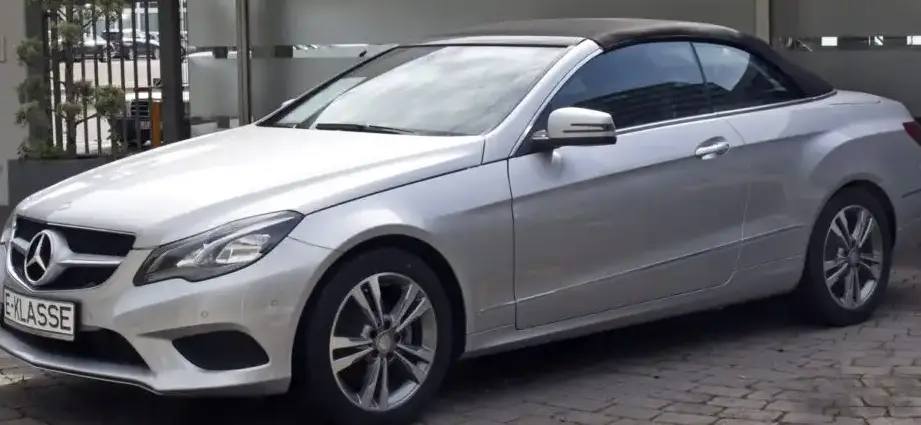
The Mercedes-Benz E-Class Cabriolet (A207) facelift, specifically the E 250 CDI variant with the 7G-TRONIC PLUS automatic transmission, was produced from June 2013 to July 2014. This model represented a mid-cycle refresh of the A207 generation E-Class Cabriolet, which itself was based on the W207 E-Class platform. Positioned as a fuel-efficient and comfortable open-top luxury car, the E 250 CDI aimed to offer a balance between performance and economy within the E-Class Cabriolet range. It served as a key offering in European markets where diesel engines were highly favored, providing a refined driving experience with lower running costs compared to its gasoline-powered siblings.
Technical Specifications
| Brand | Mercedes-Benz |
| Model | E-Class |
| Generation | E-Class Cabrio (A207, facelift 2013) |
| Type (Engine) | E 250 CDI (204 Hp) 7G-TRONIC PLUS |
| Start of production | June, 2013 |
| End of production | July, 2014 |
| Powertrain Architecture | Internal Combustion engine |
| Body type | Cabriolet |
| Seats | 4 |
| Doors | 2 |
| Fuel consumption (urban) | 5.8-5.9 l/100 km (40.6 – 39.9 US mpg) |
| Fuel consumption (extra urban) | 4.2-4.4 l/100 km (56 – 53.5 US mpg) |
| Fuel consumption (combined) | 4.8-4.9 l/100 km (49 – 48 US mpg) |
| CO2 emissions | 126-130 g/km |
| Fuel Type | Diesel |
| Acceleration 0 – 100 km/h | 7.7 sec |
| Acceleration 0 – 62 mph | 7.7 sec |
| Acceleration 0 – 60 mph | 7.3 sec |
| Maximum speed | 243 km/h (150.99 mph) |
| Emission standard | Euro 5 |
| Weight-to-power ratio | 8.7 kg/Hp |
| Weight-to-torque ratio | 3.5 kg/Nm |
| Power | 204 Hp @ 3800 rpm |
| Torque | 500 Nm @ 1600-1800 rpm (368.78 lb.-ft. @ 1600-1800 rpm) |
| Engine layout | Front, Longitudinal |
| Engine Model/Code | OM 651.911 |
| Engine displacement | 2143 cm3 (130.77 cu. in.) |
| Number of cylinders | 4 |
| Engine configuration | Inline |
| Cylinder Bore | 83 mm (3.27 in.) |
| Piston Stroke | 99 mm (3.9 in.) |
| Compression ratio | 16.2:1 |
| Number of valves per cylinder | 4 |
| Fuel injection system | Diesel Commonrail |
| Engine aspiration | BiTurbo, Intercooler |
| Valvetrain | DOHC |
| Engine oil capacity | 6.5 l (6.87 US qt | 5.72 UK qt) |
| Kerb Weight | 1770 kg (3902.18 lbs.) |
| Max. weight | 2315 kg (5103.7 lbs.) |
| Max load | 545 kg (1201.52 lbs.) |
| Trunk (boot) space – minimum | 300 l (10.59 cu. ft.) |
| Trunk (boot) space – maximum | 390 l (13.77 cu. ft.) |
| Fuel tank capacity | 66 l (17.44 US gal | 14.52 UK gal) |
| Permitted trailer load with brakes (12%) | 1800 kg (3968.32 lbs.) |
| Permitted trailer load without brakes | 750 kg (1653.47 lbs.) |
| Permitted towbar download | 75 kg (165.35 lbs.) |
| Length | 4703 mm (185.16 in.) |
| Width | 1786 mm (70.31 in.) |
| Width including mirrors | 2016 mm (79.37 in.) |
| Height | 1398 mm (55.04 in.) |
| Wheelbase | 2760 mm (108.66 in.) |
| Front track | 1538 mm (60.55 in.) |
| Rear track | 1541 mm (60.67 in.) |
| Front overhang | 862 mm (33.94 in.) |
| Rear overhang | 1081 mm (42.56 in.) |
| Drag coefficient (Cd) | 0.29 |
| Minimum turning circle | 11.15 m (36.58 ft.) |
| Drivetrain Architecture | Rear wheel drive |
| Number of gears and type of gearbox | 7 gears, automatic transmission G-TRONIC PLUS |
| Front suspension | Coil spring, Independent multi-link suspension, Transverse stabilizer |
| Rear suspension | Independent multi-link spring suspension with stabilizer |
| Front brakes | Ventilated discs |
| Rear brakes | Disc |
| Assisting systems | ABS (Anti-lock braking system) |
| Steering type | Steering rack and pinion |
| Power steering | Electric Steering |
| Tires size (Front) | 235/45 R17; 235/40 R18; 235/35 R19 |
| Tires size (Rear) | 235/45 R17; 255/35 R18; 255/30 R19 |
| Wheel rims size (Front) | 7.5J x 17; 8J x 18; 8J x 19; 8.5J x 19 |
| Wheel rims size (Rear) | 7.5J x 17; 8.5J x 18; 8.5J x 19 |
Powertrain & Engine Architecture
The E 250 CDI Cabriolet was powered by the OM651.911 2.1-liter inline-four diesel engine. This engine was a mainstay in the Mercedes-Benz lineup, known for its robust construction and fuel efficiency. The OM651 featured a common rail direct injection system, delivering fuel at extremely high pressures for optimized combustion. A sophisticated bi-turbocharger setup, consisting of a small, low-pressure turbo and a larger, high-pressure turbo, minimized turbo lag and provided a broad torque curve. The engine also incorporated an intercooler to further enhance performance. The 7G-TRONIC PLUS automatic transmission, a seven-speed unit, was specifically tuned to complement the engine’s characteristics, offering smooth and efficient gear changes. This transmission featured a torque converter lock-up clutch to improve fuel economy at cruising speeds.
Driving Characteristics
The E 250 CDI Cabriolet offered a comfortable and refined driving experience. While not a sports car, the 204 horsepower and 368 lb-ft of torque provided adequate performance for everyday driving and highway cruising. Acceleration from 0-60 mph took around 7.3 seconds. The 7G-TRONIC PLUS transmission contributed to smooth acceleration, and the wide gear ratios allowed the engine to operate efficiently at various speeds. Compared to the more powerful E 350 or E 550 Cabriolet models, the E 250 CDI prioritized fuel economy and relaxed cruising over outright performance. The automatic transmission, while smooth, didn’t offer the same level of driver engagement as a manual gearbox, but it suited the car’s intended purpose as a comfortable and luxurious open-top tourer.
Equipment & Trim Levels
The E 250 CDI Cabriolet typically came well-equipped, reflecting its position as a premium vehicle. Standard features included leather upholstery, automatic climate control, a multi-function steering wheel, and a high-quality audio system. Optional extras included features like the AIRCAP system (which reduced wind turbulence in the cabin at higher speeds), COMAND infotainment system with navigation, heated and ventilated seats, and various driver assistance systems such as lane keeping assist and blind spot monitoring. Trim levels varied depending on the market, but generally offered packages that added cosmetic enhancements and additional convenience features.
Chassis & Braking
The A207 E-Class Cabriolet utilized a robust chassis designed to provide a comfortable ride and good handling. The front suspension featured a multi-link independent setup with a transverse stabilizer bar, while the rear suspension employed a multi-link independent setup with a stabilizer bar. The E 250 CDI was equipped with ventilated disc brakes at the front and solid discs at the rear. Anti-lock braking system (ABS) was standard, providing enhanced braking performance and stability. The steering was a rack-and-pinion system with power assistance, offering precise and responsive steering feel.
Market Reception & Comparison
The E 250 CDI Cabriolet was generally well-received by automotive critics, particularly for its fuel efficiency and comfortable ride. It was often praised as a sensible choice for buyers who wanted a luxurious open-top car without the high running costs associated with gasoline engines. Compared to the E 350 Cabriolet, the E 250 CDI offered significantly better fuel economy, making it a more practical option for those who drove long distances. However, the E 350 provided noticeably quicker acceleration and a more engaging driving experience. Reliability was generally good, with the OM651 engine proving to be a durable and long-lasting unit.
Legacy
The Mercedes-Benz E 250 CDI Cabriolet (A207) remains a popular choice in the used car market, particularly in Europe. The OM651 engine is known for its longevity and relatively low maintenance costs, making it an attractive option for buyers seeking a reliable and fuel-efficient luxury car. While the A207 generation has been superseded by newer E-Class models, the E 250 CDI continues to offer a compelling combination of style, comfort, and economy, solidifying its place as a well-regarded member of the E-Class family.