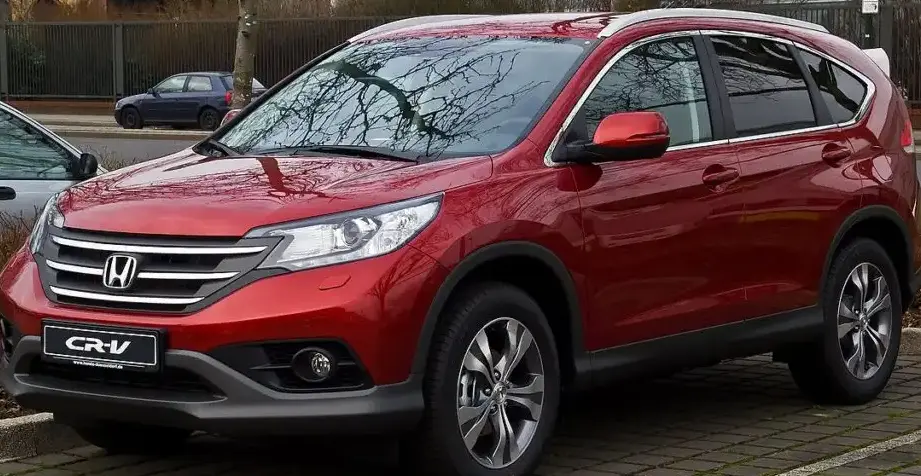
The Honda CR-V III, produced from 2006 to 2009, represented a significant evolution in Honda’s popular compact SUV lineup. The 2.4 i-VTEC variant, equipped with a 2.4-liter four-cylinder engine producing 166 horsepower and paired with an automatic transmission and all-wheel drive (AWD), was a key model within the third generation (RE series). This configuration aimed to balance performance, fuel efficiency, and practicality for the North American market, where the CR-V had established a strong foothold. It sat in the mid-range of the CR-V lineup, offering more power than the base 2.0-liter engine but remaining more accessible than potential future performance-oriented trims.
Technical Specifications
| Brand | Honda |
| Model | CR-V |
| Generation | CR-V III |
| Type (Engine) | 2.4 i-VTEC (166 Hp) AWD Automatic |
| Start of production | 2006 |
| End of production | September, 2009 |
| Powertrain Architecture | Internal Combustion engine |
| Body type | SUV |
| Seats | 5 |
| Doors | 5 |
| Fuel consumption (economy) – urban (EPA) | 11.8 l/100 km (19.9 US mpg) |
| Fuel consumption (economy) – extra urban (EPA) | 9 l/100 km (26.1 US mpg) |
| Fuel Type | Petrol (Gasoline) |
| Emission standard | ULEV-2 |
| Weight-to-power ratio | 9.6 kg/Hp, 104.5 Hp/tonne |
| Weight-to-torque ratio | 7.3 kg/Nm, 137.3 Nm/tonne |
| Power | 166 Hp @ 5800 rpm |
| Power per litre | 70.5 Hp/l |
| Torque | 218 Nm @ 4200 rpm (160.79 lb.-ft. @ 4200 rpm) |
| Engine layout | Front, Transverse |
| Engine Model/Code | K24Z1 |
| Engine displacement | 2354 cm3 (143.65 cu. in.) |
| Number of cylinders | 4 |
| Engine configuration | Inline |
| Cylinder Bore | 87 mm (3.43 in.) |
| Piston Stroke | 99 mm (3.9 in.) |
| Compression ratio | 9.7:1 |
| Number of valves per cylinder | 4 |
| Fuel injection system | Multi-port manifold injection |
| Engine aspiration | Naturally aspirated engine |
| Valvetrain | DOHC, i-VTEC |
| Engine oil capacity | 4.2 l (4.44 US qt | 3.7 UK qt) |
| Coolant | 5 l (5.28 US qt | 4.4 UK qt) |
| Kerb Weight | 1588 kg (3500.94 lbs.) |
| Max. weight | 2068 kg (4559.16 lbs.) |
| Max load | 480 kg (1058.22 lbs.) |
| Trunk (boot) space – minimum | 524 l (18.5 cu. ft.) |
| Trunk (boot) space – maximum | 1532 l (54.1 cu. ft.) |
| Fuel tank capacity | 58 l (15.32 US gal | 12.76 UK gal) |
| Permitted trailer load with brakes (12%) | 680 kg (1499.14 lbs.) |
| Length | 4519 mm (177.91 in.) |
| Width | 1820 mm (71.65 in.) |
| Height | 1679 mm (66.1 in.) |
| Wheelbase | 2620 mm (103.15 in.) |
| Front track | 1565 mm (61.61 in.) |
| Rear (Back) track | 1565 mm (61.61 in.) |
| Ride height (ground clearance) | 185 mm (7.28 in.) |
| Minimum turning circle (turning diameter) | 11.5 m (37.73 ft.) |
| Approach angle | 28° |
| Departure angle | 23.2° |
| Ramp-over (brakeover) angle | 18° |
| Drivetrain Architecture | The Internal combustion engine (ICE) drives the front wheels permanently, and the rear wheels are driven through an electrically or mechanically operated clutch if necessary. |
| Drive wheel | All wheel drive (4×4) |
| Number of gears and type of gearbox | 5 gears, automatic transmission |
| Front suspension | Independent, type McPherson with coil spring and anti-roll bar |
| Rear suspension | Independent multi-link spring suspension with stabilizer |
| Front brakes | Ventilated discs, 296 mm |
| Rear brakes | Disc, 305 mm |
| Assisting systems | ABS (Anti-lock braking system) |
| Steering type | Steering rack and pinion |
| Power steering | Hydraulic Steering |
| Tires size | 225/65 R17 |
| Wheel rims size | 6.5J x 17 |
Powertrain & Engine Architecture
The heart of the 2.4 i-VTEC CR-V is the K24Z1 engine, a 2.4-liter inline-four cylinder powerplant. This engine is a member of Honda’s renowned K-series, known for its reliability and relatively high output for its displacement. The K24Z1 features a cast iron block and an aluminum cylinder head, contributing to a good balance of durability and weight. It utilizes Honda’s i-VTEC (intelligent Variable Valve Timing and Lift Electronic Control) system, which adjusts both the timing and lift of the intake valves to optimize performance across the rev range. This system provides improved low-end torque while maintaining high-end horsepower. Fuel delivery is managed by a multi-point fuel injection system. The engine is transversely mounted in the front of the vehicle. The automatic transmission used in this variant is a five-speed unit, designed to provide smooth shifts and adequate acceleration. It’s a conventional torque converter automatic, prioritizing comfort and ease of use over outright performance.
Driving Characteristics
The 2.4 i-VTEC automatic CR-V offered a comfortable and predictable driving experience. While not particularly sporty, the 166 horsepower provided sufficient power for everyday driving and highway merging. Acceleration from a standstill was adequate, but not brisk. The automatic transmission, while smooth, could sometimes feel hesitant during quick overtaking maneuvers. Compared to the five-speed manual transmission available on some CR-V models, the automatic resulted in a slight performance decrease due to power loss through the torque converter. The AWD system provided enhanced traction in inclement weather conditions, making it a popular choice in regions with snow or rain. The gear ratios were tuned for fuel efficiency and drivability, rather than maximizing acceleration.
Equipment & Trim Levels
The 2.4 i-VTEC AWD Automatic CR-V typically came standard with features such as air conditioning, power windows and locks, a CD player with auxiliary input, and keyless entry. Higher trim levels, such as the EX and EX-L, added features like a sunroof, leather upholstery, heated front seats, and a premium audio system. Interior upholstery was typically cloth on the base models, with leather available on the higher trims. The dashboard layout was functional and straightforward, with easy-to-read gauges and controls. Optional extras included a navigation system and a rear entertainment system.
Chassis & Braking
The CR-V III utilized an independent suspension system at all four wheels. The front suspension employed McPherson struts with coil springs and an anti-roll bar, while the rear suspension featured a multi-link design with a stabilizer bar. This setup provided a comfortable ride and decent handling characteristics. Braking duties were handled by ventilated discs at the front and solid discs at the rear. An Anti-lock Braking System (ABS) was standard equipment. The chassis was designed to provide a balance between rigidity and weight, contributing to the vehicle’s overall stability.
Market Reception & Comparison
The 2.4 i-VTEC AWD Automatic CR-V was generally well-received by critics and consumers alike. It was praised for its spacious interior, comfortable ride, and strong resale value. Fuel economy was considered average for its class. Compared to the base 2.0-liter CR-V, the 2.4-liter engine offered a noticeable improvement in performance. However, the 2.4-liter engine was slightly less fuel-efficient. Compared to competitors like the Toyota RAV4 and Nissan Rogue, the CR-V offered a compelling combination of features and value.
Legacy
The K24Z1 engine, when properly maintained, has proven to be a remarkably durable and reliable powerplant. The automatic transmission, while not known for being particularly innovative, has also demonstrated good long-term reliability. Today, the 2006-2009 CR-V 2.4 i-VTEC AWD Automatic remains a popular choice in the used car market, particularly for buyers seeking a practical and dependable SUV. Common maintenance items include regular oil changes, timing belt replacement (typically around 100,000 miles), and inspection of the cooling system. Due to its reputation for reliability, well-maintained examples often command a premium price.