
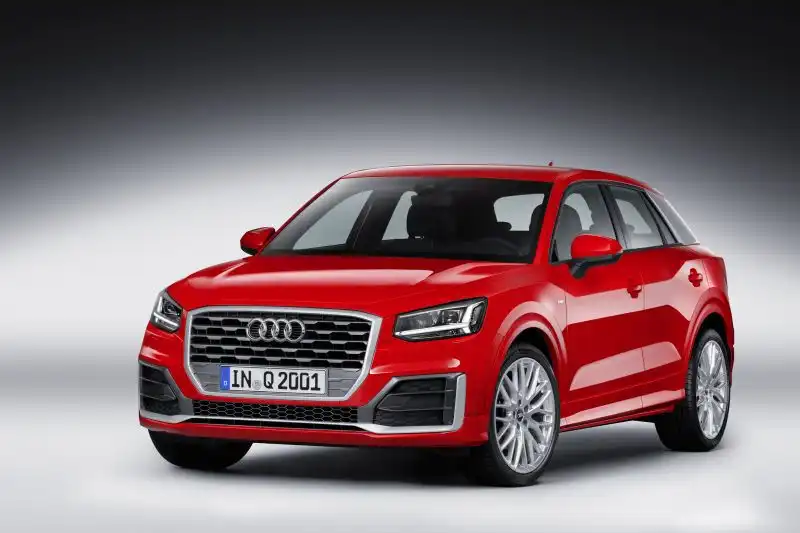
The Audi Q2 1.0 TFSI (116 hp) was a front-wheel-drive subcompact luxury crossover SUV produced by the German manufacturer Audi from 2016 to 2018. Positioned as the entry-level variant of the first-generation Q2 (GA) series, it aimed to attract younger buyers with its stylish design, relatively affordable price point, and fuel-efficient engine. This model played a significant role in expanding Audi’s presence in the burgeoning subcompact SUV segment, particularly in European markets. It was built on the Volkswagen Group’s MQB platform, shared with models like the Audi A3, Volkswagen Golf, and SEAT Leon.
Technical Specifications
| Brand | Audi |
| Model | Q2 |
| Generation | Q2 |
| Type (Engine) | 1.0 TFSI (116 Hp) |
| Start of production | 2016 |
| End of production | 2018 |
| Powertrain Architecture | Internal Combustion engine |
| Body type | SUV |
| Seats | 5 |
| Doors | 5 |
| Fuel consumption (urban) | 6.2-6.3 l/100 km (37.9 – 37.3 US mpg) |
| Fuel consumption (extra urban) | 4.5-4.7 l/100 km (52.3 – 50 US mpg) |
| Fuel consumption (combined) | 5.1-5.3 l/100 km (46.1 – 44.4 US mpg) |
| CO2 emissions | 117-121 g/km |
| Fuel Type | Petrol (Gasoline) |
| Acceleration 0 – 100 km/h | 10.7 sec |
| Acceleration 0 – 62 mph | 10.7 sec |
| Acceleration 0 – 60 mph | 10.2 sec |
| Maximum speed | 190 km/h (118.06 mph) |
| Emission standard | Euro 6 |
| Power | 116 Hp @ 5500 rpm |
| Torque | 200 Nm @ 2000-3500 rpm (147.51 lb.-ft. @ 2000-3500 rpm) |
| Engine layout | Front, Transverse |
| Engine Model/Code | CHZJ |
| Engine displacement | 999 cm3 (60.96 cu. in.) |
| Number of cylinders | 3 |
| Engine configuration | Inline |
| Fuel injection system | Direct injection |
| Engine aspiration | Turbocharger, Intercooler |
| Engine oil capacity | 4 l (4.23 US qt | 3.52 UK qt) |
| Coolant capacity | 8 l (8.45 US qt | 7.04 UK qt) |
| Trunk (boot) space – minimum | 405 l (14.3 cu. ft.) |
| Trunk (boot) space – maximum | 1050 l (37.08 cu. ft.) |
| Length | 4191 mm (165 in.) |
| Width | 1794 mm (70.63 in.) |
| Width including mirrors | 2009 mm (79.09 in.) |
| Height | 1508 mm (59.37 in.) |
| Wheelbase | 2601 mm (102.4 in.) |
| Front track | 1547 mm (60.91 in.) |
| Rear track | 1541 mm (60.67 in.) |
| Drivetrain | Front wheel drive |
| Number of gears | 6 |
| Gearbox type | Manual transmission |
| Front brakes | Ventilated discs |
| Rear brakes | Disc |
| Steering type | Steering rack and pinion |
| Power steering | Electric |
Powertrain & Engine Architecture
The Audi Q2 1.0 TFSI utilized the Volkswagen Group’s EA211 family of engines, specifically the CHZJ engine code. This is a 1.0-liter, three-cylinder turbocharged gasoline engine. It features direct fuel injection, a single scroll turbocharger, and an intercooler to enhance performance and efficiency. The engine’s aluminum block and cylinder head contribute to its relatively lightweight design. The engine produces 116 horsepower at 5500 rpm and 200 Nm (147.51 lb-ft) of torque between 2000 and 3500 rpm. The engine is paired with a six-speed manual transmission, delivering power to the front wheels. This configuration was chosen for its balance of fuel economy and acceptable performance for urban driving.
Driving Characteristics
The 1.0 TFSI-equipped Q2 offered a comfortable, yet not particularly sporty, driving experience. Acceleration from 0-60 mph took around 10.2 seconds, making it adequate for everyday commuting but not ideal for spirited driving. The turbocharger provides a noticeable boost in power, but the engine can feel strained at higher speeds or when fully loaded. The six-speed manual transmission is well-matched to the engine, offering precise shifts and allowing drivers to keep the engine in its optimal power band. Compared to the more powerful 1.4 TFSI and 2.0 TFSI variants, the 1.0 TFSI felt noticeably slower, but it compensated with superior fuel economy.
Equipment & Trim Levels
The base Q2 1.0 TFSI typically came standard with features such as alloy wheels, Audi’s MMI infotainment system with a 5.8-inch display, Bluetooth connectivity, air conditioning, and a leather-wrapped steering wheel. Safety features included ABS, electronic stability control, and multiple airbags. Optional extras included larger alloy wheels, a panoramic sunroof, upgraded infotainment system with a larger screen, navigation, parking sensors, and a premium sound system. Interior upholstery was typically cloth, with leather options available as an upgrade. The dashboard design was modern and minimalist, reflecting Audi’s contemporary interior aesthetic.
Chassis & Braking
The Q2’s chassis featured MacPherson strut front suspension and a multi-link rear suspension, providing a comfortable ride and decent handling. The front brakes were ventilated discs, while the rear brakes were solid discs. The steering was an electric power-assisted rack and pinion system, offering light and precise steering feel. Stabilizer bars were fitted to both the front and rear axles to reduce body roll during cornering. The suspension tuning was geared towards comfort rather than outright sportiness, making it well-suited for everyday driving conditions.
Market Reception & Comparison
The Audi Q2 1.0 TFSI was generally well-received by automotive critics, who praised its stylish design, comfortable interior, and fuel efficiency. However, some reviewers noted that the 1.0-liter engine felt underpowered, particularly when the vehicle was fully loaded or driving on inclines. Compared to the 1.4 TFSI variant, the 1.0 TFSI offered significantly better fuel economy but at the cost of performance. The 1.0 TFSI was positioned as the entry-level option, appealing to buyers who prioritized affordability and efficiency over outright power. It competed with other subcompact luxury crossovers such as the MINI Countryman and the BMW X1.
Legacy
The Audi Q2 1.0 TFSI, while not the most powerful variant, proved to be a reliable and fuel-efficient option in the used car market. The EA211 engine family is known for its durability, and with proper maintenance, these engines can provide many years of trouble-free service. The Q2’s stylish design and well-appointed interior continue to appeal to buyers looking for a compact and practical luxury crossover. The 1.0 TFSI variant remains a popular choice for those seeking a balance of affordability, efficiency, and Audi’s renowned build quality. Common issues reported with this engine are related to the timing chain tensioner, but these are not widespread and are often addressed with preventative maintenance.
