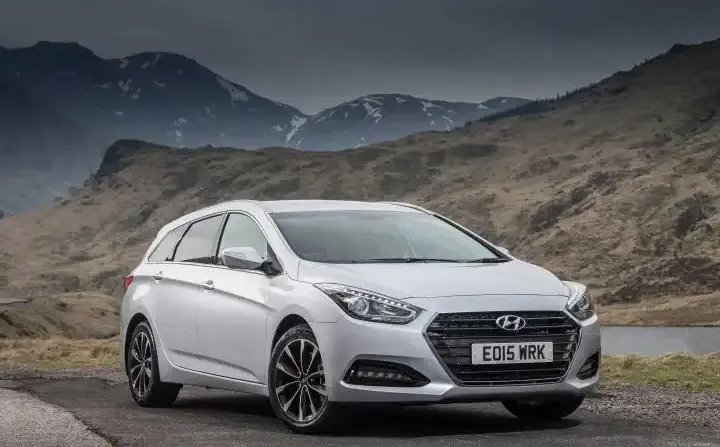
The Hyundai i40 Combi 1.7 CRDi (136 hp) was a station wagon produced by the South Korean automaker Hyundai from 2011 to 2015. Positioned as a practical and fuel-efficient option within the i40 range (which also included a sedan body style), the Combi – Hyundai’s term for its wagon – aimed to compete with established European rivals like the Ford Focus Estate and Volkswagen Golf Variant. This particular variant, powered by the 1.7-liter diesel engine and equipped with a six-speed manual transmission, represented a mid-range offering, balancing affordability with reasonable performance and economy. It was primarily marketed in Europe, where the station wagon body style remains popular.
Technical Specifications
| Brand | Hyundai |
| Model | i40 |
| Generation | i40 Combi |
| Type (Engine) | 1.7 CRDi (136 Hp) |
| Start of production | 2011 |
| End of production | 2015 |
| Powertrain Architecture | Internal Combustion engine |
| Body type | Station wagon (estate) |
| Seats | 5 |
| Doors | 5 |
| Fuel consumption (urban) | 5.9 l/100 km (39.9 US mpg, 47.9 UK mpg, 16.9 km/l) |
| Fuel consumption (extra urban) | 4.6 l/100 km (51.1 US mpg, 61.4 UK mpg, 21.7 km/l) |
| Fuel consumption (combined) | 5.1 l/100 km (46.1 US mpg, 55.4 UK mpg, 19.6 km/l) |
| Fuel Type | Diesel |
| Acceleration 0 – 100 km/h | 10.6 sec |
| Acceleration 0 – 62 mph | 10.6 sec |
| Acceleration 0 – 60 mph | 10.1 sec |
| Maximum speed | 198 km/h (123.03 mph) |
| Emission standard | Euro 5 |
| Weight-to-power ratio | 11 kg/Hp, 91 Hp/tonne |
| Weight-to-torque ratio | 4.6 kg/Nm, 217.4 Nm/tonne |
| Power | 136 Hp @ 4000 rpm |
| Power per litre | 80.7 Hp/l |
| Torque | 325 Nm @ 2000-2500 rpm (239.71 lb.-ft. @ 2000-2500 rpm) |
| Engine layout | Front, Transverse |
| Engine Model/Code | U II / D4FD |
| Engine displacement | 1685 cm3 (102.83 cu. in.) |
| Number of cylinders | 4 |
| Engine configuration | Inline |
| Cylinder Bore | 77.2 mm (3.04 in.) |
| Piston Stroke | 90 mm (3.54 in.) |
| Compression ratio | 17:1 |
| Number of valves per cylinder | 4 |
| Fuel injection system | Diesel Commonrail |
| Engine aspiration | Turbocharger, Intercooler |
| Valvetrain | DOHC |
| Engine oil capacity | 5.3 l (5.6 US qt | 4.66 UK qt) |
| Coolant | 6.9 l (7.29 US qt | 6.07 UK qt) |
| Kerb Weight | 1495 kg (3295.91 lbs.) |
| Max. weight | 2120 kg (4673.8 lbs.) |
| Max load | 625 kg (1377.89 lbs.) |
| Trunk (boot) space – minimum | 553 l (19.53 cu. ft.) |
| Trunk (boot) space – maximum | 1719 l (60.71 cu. ft.) |
| Fuel tank capacity | 70 l (18.49 US gal | 15.4 UK gal) |
| Length | 4770 mm (187.8 in.) |
| Width | 1815 mm (71.46 in.) |
| Height | 1470 mm (57.87 in.) |
| Wheelbase | 2770 mm (109.06 in.) |
| Front track | 1591 mm (62.64 in.) |
| Rear (Back) track | 1597 mm (62.87 in.) |
| Minimum turning circle | 10.94 m (35.89 ft.) |
| Drivetrain Architecture | Front wheel drive |
| Number of gears | 6 gears, manual transmission |
| Front suspension | Independent type McPherson |
| Rear suspension | Independent coil spring |
| Front brakes | Ventilated discs |
| Rear brakes | Disc |
| Tires size | 205/60 R16; 215/50 R17; 225/45 R18 |
| Wheel rims size | 7.0J x 16; 7.5J x 17; 8.0J x 18 |
Powertrain & Engine Architecture
The i40 Combi 1.7 CRDi utilized the Hyundai-Kia U II engine family, specifically the D4FD diesel engine. This 1.7-liter, four-cylinder engine featured a cast iron block and aluminum cylinder head, employing a common-rail direct injection system for optimized fuel delivery. The engine benefited from a turbocharger with an intercooler, boosting power output to 136 horsepower at 4,000 rpm and 325 Nm (239.71 lb-ft) of torque between 2,000 and 2,500 rpm. The engine’s valvetrain consisted of a double overhead camshaft (DOHC) design with four valves per cylinder. The six-speed manual transmission was chosen for its balance of fuel efficiency and driver engagement. The gear ratios were tuned to prioritize fuel economy during highway cruising while still providing adequate acceleration in urban environments.
Driving Characteristics
The 1.7 CRDi engine, paired with the six-speed manual, provided adequate, though not exhilarating, performance. Acceleration from 0 to 60 mph took approximately 10.1 seconds, and the top speed was around 123 mph. The engine’s strong low-end torque made it well-suited for everyday driving, offering responsive acceleration for merging onto highways and overtaking. Compared to higher-output versions of the i40, such as the 1.6 GDI gasoline engine, the 1.7 CRDi prioritized fuel economy over outright speed. The manual transmission allowed for greater driver control, but the gear ratios were somewhat tall, requiring downshifts for quicker acceleration. The wagon’s added weight compared to the sedan was noticeable, particularly when fully loaded.
Equipment & Trim Levels
The i40 Combi 1.7 CRDi typically came with a reasonable level of standard equipment. Base models included air conditioning, power windows, central locking, and a basic audio system. Higher trim levels, such as Style and Premium, added features like alloy wheels, a touchscreen infotainment system with navigation, rear parking sensors, automatic climate control, and leather upholstery. Optional extras included a panoramic sunroof, heated seats, and a more advanced audio system. Interior upholstery was typically cloth on base models, with leather available on higher trims. The dashboard layout was functional and straightforward, prioritizing usability over stylistic flair.
Chassis & Braking
The i40 Combi featured a front-wheel-drive layout with independent suspension at all four corners. The front suspension utilized a McPherson strut design, while the rear employed an independent multi-link setup. This configuration provided a comfortable ride quality and decent handling characteristics. Braking duties were handled by ventilated discs at the front and solid discs at the rear, equipped with an Anti-lock Braking System (ABS). The steering was electrically assisted, providing light and precise control. Stabilizer bars were fitted to both the front and rear axles to reduce body roll during cornering.
Market Reception & Comparison
The Hyundai i40 Combi 1.7 CRDi was generally well-received by automotive critics for its practicality, fuel efficiency, and competitive pricing. It was often praised for its spacious interior and large cargo area. However, some reviewers noted that the engine could be somewhat noisy and that the driving experience lacked the refinement of some European rivals. Compared to the gasoline-powered i40 models, the 1.7 CRDi offered significantly better fuel economy, making it a popular choice for drivers who prioritized running costs. The 1.7 CRDi was also more affordable than the higher-output gasoline engines, appealing to budget-conscious buyers.
Legacy
The Hyundai i40 Combi 1.7 CRDi has proven to be a relatively reliable vehicle in the used car market. The 1.7-liter diesel engine, while not without its potential issues (such as diesel particulate filter problems if not properly maintained), is generally considered durable. Regular servicing and the use of quality engine oil are crucial for long-term reliability. Today, the i40 Combi 1.7 CRDi represents a practical and affordable option for those seeking a spacious and fuel-efficient station wagon. Its combination of practicality, economy, and reasonable running costs continues to make it a viable choice in the used car market.