
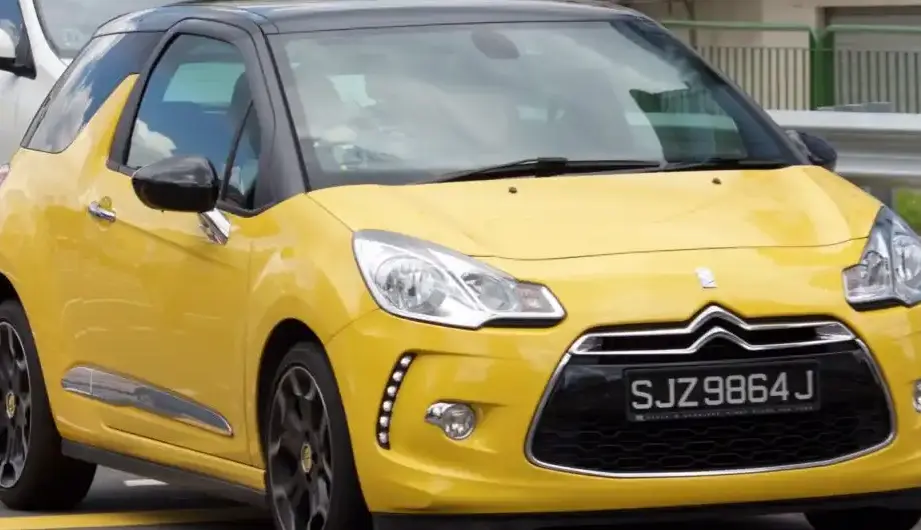
The Citroen DS 3 (Phase I) 1.4 VTi Airdream, producing 95 horsepower, was a key variant in the initial lineup of Citroen’s stylish subcompact hatchback, launched in September 2010 and remaining in production through 2012. Positioned as an entry-level offering, it aimed to provide a balance of affordability, fuel efficiency, and the DS 3’s distinctive design. The DS 3 itself was a significant departure for Citroen, moving away from traditional hatchback conventions with its bold styling cues and a focus on personalization. This first generation, internally designated as the A1 platform, sought to attract a younger demographic and establish a premium image for the Citroen brand.
Technical Specifications
| Brand | Citroen |
| Model | DS3 |
| Generation | DS 3 (Phase I) |
| Type (Engine) | 1.4 VTi Airdream (95 Hp) |
| Start of production | September, 2010 |
| End of production | 2012 |
| Powertrain Architecture | Internal Combustion engine |
| Body type | Hatchback |
| Seats | 5 |
| Doors | 3 |
| Fuel consumption (urban) | 7.6-7.7 l/100 km (30.9 – 30.5 US mpg) |
| Fuel consumption (extra urban) | 4.8-4.9 l/100 km (49 – 48 US mpg) |
| Fuel consumption (combined) | 5.8-5.9 l/100 km (40.6 – 39.9 US mpg) |
| CO2 emissions | 134-136 g/km |
| Fuel Type | Petrol (Gasoline) |
| Acceleration 0 – 100 km/h | 10.6 sec |
| Acceleration 0 – 62 mph | 10.6 sec |
| Acceleration 0 – 60 mph | 10.1 sec |
| Maximum speed | 184 km/h (114.33 mph) |
| Emission standard | EURO 5 |
| Weight-to-power ratio | 11.3 kg/Hp |
| Weight-to-torque ratio | 7.9 kg/Nm |
| Power | 95 Hp @ 6000 rpm |
| Torque | 136 Nm @ 4000 rpm (100.31 lb.-ft. @ 4000 rpm) |
| Engine layout | Front, Transverse |
| Engine Model/Code | 8FP EP3C |
| Engine displacement | 1397 cm3 (85.25 cu. in.) |
| Number of cylinders | 4 |
| Engine configuration | Inline |
| Cylinder Bore | 77 mm (3.03 in.) |
| Piston Stroke | 75 mm (2.95 in.) |
| Fuel injection system | Multi-port manifold injection |
| Engine aspiration | Naturally aspirated engine |
| Engine oil capacity | 4.3 l (4.54 US qt | 3.78 UK qt) |
| Kerb Weight | 1075 kg (2369.97 lbs.) |
| Max. weight | 1552 kg (3421.57 lbs.) |
| Max load | 477 kg (1051.6 lbs.) |
| Trunk (boot) space – minimum | 285 l (10.06 cu. ft.) |
| Trunk (boot) space – maximum | 980 l (34.61 cu. ft.) |
| Fuel tank capacity | 50 l (13.21 US gal | 11 UK gal) |
| Max. roof load | 70 kg (154.32 lbs.) |
| Permitted trailer load with brakes (12%) | 900 kg (1984.16 lbs.) |
| Permitted trailer load without brakes | 570 kg (1256.63 lbs.) |
| Permitted towbar download | 46 kg (101.41 lbs.) |
| Length | 3948 mm (155.43 in.) |
| Width | 1715 mm (67.52 in.) |
| Height | 1458-1483 mm (57.4 – 58.39 in.) |
| Wheelbase | 2464 mm (97.01 in.) |
| Front track | 1465-1468 mm (57.68 – 57.8 in.) |
| Rear (Back) track | 1467-1471 mm (57.76 – 57.91 in.) |
| Front overhang | 824 mm (32.44 in.) |
| Rear overhang | 660 mm (25.98 in.) |
| Minimum turning circle | 10.2 m (33.46 ft.) |
| Drivetrain Architecture | Front wheel drive |
| Drive wheel | Front wheel drive |
| Number of gears and type of gearbox | 5 gears, manual transmission |
| Front suspension | Independent, type McPherson with coil spring and anti-roll bar |
| Rear suspension | Independent coil spring, Elastic beam |
| Front brakes | Ventilated discs |
| Rear brakes | Drum |
| Assisting systems | ABS (Anti-lock braking system) |
| Steering type | Steering rack and pinion |
| Tires size | 195/55 R16 |
| Wheel rims size | 16 |
Powertrain & Engine Architecture
The 1.4 VTi Airdream engine, identified by the code 8FP EP3C, is a naturally aspirated, inline-four cylinder petrol engine. It’s part of the Prince engine family, a collaborative development between PSA Peugeot Citroen and BMW. This engine utilizes multi-point fuel injection and features variable valve timing on both the intake and exhaust camshafts, contributing to improved efficiency and a broader torque curve. The 95 horsepower output is achieved at 6000 rpm, with peak torque of 136 Nm (100.31 lb-ft) delivered at 4000 rpm. The engine’s design prioritizes fuel economy and reduced emissions, aligning with Citroen’s “Airdream” branding. The engine was typically paired with a 5-speed manual transmission in this configuration, although an automated manual transmission (ETG6) was also offered as an option. The ETG6, while offering some convenience, was often criticized for its slow and jerky shifts.
Driving Characteristics
The 1.4 VTi Airdream with the 5-speed manual transmission offered adequate, but not exhilarating, performance. Acceleration from 0-60 mph took around 10.1 seconds, and top speed was approximately 114 mph. The engine felt relatively strained when pushed hard, particularly when fully loaded or tackling steep inclines. The gear ratios were tuned for fuel efficiency rather than outright performance, meaning frequent downshifts were often required to maintain momentum. Compared to the more powerful 1.6 VTi variants, the 1.4 felt noticeably slower. However, it provided a more relaxed driving experience, particularly in urban environments, and its lighter weight contributed to improved handling and agility.
Equipment & Trim Levels
The 1.4 VTi Airdream typically served as the entry point to the DS 3 range. Standard equipment included air conditioning, electric front windows, a CD stereo with USB connectivity, and ABS brakes. Safety features such as driver and passenger airbags were also standard. Higher trim levels, such as DSport and DSign, added features like alloy wheels, automatic headlights, rain-sensing wipers, and a more comprehensive infotainment system. Customers could personalize their DS 3 with a wide range of options, including different roof colors, interior trim materials, and exterior styling packs.
Chassis & Braking
The DS 3 (Phase I) utilized a McPherson strut front suspension and an elastic beam rear suspension. This setup provided a good balance between ride comfort and handling. The front suspension incorporated an anti-roll bar to reduce body roll during cornering. Braking duties were handled by ventilated discs at the front and drum brakes at the rear. ABS (Anti-lock Braking System) was standard, providing enhanced braking performance and stability. The relatively lightweight nature of the 1.4 VTi Airdream variant contributed to its nimble handling characteristics.
Market Reception & Comparison
The DS 3 1.4 VTi Airdream was generally well-received by critics as an affordable and stylish entry point into the DS 3 range. Its fuel economy, averaging around 40 mpg in combined driving, was a key selling point. However, some reviewers criticized its lack of outright performance and the sometimes-clunky operation of the optional ETG6 automated manual transmission. Compared to the 1.6 VTi models, the 1.4 offered a more economical option, but at the expense of performance. The 1.6 HDi diesel variants provided even better fuel economy, but with a higher initial purchase price.
Legacy
The 1.4 VTi Airdream engine, while not known for exceptional durability, has proven to be reasonably reliable in the DS 3. Common issues include occasional problems with the timing chain and fuel injectors. However, these are typically not catastrophic failures and can be addressed with routine maintenance. On the used car market, the 1.4 VTi Airdream variants tend to be more affordable than their higher-powered counterparts, making them an attractive option for budget-conscious buyers. The DS 3 itself has become a popular choice among those seeking a stylish and distinctive small hatchback, and the 1.4 VTi Airdream remains a viable option for those prioritizing fuel efficiency and affordability.
