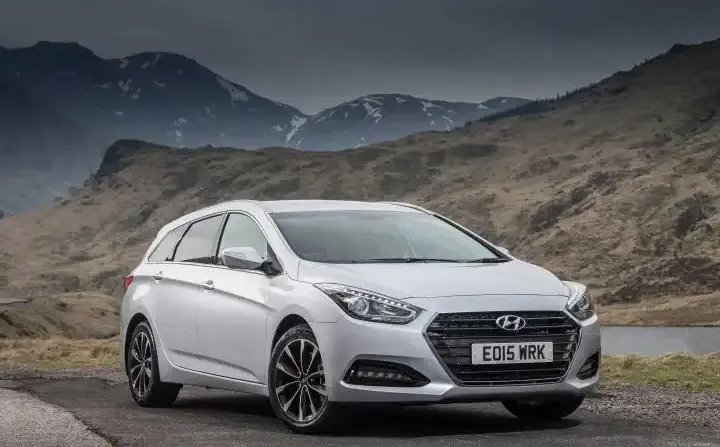
The Hyundai i40 Combi 1.7 VGT (140 hp) Automatic, produced between 2011 and 2015, represents a significant offering in Hyundai’s European lineup. Positioned as a practical and well-equipped station wagon (estate), the i40 Combi aimed to compete with established players like the Ford Mondeo, Volkswagen Passat, and Opel/Vauxhall Insignia. This particular variant, combining a 1.7-liter diesel engine with a six-speed automatic transmission, was designed to appeal to buyers prioritizing fuel efficiency and ease of driving over outright performance. It sat in the mid-range of the i40 Combi offerings, offering a balance between the base models and the more powerful gasoline options.
Technical Specifications
| Brand | Hyundai |
| Model | i40 |
| Generation | i40 Combi |
| Type (Engine) | 1.7 VGT (140 Hp) Automatic |
| Start of production | 2011 |
| End of production | 2015 |
| Powertrain Architecture | Internal Combustion engine |
| Body type | Station wagon (estate) |
| Seats | 5 |
| Doors | 5 |
| Fuel Type | Diesel |
| Weight-to-power ratio | 10.9 kg/Hp, 91.5 Hp/tonne |
| Weight-to-torque ratio | 4.7 kg/Nm, 211.8 Nm/tonne |
| Power | 140 Hp @ 4000 rpm |
| Power per litre | 83.1 Hp/l |
| Torque | 324 Nm @ 2000-2500 rpm (238.97 lb.-ft. @ 2000-2500 rpm) |
| Engine layout | Front, Transverse |
| Engine Model/Code | U II / D4FD |
| Engine displacement | 1685 cm3 (102.83 cu. in.) |
| Number of cylinders | 4 |
| Engine configuration | Inline |
| Cylinder Bore | 77.2 mm (3.04 in.) |
| Piston Stroke | 90 mm (3.54 in.) |
| Compression ratio | 17:1 |
| Number of valves per cylinder | 4 |
| Fuel injection system | Diesel Commonrail |
| Engine aspiration | Turbocharger, Intercooler |
| Valvetrain | DOHC |
| Engine oil capacity | 5.3 l (5.6 US qt | 4.66 UK qt) |
| Coolant | 6.9 l (7.29 US qt | 6.07 UK qt) |
| Kerb Weight | 1530 kg (3373.07 lbs.) |
| Fuel tank capacity | 70 l (18.49 US gal | 15.4 UK gal) |
| Length | 4815 mm (189.57 in.) |
| Width | 1815 mm (71.46 in.) |
| Height | 1470 mm (57.87 in.) |
| Wheelbase | 2770 mm (109.06 in.) |
| Front track | 1579 mm (62.17 in.) |
| Rear (Back) track | 1585 mm (62.4 in.) |
| Drag coefficient (Cd) | 0.29 |
| Minimum turning circle (turning diameter) | 10.94 m (35.89 ft.) |
| Drivetrain Architecture | The Internal combustion engine (ICE) drives the front wheels of the vehicle. |
| Drive wheel | Front wheel drive |
| Number of gears and type of gearbox | 6 gears, automatic transmission |
| Front brakes | Ventilated discs |
| Rear brakes | Ventilated discs |
| Assisting systems | ABS (Anti-lock braking system) |
| Steering type | Steering rack and pinion |
| Power steering | Electric Steering |
| Tires size | 215/50 R17 |
| Wheel rims size | 17 |
Powertrain & Engine Architecture
The heart of the i40 Combi 1.7 VGT Automatic is the U II / D4FD engine, a 1.7-liter inline-four cylinder diesel. This engine utilizes a second-generation common rail direct injection system, delivering fuel at extremely high pressures for optimized combustion. A turbocharger with an intercooler is employed to boost power and torque, mitigating the typical turbo lag associated with smaller displacement engines. The engine features a double overhead camshaft (DOHC) valvetrain with four valves per cylinder, enhancing volumetric efficiency. The 17:1 compression ratio is typical for diesel engines, contributing to their inherent efficiency. The six-speed automatic transmission, while not a dual-clutch unit like some competitors, provides smooth and relatively quick shifts. It’s designed to work in harmony with the engine’s torque curve, prioritizing fuel economy and comfortable cruising.
Driving Characteristics
The 140 hp and 324 Nm (238.97 lb-ft) of torque delivered by this powertrain configuration results in a comfortable, rather than sporty, driving experience. Acceleration is adequate for everyday driving, with a 0-60 mph time estimated around 10.5-11 seconds. The automatic transmission is programmed for smooth shifts and prioritizes fuel efficiency, sometimes at the expense of responsiveness. Compared to the manual transmission version, the automatic offers less driver engagement but greater convenience, particularly in urban traffic. The torque curve is relatively flat, providing good pulling power from low engine speeds, making it well-suited for carrying passengers and luggage. Compared to higher-output gasoline versions of the i40, this diesel automatic sacrifices outright performance but gains significantly in fuel economy.
Equipment & Trim Levels
The i40 Combi 1.7 VGT Automatic typically came equipped with a respectable level of standard features. These included air conditioning, electric windows and mirrors, a radio/CD player with USB connectivity, and ABS brakes. Higher trim levels added features such as alloy wheels, a touchscreen infotainment system with navigation, rear parking sensors, and climate control. Interior upholstery was generally cloth, with leather options available as an upgrade. Dashboard design was functional and modern, with a focus on ergonomics. Optional extras often included a panoramic sunroof, heated seats, and a premium sound system.
Chassis & Braking
The i40 Combi’s chassis is a typical front-wheel-drive configuration, utilizing MacPherson strut suspension at the front and a multi-link suspension at the rear. This setup provides a good balance between ride comfort and handling. The braking system consists of ventilated discs on all four wheels, providing adequate stopping power. ABS (Anti-lock Braking System) is standard. Stabilizer bars are fitted to both the front and rear axles to reduce body roll during cornering. The suspension tuning is geared towards comfort, prioritizing a smooth ride over sharp handling.
Market Reception & Comparison
The Hyundai i40 Combi 1.7 VGT Automatic was generally well-received by automotive critics. It was praised for its spacious interior, comfortable ride, and competitive fuel economy. However, some reviewers noted that the automatic transmission could feel sluggish at times, and the engine lacked the refinement of some of its rivals. Compared to the 1.6 GDI gasoline version, the diesel offered significantly better fuel economy but less power. Against competitors like the Ford Mondeo and Volkswagen Passat, the i40 Combi offered a compelling value proposition, often undercutting them on price while providing a similar level of equipment. Reliability reports generally indicate good dependability for this powertrain, although regular maintenance is crucial for diesel engines.
Legacy
The Hyundai i40 Combi 1.7 VGT Automatic has proven to be a relatively reliable and durable vehicle in the used car market. The 1.7-liter diesel engine, while not known for being exceptionally powerful, is generally robust and capable of high mileage with proper maintenance. The automatic transmission, while not the most advanced, has also proven to be fairly dependable. Today, these vehicles represent a practical and affordable option for buyers seeking a spacious and fuel-efficient station wagon. Parts availability is generally good, and maintenance costs are reasonable. The i40 Combi, in this configuration, remains a testament to Hyundai’s growing reputation for building well-rounded and dependable vehicles.