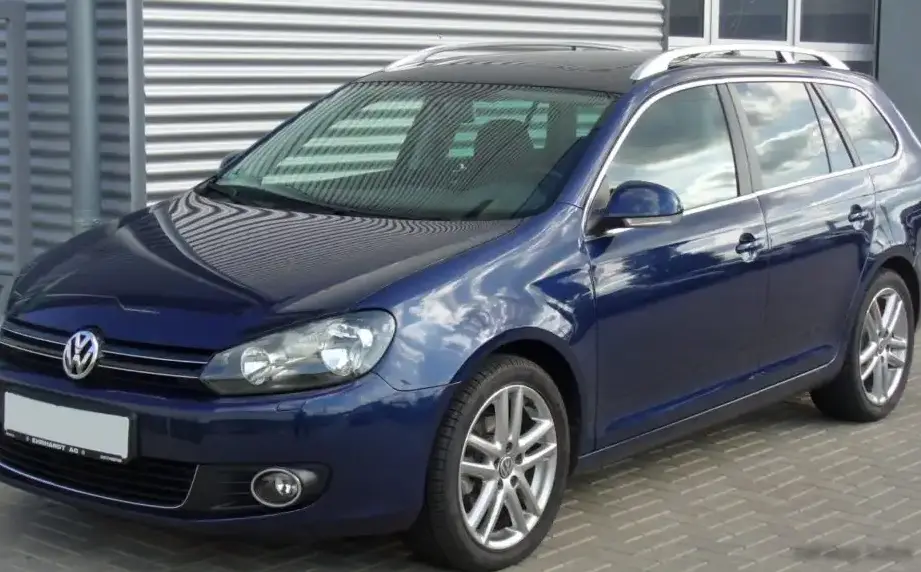
The Volkswagen Golf VI Variant 1.2 TSI (85 hp) was a front-wheel-drive, five-door station wagon produced between 2010 and 2013. Positioned as an entry-level offering within the Golf VI Variant range, it aimed to provide practicality and fuel efficiency to buyers seeking a compact estate car. This variant was part of the larger Golf VI (Mk6) generation, built on the A6 platform, which also underpinned models like the Scirocco and Touran. The 1.2 TSI engine represented Volkswagen’s downsized, turbocharged engine strategy, offering a balance between performance and economy.
Technical Specifications
| Brand | Volkswagen |
| Model | Golf |
| Generation | Golf VI Variant |
| Type (Engine) | 1.2 TSI (85 Hp) |
| Start of production | 2010 |
| End of production | 2013 |
| Powertrain Architecture | Internal Combustion engine |
| Body type | Station wagon (estate) |
| Seats | 5 |
| Doors | 5 |
| Fuel consumption (urban) | 7.1 l/100 km (33.1 US mpg, 39.8 UK mpg, 14.1 km/l) |
| Fuel consumption (extra urban) | 4.7 l/100 km (50 US mpg, 60.1 UK mpg, 21.3 km/l) |
| Fuel consumption (combined) | 5.6 l/100 km (42 US mpg, 50.4 UK mpg, 17.9 km/l) |
| CO2 emissions | 132 g/km |
| Fuel Type | Petrol (Gasoline) |
| Acceleration 0 – 100 km/h | 13.3 sec |
| Acceleration 0 – 62 mph | 13.3 sec |
| Acceleration 0 – 60 mph | 12.6 sec |
| Maximum speed | 178 km/h (110.6 mph) |
| Emission standard | Euro 5 |
| Weight-to-power ratio | 15 kg/Hp |
| Weight-to-torque ratio | 8 kg/Nm |
| Power | 85 Hp @ 4800 rpm |
| Torque | 160 Nm @ 1500-3500 rpm (118.01 lb.-ft. @ 1500-3500 rpm) |
| Engine layout | Front, Transverse |
| Engine Model/Code | CBZA |
| Engine displacement | 1197 cm3 (73.05 cu. in.) |
| Number of cylinders | 4 |
| Engine configuration | Inline |
| Cylinder Bore | 71 mm (2.8 in.) |
| Piston Stroke | 75.6 mm (2.98 in.) |
| Compression ratio | 10.5:1 |
| Number of valves per cylinder | 2 |
| Fuel injection system | Direct injection |
| Engine aspiration | Turbocharger, Intercooler |
| Valvetrain | SOHC |
| Engine oil capacity | 3.6 l (3.8 US qt | 3.17 UK qt) |
| Kerb Weight | 1272 kg (2804.28 lbs.) |
| Max. weight | 1900 kg (4188.78 lbs.) |
| Max load | 628 kg (1384.5 lbs.) |
| Trunk (boot) space – minimum | 505 l (17.83 cu. ft.) |
| Trunk (boot) space – maximum | 1495 l (52.8 cu. ft.) |
| Fuel tank capacity | 55 l (14.53 US gal | 12.1 UK gal) |
| Max. roof load | 75 kg (165.35 lbs.) |
| Permitted trailer load with brakes (8%) | 1400 kg (3086.47 lbs.) |
| Permitted trailer load with brakes (12%) | 1100 kg (2425.08 lbs.) |
| Permitted trailer load without brakes | 670 kg (1477.1 lbs.) |
| Permitted towbar download | 75 kg (165.35 lbs.) |
| Length | 4534 mm (178.5 in.) |
| Width | 1781 mm (70.12 in.) |
| Width including mirrors | 2003 mm (78.86 in.) |
| Height | 1504 mm (59.21 in.) |
| Wheelbase | 2578 mm (101.5 in.) |
| Front track | 1535 mm (60.43 in.) |
| Rear track | 1508 mm (59.37 in.) |
| Ride height (ground clearance) | 141 mm (5.55 in.) |
| Minimum turning circle | 10.9 m (35.76 ft.) |
| Front suspension | Independent type McPherson, Transverse stabilizer |
| Rear suspension | Independent multi-link suspension, Transverse stabilizer |
| Front brakes | Ventilated discs |
| Rear brakes | Disc |
| Assisting systems | ABS (Anti-lock braking system) |
| Steering type | Steering rack and pinion |
| Power steering | Electric Steering |
| Tires size | 205/55 R16 |
| Wheel rims size | 6.5J x 16 |
INTRODUCTION
The Golf VI Variant 1.2 TSI (85 hp) was introduced in 2010 as part of the Golf Mk6’s mid-cycle refresh. The Variant, Volkswagen’s designation for its station wagon models, offered increased cargo capacity compared to the standard hatchback. This particular engine and power output was aimed at buyers prioritizing fuel economy and lower running costs, making it a popular choice in Europe where fuel prices are typically higher and smaller engines are favored. It served as the entry point into the Golf Variant range, with more powerful engine options like the 1.4 TSI and 2.0 TDI available for those seeking greater performance.
Powertrain & Engine Architecture
The heart of this Golf Variant is the CBZA engine code, a 1.2-liter inline-four cylinder gasoline engine. This engine is a member of Volkswagen’s EA111 family, known for its compact size and efficiency. It features direct fuel injection (FSI) and a single overhead camshaft (SOHC) valvetrain with two valves per cylinder. A turbocharger with an intercooler is employed to boost power output, overcoming the limitations of the small displacement. The engine’s control unit manages fuel delivery and ignition timing for optimal performance and emissions. The 1.2 TSI engine was paired with a five-speed automatic transmission, offering convenient gear changes but sacrificing some of the efficiency of a manual gearbox. This automatic transmission was a conventional torque converter type, prioritizing smoothness over outright performance.
Driving Characteristics
The 85 hp output and automatic transmission combination resulted in a driving experience focused on practicality rather than sportiness. Acceleration from 0-60 mph took around 12.6 seconds, and the top speed was 110.6 mph. The engine delivered its peak torque of 160 Nm (118 lb-ft) between 1500 and 3500 rpm, providing adequate pulling power for everyday driving situations. However, overtaking maneuvers required careful planning. The automatic transmission, while smooth, could feel somewhat sluggish, particularly when downshifting. Compared to the manual version of the same engine, the automatic offered less driver engagement and slightly reduced fuel economy. Higher-output versions, such as the 1.4 TSI, provided significantly more responsive performance.
Equipment & Trim Levels
The 1.2 TSI automatic typically came with a reasonable level of standard equipment. This included air conditioning, electric front windows, central locking, and an audio system with CD player. Safety features such as ABS, front airbags, and stability control were also standard. Interior upholstery was typically cloth, and the dashboard featured a functional, if somewhat understated, design. Optional extras included alloy wheels, parking sensors, a multi-function steering wheel, and upgraded audio systems. Trim levels varied depending on the market, but generally, this variant represented a mid-range offering, bridging the gap between basic and more luxurious specifications.
Chassis & Braking
The Golf VI Variant featured independent suspension on both the front and rear axles. The front utilized a McPherson strut setup, while the rear employed a multi-link system. This configuration provided a comfortable ride and decent handling characteristics. The front brakes were ventilated discs, offering good stopping power, while the rear brakes were solid discs. The steering was electrically assisted, providing light and precise control. Stabilizer bars were fitted to both axles to reduce body roll during cornering. The weight distribution was reasonably balanced, contributing to predictable handling.
Market Reception & Comparison
The Golf VI Variant 1.2 TSI (85 hp) was generally well-received by critics as a practical and economical estate car. Its fuel economy of around 42 US mpg combined was a major selling point. However, some reviewers criticized its lack of outright performance, particularly when paired with the automatic transmission. Compared to the 1.4 TSI and 2.0 TDI variants, it offered less power and a slower driving experience. However, it was significantly cheaper to purchase and run, making it an attractive option for budget-conscious buyers. The 1.2 TSI engine was also praised for its refinement and relatively quiet operation.
Legacy
The CBZA 1.2 TSI engine, while generally reliable, has been known to exhibit some issues over time, including potential problems with the turbocharger and fuel injectors. Regular maintenance, including oil changes and timely replacement of wear items, is crucial for ensuring long-term reliability. In the used car market, the Golf VI Variant 1.2 TSI (85 hp) represents a relatively affordable and practical option. Its fuel efficiency and spacious interior continue to appeal to buyers seeking a compact estate car. However, potential buyers should be aware of the potential maintenance costs associated with the turbocharged engine and automatic transmission. The Golf VI Variant remains a popular choice for families and individuals needing a versatile and economical vehicle.