
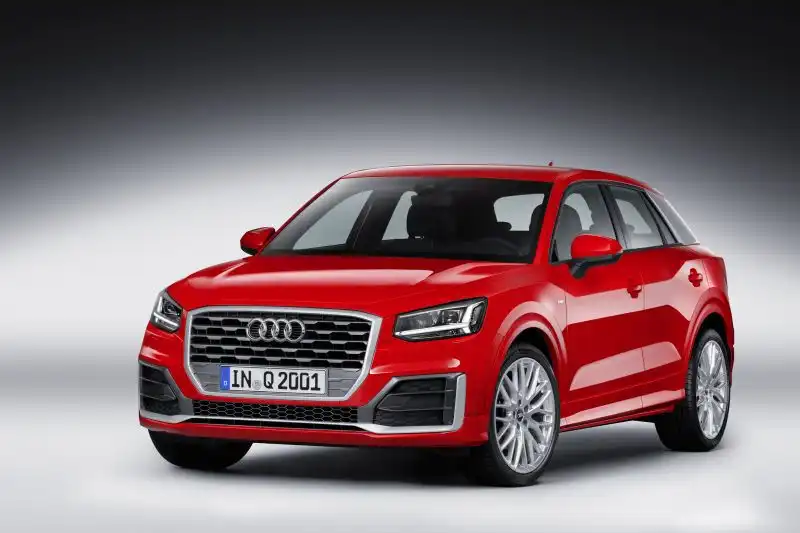
The Audi Q2 1.6 TDI (116 hp) S tronic was a front-wheel-drive subcompact luxury crossover SUV produced by the German manufacturer Audi between 2016 and 2018. Positioned as an entry-level offering within the broader Q2 range, it aimed to attract buyers seeking a premium vehicle with good fuel economy and a manageable price point. This variant played a significant role in establishing the Q2 as a popular choice in the European market, offering a balance between practicality, style, and efficiency. It was part of the first generation of the Q2 (GA), built on the Volkswagen Group’s MQB platform.
Technical Specifications
| Brand | Audi |
| Model | Q2 |
| Generation | Q2 |
| Type (Engine) | 1.6 TDI (116 Hp) S tronic |
| Start of production | 2016 |
| End of production | 2018 |
| Powertrain Architecture | Internal Combustion engine |
| Body type | SUV |
| Seats | 5 |
| Doors | 5 |
| Fuel consumption (urban) | 4.4-4.6 l/100 km (53.5 – 51.1 US mpg) |
| Fuel consumption (extra urban) | 4-4.3 l/100 km (58.8 – 54.7 US mpg) |
| Fuel consumption (combined) | 4.1-4.3 l/100 km (57.4 – 54.7 US mpg) |
| CO2 emissions | 109-114 g/km |
| Fuel Type | Diesel |
| Acceleration 0 – 100 km/h | 10.7 sec |
| Acceleration 0 – 62 mph | 10.7 sec |
| Acceleration 0 – 60 mph | 10.2 sec |
| Maximum speed | 190 km/h (118.06 mph) |
| Emission standard | Euro 6 |
| Power | 116 Hp @ 3250-4000 rpm |
| Torque | 250 Nm @ 1500-3200 rpm (184.39 lb.-ft. @ 1500-3200 rpm) |
| Engine layout | Front, Transverse |
| Engine Model/Code | DDYA |
| Engine displacement | 1598 cm3 (97.52 cu. in.) |
| Number of cylinders | 4 |
| Engine configuration | Inline |
| Fuel injection system | Diesel Commonrail |
| Engine aspiration | Turbocharger, Intercooler |
| Engine oil capacity | 4.7 l (4.97 US qt | 4.14 UK qt) |
| Coolant capacity | 8 l (8.45 US qt | 7.04 UK qt) |
| Trunk (boot) space – minimum | 405 l (14.3 cu. ft.) |
| Trunk (boot) space – maximum | 1050 l (37.08 cu. ft.) |
| Length | 4191 mm (165 in.) |
| Width | 1794 mm (70.63 in.) |
| Width including mirrors | 2009 mm (79.09 in.) |
| Height | 1508 mm (59.37 in.) |
| Wheelbase | 2601 mm (102.4 in.) |
| Front track | 1547 mm (60.91 in.) |
| Rear track | 1541 mm (60.67 in.) |
| Drivetrain Architecture | Front wheel drive |
| Number of gears and type of gearbox | 7 gears, automatic transmission S-tronic |
| Front brakes | Ventilated discs |
| Rear brakes | Disc |
Powertrain & Engine Architecture
The Audi Q2 1.6 TDI S tronic was powered by the Volkswagen Group’s DDYA engine, a 1.6-liter inline-four cylinder diesel engine. This engine utilized a common rail direct injection system, delivering fuel at high pressure directly into the combustion chamber for improved efficiency and reduced emissions. A turbocharger with an intercooler was employed to boost power output. The engine produced 116 horsepower at 3250-4000 rpm and 250 Nm (184 lb-ft) of torque between 1500-3200 rpm. The S tronic transmission was a seven-speed dual-clutch transmission (DCT), known for its quick and smooth gear changes. This transmission allowed for both fully automatic operation and manual gear selection via steering wheel-mounted paddles or the gear selector.
Driving Characteristics
The 1.6 TDI S tronic offered a comfortable and refined driving experience, prioritizing fuel efficiency over outright performance. Acceleration from 0-60 mph took approximately 10.2 seconds, making it adequate for everyday driving but not particularly sporty. The S tronic transmission provided responsive shifts, and the engine delivered a usable amount of torque at low revs, making it easy to navigate city traffic. Compared to the more powerful 2.0 TDI variants, the 1.6 TDI felt less energetic, especially when fully loaded or tackling steep inclines. However, the lower power output also contributed to better fuel economy.
Equipment & Trim Levels
The Q2 1.6 TDI S tronic typically came standard with features such as air conditioning, a multi-function steering wheel, Audi’s MMI radio system with a 5.8-inch color display, Bluetooth connectivity, and alloy wheels. Safety features included ABS, electronic stability control, and multiple airbags. Optional extras included upgrades to the MMI system with navigation, a panoramic sunroof, leather upholstery, parking sensors, and various driver assistance systems like adaptive cruise control. Trim levels varied by market, but generally offered progressive enhancements in terms of interior materials, exterior styling, and technology features.
Chassis & Braking
The Q2’s chassis featured a MacPherson strut front suspension and a multi-link rear suspension, providing a good balance between ride comfort and handling. The front brakes were ventilated discs, while the rear brakes were solid discs. The steering was an electromechanical power steering system, offering precise and responsive control. Stabilizer bars were fitted to both the front and rear axles to reduce body roll during cornering. The suspension setup was tuned to prioritize comfort, but still provided a reasonably engaging driving experience.
Market Reception & Comparison
The Audi Q2 1.6 TDI S tronic was generally well-received by automotive critics for its stylish design, comfortable interior, and fuel efficiency. However, some reviewers noted that the 1.6 TDI engine felt underpowered compared to the more potent engine options. Compared to rivals like the BMW X1 and Mercedes-Benz GLA, the Q2 offered a more youthful and modern aesthetic, but the 1.6 TDI variant lacked the performance of some of its competitors. Fuel economy was a strong point, with combined figures ranging from 4.1 to 4.3 l/100 km (57.4 – 54.7 US mpg), making it an attractive option for drivers prioritizing efficiency.
Legacy
The Audi Q2 1.6 TDI S tronic, while not the most powerful variant in the Q2 lineup, proved to be a reliable and economical choice for many buyers. The DDYA engine, while having some known issues with diesel particulate filter (DPF) clogging if not driven on longer journeys, generally proved durable with regular maintenance. On the used car market, these models represent a relatively affordable entry point into Audi ownership. The S tronic transmission, when properly maintained, is also known for its longevity. The Q2 itself established Audi’s presence in the subcompact luxury crossover segment, and the 1.6 TDI variant played a key role in its initial success, particularly in Europe.
