
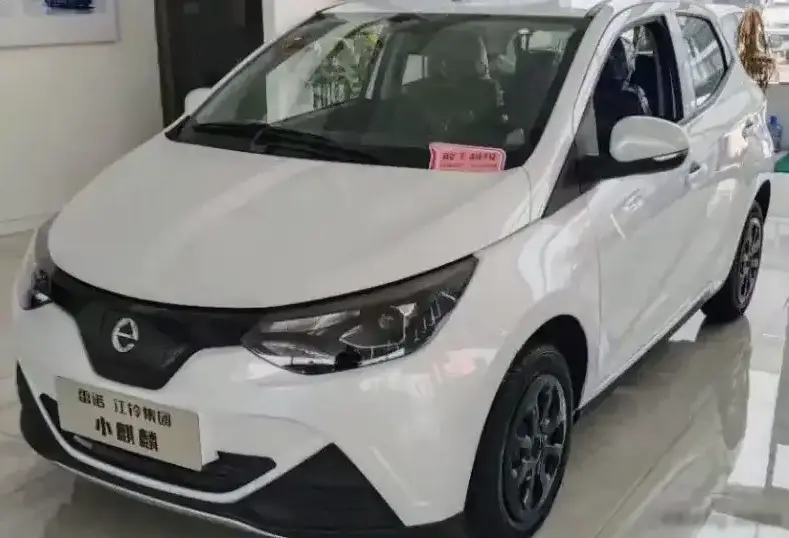
The JMEV EV2, also marketed as the Xiaoqilin (小企麟, meaning “Little Unicorn”), is a small, all-electric hatchback produced by the Chinese manufacturer JMEV (Jiangsu Jinteng Vehicle Manufacturing Co., Ltd.) starting in 2022. Designed primarily for urban commuting and short-distance travel within China, the EV2 represents a budget-friendly entry point into the burgeoning electric vehicle market. This article focuses specifically on the base variant equipped with the 15.86 kWh battery pack and 35 horsepower electric motor, which serves as the entry-level offering in the EV2 lineup.
Technical Specifications
| Brand | JMEV |
| Model | EV2/Xiaoqilin |
| Type (Engine) | 15.86 kWh (35 Hp) Electric |
| Start of production | 2022 |
| Powertrain Architecture | BEV (Electric Vehicle) |
| Body type | Hatchback |
| Seats | 4 |
| Doors | 5 |
| Fuel Type | Electricity |
| Maximum speed | 100 km/h (62.14 mph) |
| Weight-to-power ratio | 25.4 kg/Hp, 39.3 Hp/tonne |
| Weight-to-torque ratio | 10.6 kg/Nm, 94.4 Nm/tonne |
| Gross battery capacity | 15.86 kWh |
| Battery technology | Lithium iron phosphate (LiFePO4) |
| Battery location | Below the floor |
| All-electric range (CLTC) | 201 km (124.9 mi) |
| Electric motor power | 35 Hp |
| Electric motor Torque | 84 Nm (61.96 lb.-ft.) |
| Electric motor location | Front axle, Transverse |
| Electric motor type | Synchronous |
| System power | 35 Hp |
| System torque | 84 Nm (61.96 lb.-ft.) |
| Kerb Weight | 890 kg (1962.11 lbs.) |
| Max. weight | 1190 kg (2623.5 lbs.) |
| Max load | 300 kg (661.39 lbs.) |
| Length | 3500 mm (137.8 in.) |
| Width | 1646 mm (64.8 in.) |
| Height | 1460 mm (57.48 in.) |
| Wheelbase | 2340 mm (92.13 in.) |
| Front track | 1420 mm (55.91 in.) |
| Rear (Back) track | 1420 mm (55.91 in.) |
| Ride height (ground clearance) | 110 mm (4.33 in.) |
| Drivetrain Architecture | One electric motor drives the front wheels. |
| Drive wheel | Front wheel drive |
| Number of gears and type of gearbox | 1 gears, automatic transmission |
| Front suspension | Independent type McPherson |
| Rear suspension | Wishbone |
| Front brakes | Disc |
| Rear brakes | Drum |
| Assisting systems | ABS (Anti-lock braking system) |
| Steering type | Steering rack and pinion |
| Power steering | Electric Steering |
| Tires size | 165/65 R14 |
| Wheel rims size | 14 |
Powertrain & Engine Architecture
The JMEV EV2 utilizes a fully Battery Electric Vehicle (BEV) powertrain. The core of this variant is a single synchronous electric motor, transversely mounted at the front axle, producing 35 horsepower and 84 Nm (61.96 lb.-ft.) of torque. Power is delivered through a single-speed automatic transmission – a characteristic of most electric vehicles, as the electric motor provides instant torque across a wide RPM range, negating the need for multiple gears. The vehicle is powered by a 15.86 kWh Lithium Iron Phosphate (LiFePO4) battery pack, positioned under the floor of the vehicle to optimize space and lower the center of gravity. LiFePO4 chemistry is favored for its inherent safety and longer cycle life, though it typically offers lower energy density compared to other lithium-ion chemistries. The EV2 employs a standard charging port, compatible with common charging infrastructure available in China.
Driving Characteristics
The 35 horsepower output and single-speed transmission result in modest, but adequate, performance for urban driving. Acceleration is predictably slower than higher-powered EV variants, with a focus on smooth and efficient operation. The single gear ratio prioritizes usability over outright speed. Top speed is limited to 100 km/h (62.14 mph). The EV2’s relatively light curb weight of 890 kg (1962.11 lbs.) helps mitigate the limited power output, providing a reasonably responsive driving experience in city traffic. Compared to potential future variants with larger battery packs and more powerful motors, this base model prioritizes affordability and range over performance.
Equipment & Trim Levels
The base-level EV2/Xiaoqilin 15.86 kWh variant is designed as an affordable transportation solution, and as such, features a relatively basic equipment list. Standard features typically include air conditioning, power windows, a basic audio system, and ABS (Anti-lock Braking System). Interior upholstery is typically a durable, easy-to-clean cloth material. Optional extras, depending on the specific market and dealer, may include a rearview camera, upgraded audio system, and different exterior color options. The dashboard layout is functional and straightforward, prioritizing ease of use over aesthetic complexity.
Chassis & Braking
The EV2 utilizes a McPherson strut independent suspension system at the front, providing a comfortable ride quality on typical urban roads. The rear suspension employs a wishbone configuration. Braking duties are handled by disc brakes at the front and drum brakes at the rear – a cost-saving measure common in this segment. The electric power steering system provides light and easy steering, making maneuvering in tight spaces effortless. The vehicle rides on 14-inch wheels with 165/65 R14 tires.
Market Reception & Comparison
The JMEV EV2/Xiaoqilin has found a niche in the Chinese market as a low-cost electric vehicle option. Reviews generally highlight its affordability and practicality for short-distance commuting. Critics note the limited range (201 km / 124.9 mi CLTC) and modest performance as drawbacks, but acknowledge that these are acceptable trade-offs for the price point. Compared to other entry-level EVs in China, the EV2 offers a competitive price and a relatively spacious interior for its size. Its LiFePO4 battery chemistry is also seen as a positive, offering enhanced safety and longevity.
Legacy
As a relatively recent introduction to the market, the long-term reliability of the JMEV EV2 is still being established. However, the use of a robust LiFePO4 battery pack and a simple electric powertrain suggests a potentially long service life. In the used car market, the EV2 is expected to appeal to budget-conscious buyers seeking an affordable and environmentally friendly transportation option. Its simplicity and relatively low maintenance requirements could make it a popular choice for those new to electric vehicle ownership. The EV2 represents a significant step in making electric mobility accessible to a wider range of consumers in China and potentially beyond.
