
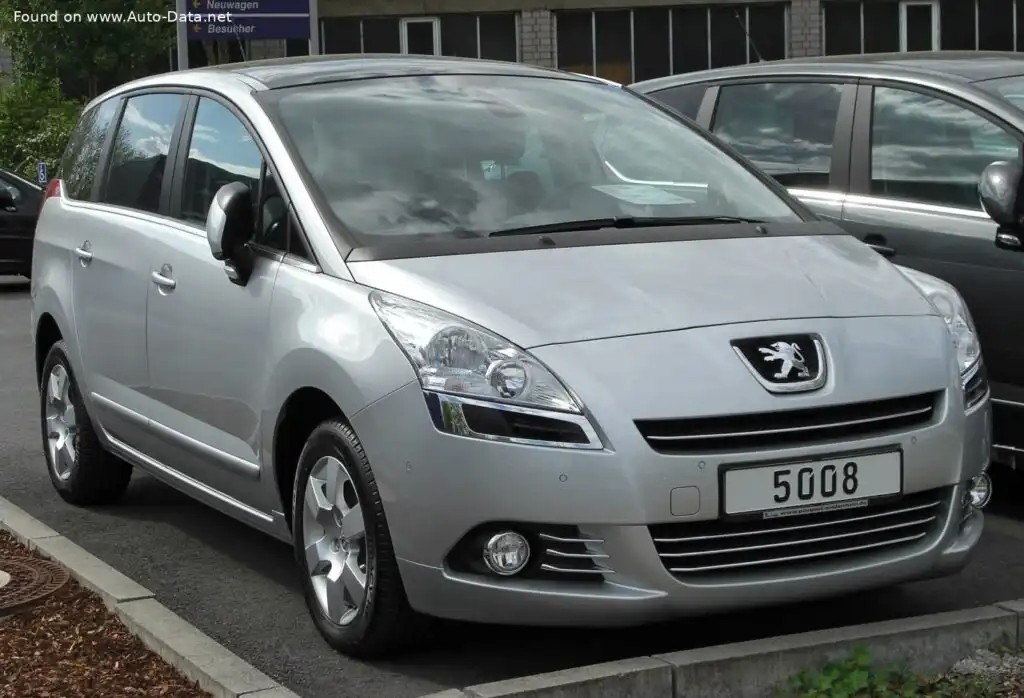
The Peugeot 5008, launched in 2009, represented Peugeot’s entry into the increasingly popular compact Multi-Purpose Vehicle (MPV) segment. The first generation, designated the 5008 I (Phase I), was produced from 2009 to 2013 and offered a practical and family-oriented alternative to traditional station wagons and smaller hatchbacks. Among the engine options available, the 1.6 HDi variant producing 112 horsepower with a Diesel Particulate Filter (DPF) – often referred to as the FAP in European markets – was a significant offering, particularly in Europe, where diesel engines dominated the market. This configuration aimed to balance fuel efficiency with acceptable performance for everyday driving needs.
Technical Specifications
| Brand | Peugeot |
| Model | 5008 |
| Generation | 5008 I (Phase I, 2009) |
| Type (Engine) | 1.6 HDi (112 Hp) FAP |
| Start of production | 2009 |
| End of production | 2013 |
| Powertrain Architecture | Internal Combustion engine |
| Body type | MPV |
| Seats | 5 |
| Doors | 5 |
| Fuel consumption (urban) | 6.6 l/100 km (35.6 US mpg, 42.8 UK mpg, 15.2 km/l) |
| Fuel consumption (extra urban) | 4.9 l/100 km (48 US mpg, 57.6 UK mpg, 20.4 km/l) |
| Fuel consumption (combined) | 5.5 l/100 km (42.8 US mpg, 51.4 UK mpg, 18.2 km/l) |
| Fuel Type | Diesel |
| Acceleration 0 – 100 km/h | 12.3 sec |
| Acceleration 0 – 62 mph | 12.3 sec |
| Acceleration 0 – 60 mph | 11.7 sec |
| Maximum speed | 183 km/h (113.71 mph) |
| Emission standard | Euro 5 |
| Weight-to-power ratio | 13.1 kg/Hp, 76.1 Hp/tonne |
| Weight-to-torque ratio | 5.5 kg/Nm, 183.4 Nm/tonne |
| Power | 112 Hp @ 3600 rpm |
| Power per litre | 71.8 Hp/l |
| Torque | 270 Nm @ 1750 rpm (199.14 lb.-ft. @ 1750 rpm) |
| Engine layout | Front, Transverse |
| Engine Model/Code | 9HR DV6C |
| Engine displacement | 1560 cm3 (95.2 cu. in.) |
| Number of cylinders | 4 |
| Engine configuration | Inline |
| Number of valves per cylinder | 2 |
| Fuel injection system | Diesel Commonrail |
| Engine aspiration | Turbocharger, Intercooler |
| Engine oil capacity | 3.75 l (3.96 US qt, 3.3 UK qt) |
| Coolant capacity | 6 l (6.34 US qt, 5.28 UK qt) |
| Kerb Weight | 1472 kg (3245.2 lbs) |
| Max. weight | 2070 kg (4563.57 lbs) |
| Max load | 598 kg (1318.36 lbs) |
| Trunk (boot) space – minimum | 679 l (23.98 cu. ft.) |
| Trunk (boot) space – maximum | 1754 l (61.94 cu. ft.) |
| Fuel tank capacity | 60 l (15.85 US gal, 13.2 UK gal) |
| Length | 4529 mm (178.31 in.) |
| Width | 1888 mm (74.33 in.) |
| Height | 1647 mm (64.84 in.) |
| Wheelbase | 2727 mm (107.36 in.) |
| Minimum turning circle | 11.1 m (36.42 ft.) |
| Drivetrain Architecture | Front wheel drive |
| Number of gears | 6 gears, manual transmission |
| Front suspension | Independent type McPherson |
| Rear suspension | Semi-independent, coil spring |
| Front brakes | Ventilated discs |
| Rear brakes | Disc |
| Tires size | 215/55 R16; 215/50 R17 |
| Wheel rims size | 16; 17; 18 |
INTRODUCTION
The 5008 1.6 HDi FAP, introduced in 2009, was positioned as a practical and economical choice within the 5008 lineup. It served as a key entry point for buyers seeking the versatility of an MPV without the higher costs associated with more powerful engine options. Built on the PSA Group’s 1HX0/A3 platform (shared with the Citroën C4 Picasso and Peugeot 308), the 5008 aimed to provide a spacious and comfortable interior, coupled with reasonable running costs. This variant was particularly popular in European markets where diesel fuel was readily available and often incentivized due to lower taxation.
Powertrain & Engine Architecture
The heart of the 5008 1.6 HDi FAP is the PSA Group’s 9HR (DV6C) engine. This 1.6-liter, four-cylinder diesel engine utilizes a common rail direct injection system, delivering fuel directly into the combustion chamber at extremely high pressure. This technology, coupled with a variable geometry turbocharger and intercooler, allows for efficient combustion and improved power output. The engine features two valves per cylinder and is known for its relatively simple design, contributing to its reliability. The ‘FAP’ designation indicates the inclusion of a Diesel Particulate Filter, a crucial component for meeting stringent Euro 5 emission standards. This filter traps soot particles produced during combustion, periodically undergoing a regeneration process to burn off the accumulated soot. The 6-speed manual transmission was standard, chosen for its efficiency and driver engagement, although an automated manual transmission was also offered as an option in some markets.
Driving Characteristics
The 112 horsepower and 270 Nm (199 lb-ft) of torque produced by the 1.6 HDi engine provided adequate, though not exhilarating, performance for the 5008. Acceleration from 0-60 mph took around 11.7 seconds, and top speed was approximately 114 mph. The engine’s torque peak at 1750 rpm meant that it offered good pulling power for everyday driving situations, such as overtaking and climbing hills. Compared to the more powerful 2.0 HDi variants, the 1.6 HDi felt less responsive, particularly at higher speeds. The 6-speed manual transmission was well-matched to the engine, offering a good spread of ratios for both fuel efficiency and performance. However, the gearshift action could feel slightly notchy compared to some competitors. The focus was clearly on fuel economy and practicality rather than sporty driving dynamics.
Equipment & Trim Levels
The 5008 1.6 HDi FAP typically came equipped with a reasonable level of standard features. These included air conditioning, electric front windows, a CD stereo system, and ABS brakes. Higher trim levels, such as ‘Sport’ or ‘Allure’, added features like alloy wheels, rear parking sensors, cruise control, and a more sophisticated infotainment system. Interior upholstery was typically cloth, with options for leather upgrades on higher trims. The 5008’s interior was designed with practicality in mind, offering a flexible seating arrangement with individual rear seats that could be folded flat or removed entirely to maximize cargo space.
Chassis & Braking
The 5008’s chassis featured an independent McPherson strut suspension at the front and a semi-independent coil spring suspension at the rear. This setup provided a comfortable ride quality, absorbing bumps and imperfections in the road surface effectively. The front brakes were ventilated discs, while the rear brakes were solid discs. ABS (Anti-lock Braking System) was standard, enhancing braking performance and stability. The steering was a rack and pinion system, providing reasonably precise control. The suspension was tuned for comfort rather than outright handling prowess, reflecting the vehicle’s role as a family MPV.
Market Reception & Comparison
The Peugeot 5008 1.6 HDi FAP was generally well-received by critics and buyers alike. It was praised for its spacious interior, fuel efficiency, and practicality. However, some reviewers noted that the engine could feel underpowered when fully loaded or driving on steep inclines. Compared to the 2.0 HDi variants, the 1.6 HDi offered significantly better fuel economy, making it an attractive option for drivers covering long distances. It also benefited from lower running costs due to its smaller engine capacity and reduced tax liabilities in many European countries. Against competitors like the Renault Scenic and Citroën C4 Picasso, the 5008 offered a compelling combination of features and value.
Legacy
The 1.6 HDi engine, in its various iterations, proved to be a reliable and durable powertrain. While the Diesel Particulate Filter (DPF) required periodic maintenance and could be prone to clogging if the vehicle was primarily used for short journeys, the engine itself was generally robust. Today, used examples of the 5008 1.6 HDi FAP remain relatively affordable and represent a practical choice for buyers seeking a spacious and economical MPV. However, potential buyers should be aware of the potential maintenance costs associated with the DPF and ensure that the vehicle has been properly serviced throughout its life. The 5008, in general, helped establish Peugeot as a serious contender in the MPV market, paving the way for the more modern and stylish second-generation model.
