Technical Specifications
| Brand | Volkswagen |
| Model | Golf |
| Generation | Golf VI Variant |
| Type (Engine) | 1.4 TSI (160 Hp) |
| Start of production | May, 2009 |
| End of production | April, 2013 |
| Powertrain Architecture | Internal Combustion engine |
| Body type | Station wagon (estate) |
| Seats | 5 |
| Doors | 5 |
| Fuel consumption (economy) – urban (NEDC) | 8.4 l/100 km (28 US mpg, 33.6 UK mpg, 11.9 km/l) |
| Fuel consumption (economy) – extra urban (NEDC) | 5.3 l/100 km (44.4 US mpg, 53.3 UK mpg, 18.9 km/l) |
| Fuel consumption (economy) – combined (NEDC) | 6.4 l/100 km (36.8 US mpg, 44.1 UK mpg, 15.6 km/l) |
| CO2 emissions (NEDC) | 149 g/km |
| Fuel Type | Petrol (Gasoline) |
| Acceleration 0 – 100 km/h | 8.4 sec |
| Acceleration 0 – 62 mph | 8.4 sec |
| Acceleration 0 – 60 mph | 8 sec |
| Maximum speed | 220 km/h (136.7 mph) |
| Emission standard | Euro 5 |
| Weight-to-power ratio | 8.6 kg/Hp, 116.5 Hp/tonne |
| Weight-to-torque ratio | 5.7 kg/Nm, 174.8 Nm/tonne |
| Power | 160 Hp @ 5800 rpm |
| Power per litre | 115.1 Hp/l |
| Torque | 240 Nm @ 1500-4500 rpm (177.01 lb.-ft. @ 1500-4500 rpm) |
| Engine layout | Front, Transverse |
| Engine Model/Code | EA111 / CAVD, CTHD, CTKA |
| Engine displacement | 1390 cm3 (84.82 cu. in.) |
| Number of cylinders | 4 |
| Engine configuration | Inline |
| Cylinder Bore | 76.5 mm (3.01 in.) |
| Piston Stroke | 75.6 mm (2.98 in.) |
| Compression ratio | 10:1 |
| Number of valves per cylinder | 4 |
| Fuel injection system | Direct injection |
| Engine aspiration | Turbocharging and Supercharger, Intercooler |
| Valvetrain | DOHC |
| Engine oil capacity | 3.6 l (3.8 US qt | 3.17 UK qt) |
| Coolant | 5.6 l (5.92 US qt | 4.93 UK qt) |
| Kerb Weight | 1373 kg (3026.95 lbs.) |
| Max. weight | 1960 kg (4321.06 lbs.) |
| Max load | 587 kg (1294.11 lbs.) |
| Trunk (boot) space – minimum | 505 l (17.83 cu. ft.) |
| Trunk (boot) space – maximum | 1495 l (52.8 cu. ft.) |
| Fuel tank capacity | 55 l (14.53 US gal | 12.1 UK gal) |
| Max. roof load | 75 kg (165.35 lbs.) |
| Permitted trailer load with brakes (8%) | 1700 kg (3747.86 lbs.) |
| Permitted trailer load with brakes (12%) | 1400 kg (3086.47 lbs.) |
| Permitted trailer load without brakes | 720 kg (1587.33 lbs.) |
| Permitted towbar download | 75 kg (165.35 lbs.) |
| Length | 4534 mm (178.5 in.) |
| Width | 1781 mm (70.12 in.) |
| Width including mirrors | 2003 mm (78.86 in.) |
| Height | 1504 mm (59.21 in.) |
| Wheelbase | 2578 mm (101.5 in.) |
| Front track | 1535 mm (60.43 in.) |
| Rear (Back) track | 1508 mm (59.37 in.) |
| Minimum turning circle (turning diameter) | 10.9 m (35.76 ft.) |
| Approach angle | 13.3° |
| Departure angle | 11.9° |
| Ramp-over (brakeover) angle | 8.8° |
| Drivetrain Architecture | The Internal combustion engine (ICE) drives the front wheels of the vehicle. |
| Drive wheel | Front wheel drive |
| Number of gears and type of gearbox | 6 gears, manual transmission |
| Front suspension | Independent, type McPherson with coil spring and anti-roll bar |
| Rear suspension | Independent multi-link spring suspension with stabilizer |
| Front brakes | Ventilated discs |
| Rear brakes | Disc |
| Assisting systems | ABS (Anti-lock braking system) |
| Steering type | Steering rack and pinion |
| Power steering | Electric Steering |
| Tires size | 205/55 R16; 225/45 R17 |
| Wheel rims size | 6.5J x 16; 7J x 17 |
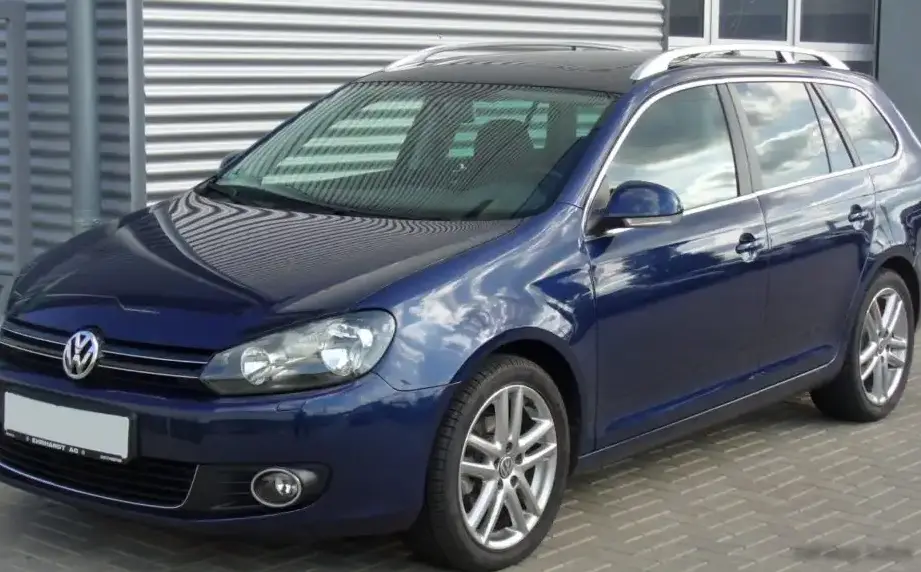
The Volkswagen Golf VI Variant 1.4 TSI (160 hp) represented a significant step forward in combining practicality with efficiency in the compact estate segment. Introduced as part of the Golf VI series (2008-2013), the Variant – Volkswagen’s term for its station wagon – offered increased cargo capacity compared to the hatchback while retaining the Golf’s renowned build quality and driving dynamics. This particular engine and trim level was aimed at buyers who needed the extra space of an estate but didn’t necessarily require the performance of the GTI or the fuel economy of a diesel. It sat comfortably in the middle of the range, offering a good balance of features and running costs.
Powertrain & Engine Architecture
At the heart of the Golf VI Variant 1.4 TSI (160 hp) lies the EA111 engine family. Specifically, engine codes CAVD, CTHD, and CTKA were commonly found in this variant. This 1.4-liter, four-cylinder engine is notable for its combination of turbocharging and supercharging – a relatively uncommon setup. The supercharger provides immediate boost at low engine speeds, eliminating turbo lag and improving responsiveness during initial acceleration. As engine speed increases, the turbocharger takes over, delivering sustained power. This dual-charging system, coupled with direct fuel injection, allowed for a relatively high specific output of 115.1 hp per liter. The engine utilizes a timing chain, contributing to its longevity. The six-speed manual transmission was standard, providing precise gear changes and contributing to the car’s overall efficiency.
Driving Characteristics
The 160 hp 1.4 TSI engine in the Golf VI Variant delivered a respectable, if not exhilarating, driving experience. Acceleration from 0-60 mph took around 8.4 seconds, making it competitive with other similarly sized estates. The dual-charging system ensured a broad torque curve, with 240 Nm (177 lb-ft) available from 1500-4500 rpm. This meant that the car felt responsive in everyday driving situations, such as overtaking or merging onto highways. While not as sporty as the Golf GTI, the 1.4 TSI offered a comfortable and refined ride, thanks to the well-tuned suspension. The six-speed manual transmission allowed drivers to make the most of the engine’s power band, while the relatively light weight of the vehicle contributed to its agility.
Equipment & Trim Levels
The Golf VI Variant 1.4 TSI (160 hp) typically came equipped with a reasonable level of standard features. These included air conditioning, electric windows, central locking, and a basic audio system. Higher trim levels, such as Trendline and Comfortline, added features like alloy wheels, a multi-function steering wheel, cruise control, and upgraded upholstery. Optional extras included a sunroof, parking sensors, and a more advanced infotainment system. Interior materials were generally of good quality, reflecting Volkswagen’s reputation for build quality. The dashboard layout was functional and user-friendly, with clear instrumentation and logically placed controls.
Chassis & Braking
The Golf VI Variant featured independent suspension on all four wheels. The front suspension utilized a McPherson strut setup, while the rear employed a multi-link system. This configuration provided a good balance between ride comfort and handling. The car was equipped with ventilated disc brakes at the front and solid discs at the rear. ABS (Anti-lock Braking System) was standard, enhancing safety during emergency braking. The steering was precise and well-weighted, providing good feedback to the driver. Stabilizer bars were fitted to both the front and rear axles, reducing body roll during cornering.
Market Reception & Comparison
The Golf VI Variant 1.4 TSI (160 hp) was generally well-received by automotive critics. It was praised for its fuel efficiency, comfortable ride, and spacious interior. However, some reviewers noted that the engine could feel strained when fully loaded or driving uphill. Compared to the 1.6-liter petrol version, the 1.4 TSI offered significantly more power and performance. In contrast to the diesel models (like the 1.6 TDI or 2.0 TDI), the 1.4 TSI was less fuel-efficient but offered a smoother and quieter driving experience. The 1.4 TSI also provided a more affordable alternative to the high-performance Golf GTI.
Legacy
The Volkswagen Golf VI Variant 1.4 TSI (160 hp) has proven to be a relatively reliable vehicle in the used car market. The EA111 engine, while complex, is generally durable if properly maintained. Common issues include occasional problems with the turbocharger and supercharger, as well as potential oil leaks. However, these issues are not widespread and can often be addressed with routine servicing. Today, these Golf Variants represent a good value proposition for buyers seeking a practical, efficient, and well-built estate car. Their combination of space, comfort, and reasonable running costs continues to make them a popular choice in the used car market.