
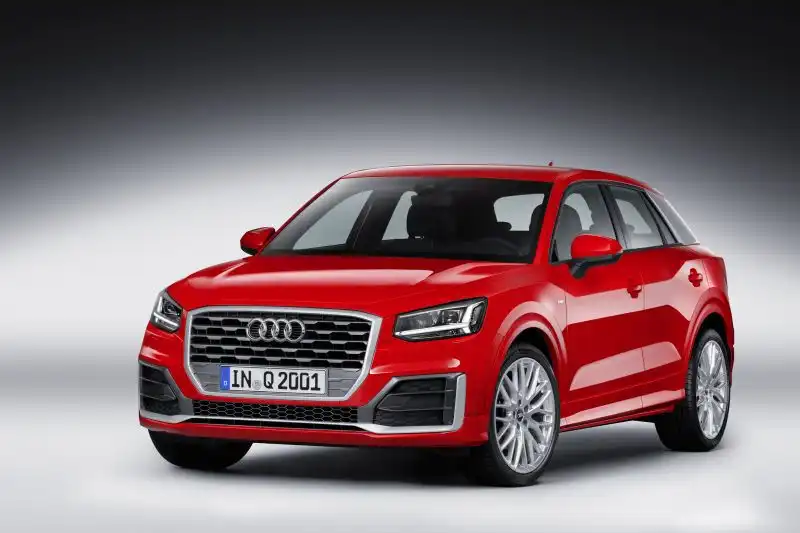
Technical Specifications
| Brand | Audi |
| Model | Q2 |
| Generation | Q2 |
| Type (Engine) | 2.0 TFSI (190 Hp) quattro S tronic |
| Start of production | 2016 |
| End of production | 2018 |
| Powertrain Architecture | Internal Combustion engine |
| Body type | SUV |
| Seats | 5 |
| Doors | 5 |
| Fuel consumption (urban) | 7.9-8.1 l/100 km (29.8 – 29 US mpg, 35.8 – 34.9 UK mpg, 12.7 – 12.3 km/l) |
| Fuel consumption (extra urban) | 5.1-5.5 l/100 km (46.1 – 42.8 US mpg, 55.4 – 51.4 UK mpg, 19.6 – 18.2 km/l) |
| Fuel consumption (combined) | 6.1-6.4 l/100 km (38.6 – 36.8 US mpg, 46.3 – 44.1 UK mpg, 16.4 – 15.6 km/l) |
| CO2 emissions | 139-146 g/km |
| Fuel Type | Petrol (Gasoline) |
| Acceleration 0 – 100 km/h | 6.5 sec |
| Acceleration 0 – 62 mph | 6.5 sec |
| Acceleration 0 – 60 mph | 6.2 sec |
| Maximum speed | 228 km/h (141.67 mph) |
| Emission standard | Euro 6 |
| Weight-to-power ratio | 7.5 kg/Hp, 132.9 Hp/tonne |
| Weight-to-torque ratio | 4.5 kg/Nm, 223.8 Nm/tonne |
| Power | 190 Hp @ 4200-6000 rpm |
| Power per litre | 95.8 Hp/l |
| Torque | 320 Nm @ 1450-4150 rpm (236.02 lb.-ft. @ 1450-4150 rpm) |
| Engine layout | Front, Transverse |
| Engine Model/Code | EA888 / CZPB |
| Engine displacement | 1984 cm3 (121.07 cu. in.) |
| Number of cylinders | 4 |
| Engine configuration | Inline |
| Cylinder Bore | 82.5 mm (3.25 in.) |
| Piston Stroke | 92.8 mm (3.65 in.) |
| Compression ratio | 11.65:1 |
| Number of valves per cylinder | 4 |
| Fuel injection system | Direct injection and Multi-port manifold injection |
| Engine aspiration | Turbocharger, Intercooler |
| Valvetrain | DOHC |
| Engine oil capacity | 5.7 l (6.02 US qt | 5.02 UK qt) |
| Coolant | 8 l (8.45 US qt | 7.04 UK qt) |
| Kerb Weight | 1430 kg (3152.61 lbs.) |
| Max. weight | 1990 kg (4387.2 lbs.) |
| Max load | 560 kg (1234.59 lbs.) |
| Trunk (boot) space – minimum | 355 l (12.54 cu. ft.) |
| Trunk (boot) space – maximum | 1000 l (35.31 cu. ft.) |
| Fuel tank capacity | 55 l (14.53 US gal | 12.1 UK gal) |
| Max. roof load | 60 kg (132.28 lbs.) |
| Permitted trailer load with brakes (8%) | 1700 kg (3747.86 lbs.) |
| Permitted trailer load with brakes (12%) | 1500 kg (3306.93 lbs.) |
| Permitted trailer load without brakes | 750 kg (1653.47 lbs.) |
| Permitted towbar download | 75 kg (165.35 lbs.) |
| Length | 4191 mm (165 in.) |
| Width | 1794 mm (70.63 in.) |
| Width including mirrors | 2009 mm (79.09 in.) |
| Height | 1508 mm (59.37 in.) |
| Wheelbase | 2595 mm (102.17 in.) |
| Front track | 1547 mm (60.91 in.) |
| Rear (Back) track | 1548 mm (60.94 in.) |
| Front overhang | 828 mm (32.6 in.) |
| Rear overhang | 768 mm (30.24 in.) |
| Minimum turning circle | 11.1 m (36.42 ft.) |
| Drivetrain Architecture | The Internal combustion engine (ICE) drives the front wheels permanently, and the rear wheels are driven through an electrically or mechanically operated clutch if necessary. |
| Drive wheel | All wheel drive (4×4) |
| Number of gears and type of gearbox | 7 gears, automatic transmission S tronic |
| Front suspension | Independent, type McPherson with coil spring and anti-roll bar |
| Rear suspension | Independent multi-link spring suspension with stabilizer |
| Front brakes | Ventilated discs |
| Rear brakes | Disc |
The Audi Q2 2.0 TFSI quattro S tronic, launched in 2016, was a key component of Audi’s expansion into the burgeoning compact SUV market. Built on the Volkswagen Group’s MQB platform (specifically the A05 variant), also underpinning the Volkswagen Polo and Audi A3, the Q2 aimed to offer a more stylish and premium alternative to mainstream competitors. The 2.0 TFSI quattro variant occupied a sweet spot in the range, providing a significant performance upgrade over the lower-powered 1.0 TFSI models while remaining more affordable and efficient than the range-topping SQ2. Production of this specific configuration continued through 2018, after which the Q2 lineup saw further revisions.
Powertrain & Engine Architecture
At the heart of the Q2 2.0 TFSI quattro lies the EA888 engine, specifically the CZPB code variant. This is a 1.984-liter (121.07 cubic inches) inline-four cylinder engine featuring direct fuel injection combined with multi-point injection. This dual-injection system optimizes combustion efficiency and reduces emissions. The engine utilizes a single turbocharger with an intercooler to boost power and torque. The valvetrain employs a dual overhead camshaft (DOHC) configuration with four valves per cylinder, contributing to its responsive nature. The engine produces 190 horsepower at 4200-6000 rpm and 320 Nm (236 lb-ft) of torque between 1450 and 4150 rpm. Paired with this engine is Audi’s renowned seven-speed S tronic dual-clutch transmission. This transmission offers rapid, seamless gear changes and contributes to both performance and fuel efficiency. The quattro all-wheel-drive system utilizes a multi-plate clutch to distribute power between the front and rear axles as needed, enhancing traction and stability, particularly in adverse weather conditions.
Driving Characteristics
The Q2 2.0 TFSI quattro S tronic delivers a noticeably more engaging driving experience than its lower-powered siblings. The 190 horsepower and 320 Nm of torque provide brisk acceleration, with a 0-60 mph time of around 6.2 seconds. The S tronic transmission contributes to this responsiveness, offering quick and precise shifts. The quattro all-wheel-drive system provides excellent grip and stability, inspiring confidence in various driving conditions. While not a sports SUV, the Q2 2.0 TFSI offers a well-balanced ride, combining comfort with a degree of agility. The gear ratios are tuned for a blend of performance and fuel economy, with the seventh gear providing relaxed cruising at highway speeds. Compared to the manual transmission versions, the S tronic offers convenience and quicker acceleration, though some enthusiasts may prefer the greater driver involvement of a manual gearbox.
Equipment & Trim Levels
The Q2 2.0 TFSI quattro S tronic typically came well-equipped as standard. Features included Audi’s MMI infotainment system with a 7-inch display, automatic climate control, Bluetooth connectivity, and a leather-wrapped steering wheel. Standard safety equipment included ABS, electronic stability control, and multiple airbags. Optional extras included a larger MMI display, navigation system, a panoramic sunroof, LED headlights, and a premium sound system. Interior upholstery was typically cloth, with leather options available as an upgrade. Trim levels varied slightly depending on the market, but generally offered a range of cosmetic enhancements, such as different wheel designs and interior trim materials.
Chassis & Braking
The Q2’s chassis features an independent McPherson strut suspension at the front and a multi-link suspension at the rear. This setup provides a good balance of ride comfort and handling precision. Stabilizer bars are fitted to both axles to reduce body roll during cornering. The braking system consists of ventilated discs at the front and solid discs at the rear. ABS (Anti-lock Braking System) is standard, along with electronic brake-force distribution and brake assist. The Q2’s relatively low weight (1430 kg / 3152.61 lbs) contributes to its agile handling characteristics.
Market Reception & Comparison
The Audi Q2 2.0 TFSI quattro S tronic was generally well-received by automotive critics. It was praised for its stylish design, refined interior, and engaging driving experience. The 2.0 TFSI engine was considered a good compromise between performance and fuel economy. Compared to the 1.0 TFSI models, the 2.0 TFSI offered a significant power boost, making it more suitable for longer journeys and more demanding driving conditions. However, it was also more expensive and slightly less fuel-efficient. Compared to rivals like the BMW X1 and Mercedes-Benz GLA, the Q2 was often seen as offering a more youthful and distinctive design, but potentially lacking the brand prestige of its German competitors.
Legacy
The Audi Q2 2.0 TFSI quattro S tronic has proven to be a relatively reliable vehicle in the used car market. The EA888 engine is known for its durability, and the S tronic transmission, while requiring regular maintenance (fluid changes are crucial), is generally robust. Common issues reported by owners include occasional sensor failures and minor electrical glitches. The Q2’s distinctive styling and premium interior continue to appeal to buyers looking for a compact luxury SUV. Its quattro all-wheel-drive system remains a valuable asset in regions with inclement weather. As a result, well-maintained examples of the Q2 2.0 TFSI quattro S tronic hold their value reasonably well in the used car market.
