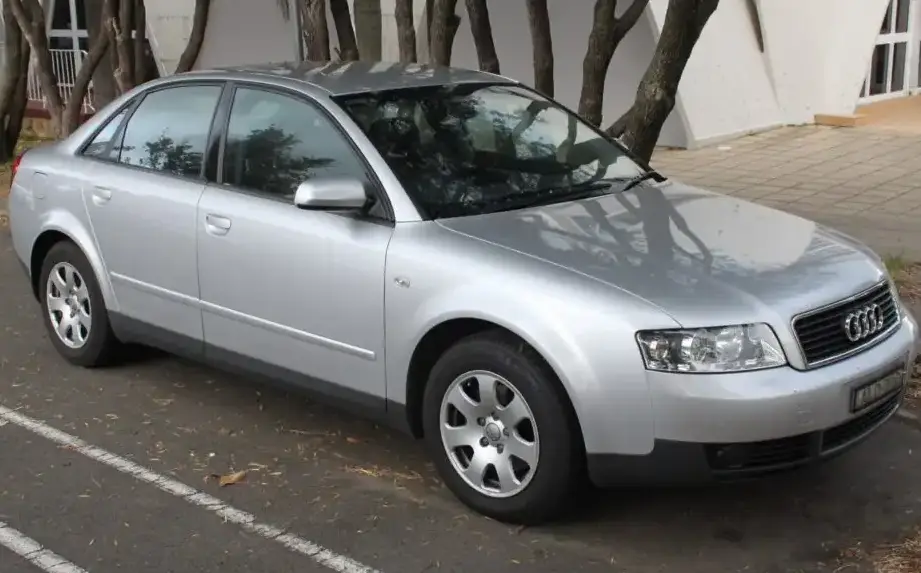
The Audi A4 (B6) 3.0i V6 with the Multitronic transmission, produced from September 2000 to 2004, represented a significant step up in performance and technology for Audi’s popular compact executive car. Positioned as a mid-to-upper trim level within the B6 A4 range (internally designated 8E), this variant offered a compelling blend of power, refinement, and advanced transmission technology. It was primarily marketed in Europe and North America as a premium alternative to rivals like the BMW 3 Series and Mercedes-Benz C-Class, appealing to buyers seeking a more sophisticated driving experience.
Technical Specifications
| Brand | Audi |
| Model | A4 |
| Generation | A4 (B6 8E) |
| Type (Engine) | 3.0i V6 (220 Hp) Multitronic |
| Start of production | September, 2000 |
| End of production | 2004 |
| Powertrain Architecture | Internal Combustion engine |
| Body type | Sedan |
| Seats | 5 |
| Doors | 4 |
| Fuel consumption (urban) | 13.6 l/100 km (17.3 US mpg, 20.8 UK mpg, 7.4 km/l) |
| Fuel consumption (extra urban) | 7 l/100 km (33.6 US mpg, 40.4 UK mpg, 14.3 km/l) |
| Fuel consumption (combined) | 9.4 l/100 km (25 US mpg, 30.1 UK mpg, 10.6 km/l) |
| Fuel Type | Petrol (Gasoline) |
| Acceleration 0 – 100 km/h | 6.9 sec |
| Acceleration 0 – 62 mph | 6.9 sec |
| Acceleration 0 – 60 mph | 6.6 sec |
| Maximum speed | 238 km/h (147.89 mph) |
| Weight-to-power ratio | 6.6 kg/Hp, 150.7 Hp/tonne |
| Weight-to-torque ratio | 4.9 kg/Nm, 205.5 Nm/tonne |
| Power | 220 Hp @ 6300 rpm |
| Power per litre | 73.9 Hp/l |
| Torque | 300 Nm @ 3200 rpm (221.27 lb.-ft. @ 3200 rpm) |
| Engine layout | Front, Longitudinal |
| Engine Model/Code | ASN, AVK |
| Engine displacement | 2976 cm3 (181.61 cu. in.) |
| Number of cylinders | 6 |
| Engine configuration | V-engine |
| Cylinder Bore | 82.5 mm (3.25 in.) |
| Piston Stroke | 92.8 mm (3.65 in.) |
| Compression ratio | 10.5:1 |
| Number of valves per cylinder | 5 |
| Fuel injection system | Multi-port manifold injection |
| Engine aspiration | Naturally aspirated engine |
| Valvetrain | DOHC |
| Engine oil capacity | 6.3 l (6.66 US qt | 5.54 UK qt) |
| Coolant | 9 l (9.51 US qt | 7.92 UK qt) |
| Kerb Weight | 1460 kg (3218.75 lbs.) |
| Max. weight | 2010 kg (4431.29 lbs.) |
| Max load | 550 kg (1212.54 lbs.) |
| Trunk (boot) space – minimum | 445 l (15.72 cu. ft.) |
| Trunk (boot) space – maximum | 720 l (25.43 cu. ft.) |
| Fuel tank capacity | 70 l (18.49 US gal | 15.4 UK gal) |
| Length | 4548 mm (179.06 in.) |
| Width | 1772 mm (69.76 in.) |
| Height | 1428 mm (56.22 in.) |
| Wheelbase | 2650 mm (104.33 in.) |
| Front track | 1528 mm (60.16 in.) |
| Rear (Back) track | 1526 mm (60.08 in.) |
| Drag coefficient (Cd) | 0.31 |
| Minimum turning circle | 11.1 m (36.42 ft.) |
| Drivetrain Architecture | The Internal combustion engine (ICE) drives the front wheels of the vehicle. |
| Drive wheel | Front wheel drive |
| Number of gears and type of gearbox | automatic transmission Multitronic |
| Front suspension | Independent multi-link suspension |
| Rear suspension | Independent multi-link suspension |
| Front brakes | Ventilated discs |
| Rear brakes | Disc |
| Assisting systems | ABS (Anti-lock braking system) |
| Steering type | Steering rack and pinion |
| Power steering | Hydraulic Steering |
| Tires size | 215/55 R16 |
| Wheel rims size | 7J x 16 |
Powertrain & Engine Architecture
At the heart of the A4 3.0i was the ASN or AVK engine code, a 2.976-liter naturally aspirated V6. This engine featured a 60-degree V-angle, contributing to its smooth operation and relatively compact size. It employed multi-port fuel injection and a double overhead camshaft (DOHC) valvetrain with five valves per cylinder (three intake, two exhaust). This configuration maximized volumetric efficiency and contributed to the engine’s strong power output. The engine produced 220 horsepower at 6300 rpm and 300 Nm (221 lb-ft) of torque at 3200 rpm. The Multitronic transmission, a continuously variable transmission (CVT), was a key feature. Unlike traditional automatic transmissions with fixed gear ratios, the Multitronic used a chain-driven system to provide a virtually infinite number of ratios, optimizing engine efficiency and providing smooth, seamless acceleration.
Driving Characteristics
The 3.0i V6 with Multitronic offered a distinctly different driving experience compared to the four-cylinder A4 models or the manual transmission variants. The V6 provided ample power for effortless cruising and confident overtaking. The Multitronic transmission, while not offering the direct engagement of a manual, allowed the engine to remain in its optimal power band, resulting in brisk acceleration – 0 to 60 mph in approximately 6.6 seconds. The CVT’s seamless shifting eliminated the traditional “shift shock” associated with conventional automatics. However, some drivers found the Multitronic’s operation somewhat detached, lacking the tactile feedback of a traditional gearbox. Compared to the 1.8T models, the 3.0i offered significantly more torque and a broader powerband, making it more relaxed and refined for long-distance driving.
Equipment & Trim Levels
The 3.0i V6 typically came well-equipped, reflecting its position as a premium trim level. Standard features often included leather upholstery, automatic climate control, a premium audio system, and alloy wheels. Optional extras included sunroof, navigation system, heated seats, and parking sensors. Interior trim levels varied, with options for wood or aluminum accents. The dashboard layout was typical of the B6 A4, characterized by a functional and understated design.
Chassis & Braking
The A4 B6 utilized a fully independent suspension system, with multi-link setups at both the front and rear. This provided a good balance between ride comfort and handling precision. The 3.0i models generally featured slightly stiffer suspension components compared to the base models to manage the increased weight and power. Braking systems consisted of ventilated discs at the front and solid discs at the rear. Anti-lock braking system (ABS) was standard. Stabilizer bars were fitted front and rear to reduce body roll during cornering.
Market Reception & Comparison
The A4 3.0i V6 Multitronic was generally well-received by automotive critics. It was praised for its smooth engine, refined transmission, and comfortable ride. However, the Multitronic transmission received some criticism for its lack of driver engagement and occasional hesitation. Fuel economy, while reasonable for a V6, was not a strong point, averaging around 25 mpg combined. Compared to the 1.8T models, the 3.0i offered a more luxurious and powerful experience, but at a higher price point. The 1.8T was often favored by those prioritizing fuel efficiency and a more sporty driving feel.
Legacy
The ASN and AVK V6 engines, when properly maintained, proved to be relatively reliable. The Multitronic transmission, however, is known to require more diligent maintenance. Regular fluid changes are crucial to prevent premature wear and failure. Today, the A4 B6 3.0i V6 represents a compelling value in the used car market, offering a blend of performance, comfort, and Audi refinement. However, potential buyers should be aware of the Multitronic transmission’s maintenance requirements and factor those costs into their ownership plans. The B6 A4, in general, is remembered as a well-built and capable car that helped solidify Audi’s reputation as a premium automotive brand.